A WBCSD case study estimates that Weir Group technologies could avoid 89,791 tonnes of CO₂-equivalent emissions when processing 15 million tonnes of copper ore in Chile.
The result suggests that redesigning rock grinding can cut emissions within the assessed processing system by 51%. It also raises a critical question: how can miners scale such claims without overstating what avoided emissions actually prove?
Mining’s Carbon Problem Starts With Crushing
One of mining’s largest energy demands begins after rock leaves the ground. Comminution, the crushing and grinding that reduces ore into particles for mineral recovery, consumes an estimated 3% of global primary energy each year, making it a major decarbonisation target for equipment manufacturers and mine operators.
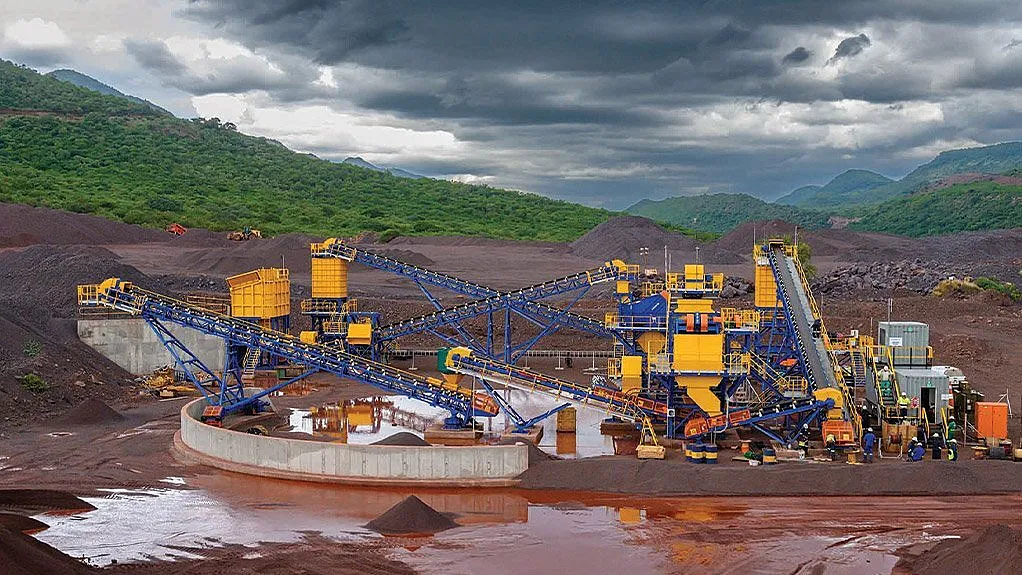
The World Business Council for Sustainable Development case study, Measuring the Impact of Carbon-Avoiding Solutions in the Mining Sector: A Case Study, examines a lower-carbon processing configuration developed by The Weir Group.
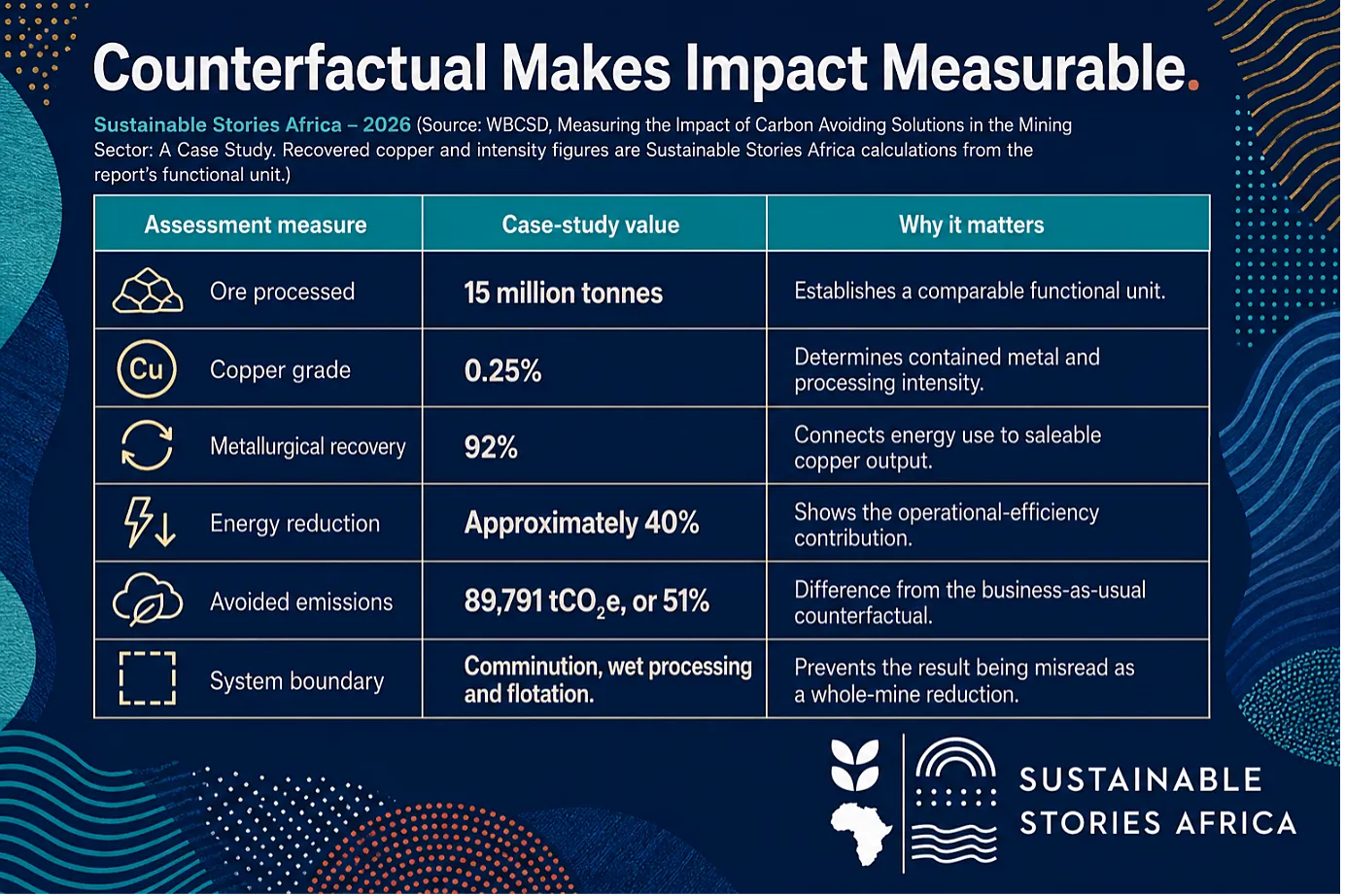
Applied to an archetypal Chilean copper mine, the assessment estimates that 89,791 tonnes of CO₂-equivalent emissions are avoided annually against a business-as-usual design.
For African mining economies, the lesson extends beyond machinery. As governments seek more local mineral processing, the carbon intensity of crushing, grinding and separation will increasingly shape export competitiveness, operating costs and the credibility of climate commitments.
The challenge is to produce more value from minerals without locking in more emissions, water stress and energy demand.
One Process Consumes 3% Globally
Traditional comminution has changed little in decades. Tumbling mills lift and rotate ore together with steel grinding media until the rock reaches the required particle size. The movement consumes large amounts of electricity, while manufacturing and replacing the steel media adds embodied carbon.
Weir’s alternative begins with high-pressure grinding rolls at the initial grinding stage. These crush ore between rotating rollers and do not require grinding media.
A vertical stirred mill improves efficiency during later grinding; in the case of a coarse-particle flotation unit, it is designed to recover valuable minerals at a larger particle size, reducing the need for further energy-intensive grinding.
Together, the configuration is estimated to use about 40% less energy than conventional processing. The case study says it could avoid up to half the CO₂-equivalent emissions produced during comminution.
That is significant in a sector described as hard to abate, where many assets run for decades, and rising demand for transition minerals can increase absolute energy use even as individual operations become more efficient.
However, the headline needs its boundary.
- The 51% result does not describe the entire mine, the full copper value chain or every Weir installation.
- It compares one defined solution with a likely conventional alternative across comminution, wet processing and flotation.
Extraction, transport and tailings sit outside the quantified system boundary shown in the assessment.
A Counterfactual Makes Impact Measurable
Avoided emissions aren't simply year-on-year drops in emissions. They estimate the gap between a lower-carbon intervention and a credible counterfactual, which would likely have occurred without the solution.
Shifting the baseline, ore characteristics, power source, recovery rate or operating conditions can substantially alter results.
The case study processes 15 million tonnes of copper ore at 0.25% grade with 92% metallurgical recovery, implying roughly 37,500 tonnes of contained copper and 34,500 tonnes recovered.
The reported 89,791 tCO₂e avoided equates to approximately 6 kilograms per tonne of ore processed, or 2.6 tonnes per tonne of recovered copper.
Accounting differs by position in the value chain. Equipment manufacturers see impacts mainly in Scope 3, Category 11, while mines using grid electricity register benefits in Scope 2, or Scope 1 if generating power on-site.
This creates an apparent paradox: a supplier's inventory may rise through increased sales while the buyer's inventory falls, meaning avoided emissions require separate accounting, not double-counting across Scope 1, 2 or 3.
The case cleared three WBCSD eligibility gates, with SLR Consulting providing limited-assurance review.
WBCSD stresses that this guidance isn't a verification standard, a distinction critical for investor credibility assessments.
Efficiency Can Strengthen African Mineral Value
For African copper and critical-mineral producers, lower-energy processing offers multiple gains simultaneously.
Reduced electricity demand eases operating exposure where grid supply is constrained, or mines depend on costly self-generation, while eliminating steel grinding media cuts embedded emissions and recurrent material costs.
Lower water consumption emerges as a further environmental benefit.
These efficiencies can strengthen local beneficiation.
- Enabling more mineral processing near extraction sites, including building industrial capability and employment, provided power, water and infrastructure demands are managed.
- Efficient comminution reinforces this case by extracting more recoverable metal per energy unit, with benefits extending beyond the mine gate: predictable power demand eases pressure on national grids and diesel logistics
- Local engineering and monitoring capacity grows alongside transparent emissions data that helps producers meet buyer demands for lower-carbon supply chains.
However, efficiency isn't automatically sustainability. Lower-carbon processing can coexist with unsafe conditions, community conflict or poor tailings management, and cheaper processing may spur higher production, offsetting emissions gains, underscoring why WBCSD's eligibility gates remain essential.
Turn Avoided Emissions Into Evidence
Mining companies should start with project-specific baselines that document ore grade, hardness, throughput, recovery, electricity source, equipment life and system boundaries.
Sensitivity analysis must show how results shift under cleaner grids, declining ore grades or varied utilisation rates; a Chilean archetype cannot simply transfer onto Zambia, the DRC, South Africa or other jurisdictions.
Equipment suppliers should publish their assumptions and separate avoided-emissions claims from corporate inventories, treating manufacturing, transport, installation and end-of-life impacts transparently.
Where supplier and mine claims overlap, contracts must clarify reporting responsibility and prevent double counting.
Mine owners and financiers should link carbon metrics to operating decisions, evaluating lifetime energy, water, and grinding-media consumption, as well as maintenance, rather than just upfront capital cost, using performance guarantees and digital metering to verify actual savings post-commissioning.
Governments can accelerate adoption through reliable grids, efficiency standards and verified-performance incentives, while independent assurance should evolve from limited pilot reviews toward consistent sector-wide rules.
Path Forward – Measure First, Scale With Integrity
The Weir case shows that redesigning mineral processing can avoid substantial emissions before electricity systems fully decarbonise.
African miners should test such solutions against local ore, grid and water conditions, using transparent baselines, metering and independent assurance.
The priority is a credible scale, not a larger headline. Avoided emissions must remain separate from corporate inventories to protect against double counting and be assessed alongside social and environmental impacts.
Done properly, measurement can turn equipment efficiency into verifiable climate and development value.