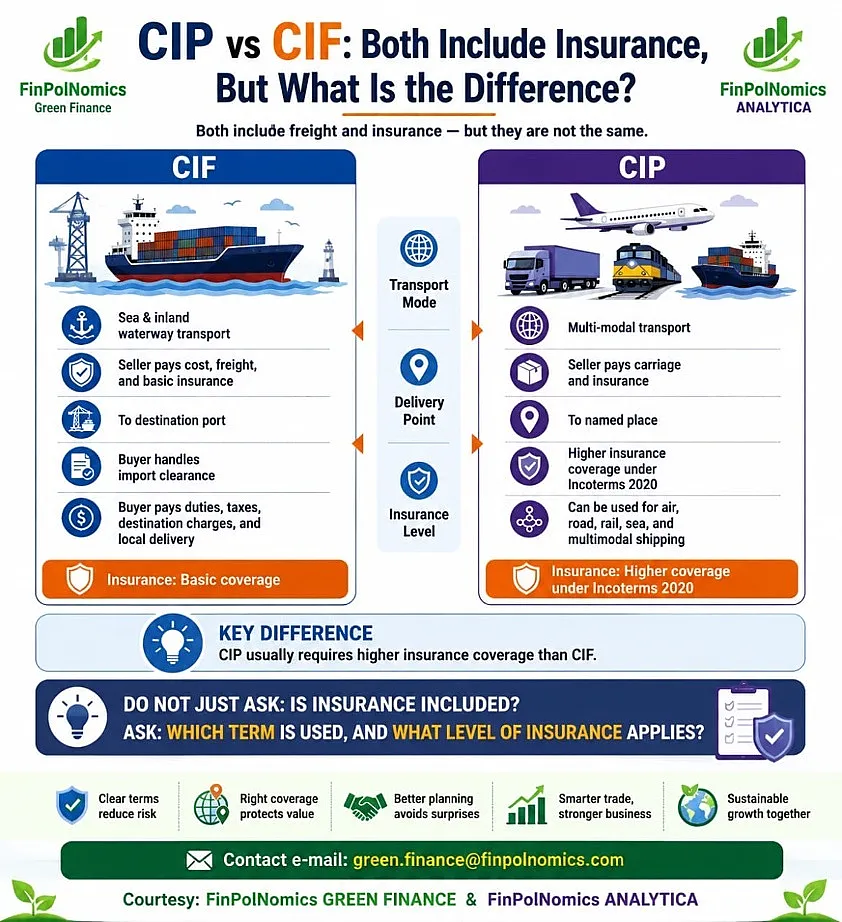
FinPolNomics highlights a costly misconception that CIP and CIF both include carriage and insurance; however, they transfer risk at origin and require different modes of transport and insurance standards.
For African firms moving goods across ports, roads, railways and borders, the wrong three-letter term can create uncovered losses, delayed claims and damaged working capital long after the contract looked settled.
Three Letters Can Reprice Every Shipment
A shipment can be fully paid, insured, and moving towards its destination while the buyer already bears the risk of loss.
That is the counterintuitive lesson behind FinPolNomics’ comparison of CIP, Carriage and Insurance Paid To, and CIF Cost, Insurance and Freight. Both require the seller to arrange transport and insurance to a named destination; however, neither keeps transit risk with the seller until arrival.
The distinction matters now because Africa’s supply chains are becoming more regional and more multimodal.
Goods may leave a factory by truck, cross a border by rail, enter a port terminal and continue by sea.
Afreximbank estimates that African trade reached about $1.4 trillion in 2025, with approximately 18% transacted within the continent.
Every additional handover creates a point where unclear delivery language can become a dispute.
For an importer awaiting machinery, medicine or production inputs, this is not legal trivia.
It determines who must notify the insurer, who bears the loss for damaged cargo, what documents a bank expects, and how long cash stays trapped.
Better Incoterms literacy is therefore a working-capital, governance and business-resilience tool.
Africa’s Trade Ambitions Need Contract Clarity
Africa’s trade-finance gap remained about $74 billion in 2025, according to the African Trade Report 2026.
In a market where finance is already scarce, preventable documentation errors impose a second cost: a firm may pay for goods, freight and insurance, discover that its policy, delivery terms and actual transport chain do not align when a loss occurs.
The International Chamber of Commerce created the Incoterms® rules to clarify tasks, costs and risks between sellers and buyers.
- They do not replace the sales contract, insurance policy, carriage contract or governing law.
- They also do not determine title to the goods or payment terms.
- Their power is narrower but critical: they identify who does what, who pays which transport-related costs and where delivery and risk transfer occur.
FinPolNomics is right to warn traders not to ask only whether insurance is included. The more useful questions are:
- Which rule fits the mode of transport?
- Where exactly does delivery occur?
- When does risk pass?
- What insurance clause applies?
- Who holds the policy document and can claim?
A three-letter abbreviation without a named place, version and supporting documents is not a complete risk allocation.
CIP And CIF Split Cost From Risk
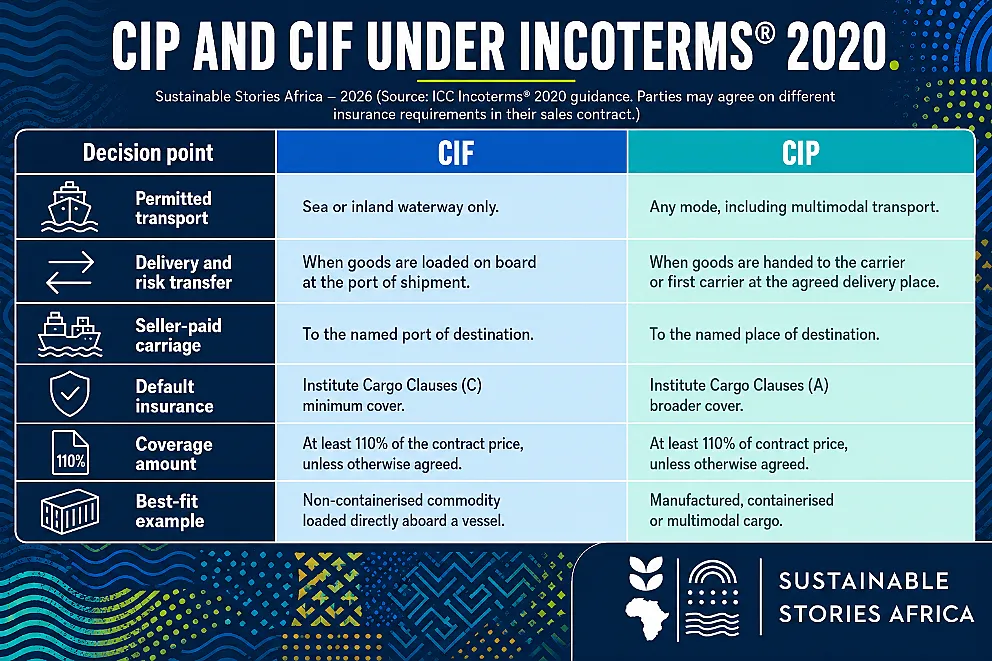
CIF applies only to sea and inland-waterway transport. Risk transfers when goods are loaded aboard the vessel at the port of shipment. However, the seller still pays carriage and insurance to the destination port, a separation that creates the trap: the seller pays at a point further than the point the buyer's risk begins.
CIP suits air, road, rail, sea or multimodal transport. Delivery and risk transfer occur when the seller hands over the goods to the first carrier at the agreed place, after the seller pays carriage and insurance to the named destination. For containerised goods handed over at a terminal, CIP often mirrors the physical chain more accurately than CIF's vessel-loading rule.
Insurance is the second key difference under Incoterms® 2020. CIP requires broader Institute Cargo Clauses (A) cover for at least 110% of contract value, while CIF retains the lower Clauses (C) minimum. Neither guarantees full coverage; exclusions and deductibles still apply.
Consider a Nairobi distributor importing diagnostic equipment via air, then by road to Lagos. CIF is unsuitable; CIP fits, but the contract must specify both destination and first-carrier handover point, since risk shifts to the buyer at that stage.
Clearer Terms Protect Capital And Relationships
Correct terms do more than allocate liability after failure. They make transactions financeable before shipment.
Banks can test the documentary chain, insurers can price the real route, and finance teams can forecast landed cost without confusing seller-paid freight with seller-retained risk.
This discipline matters as freight volatility becomes normal. UN Trade and Development reports that over 80% of global trade moves by sea, with maritime growth projected at just 0.5% in 2025, down from 2.2% in 2024, amid disruption and rising costs. African firms with thinner cash buffers have less room for demurrage or rejected claims.
The human benefit is direct.
- A manufacturer receiving timely inputs keeps production running;
- A hospital distributor replaces damaged supplies faster;
- A farmer cooperative negotiates risk at each handover rather than discovering it after loss.
Clarity replaces assumptions with evidence.
Seven Questions Should Precede Every Shipment
- First, name the exact rule and version. "CIP [named place] Incoterms® 2020", not CIP or CIF alone.
- Second, identify the delivery point at which risk transfers, separate from the destination at which the seller pays carriage; precise addresses reduce ambiguity.
- Third, match the rule to the physical transport chain rather than defaulting to CIF whenever a ship appears.
- Fourth, specify insurance beyond the headline clause: insured value, currency, deductibles, exclusions, geographic scope and claims deadlines, especially for high-value or fragile cargo.
- Fifth, build a landed-cost schedule covering freight, customs, duties, demurrage and storage, since Incoterms allocate costs but don't quote them.
- Sixth, align the invoice, transport document, insurance certificate and customs entry; conflicting details can fail a bank's documentary test even when the deal is sound.
- Seventh, assign an internal owner: procurement confirms the bargain, logistics validates handovers, finance tests currency exposure, legal reviews risk, and sustainability teams assess emissions and labour standards before signature, rather than when cargo moves.
Banks, insurers and regulators should turn these steps into standard checklists and interoperable digital-trade guidance.
PATH FORWARD – Make Trade Terms Part Of Governance
African traders should treat CIP and CIF as governance choices, not shipping shorthand.
Every contract should align the transport mode, risk-transfer point, seller-paid destination, insurance standard and documentary chain before cargo moves.
Financiers, insurers and trade bodies can make that discipline easier through shared checklists, training and interoperable records.
Clearer terms will not reduce disruption, but they can keep a damaged shipment from becoming an uninsured loss, a cash-flow crisis or a broken commercial relationship.