A Cambridge framework proposes changing how banks assess climate-exposed borrowers by integrating physical hazards, insurance adequacy and adaptation investment into default and recovery estimates.
The approach could make resilience financially visible and reward borrowers who reduce future losses.
For African markets confronting floods, droughts, heat and limited insurance, the challenge is to price climate risk without pricing vulnerable communities and businesses out of credit.
Climate Resilience Enters The Credit Equation
Banks could begin adjusting loan pricing, collateral values and provisions to reflect not only a borrower’s exposure to climate hazards, but also the resilience investments that reduce that exposure, under a new framework developed by the University of Cambridge Institute for Sustainability Leadership.
The proposal appears in CISL’s May 2026 report, Resilience-Adjusted Credit Risk: Operationalising Climate Adaptation in Financial Decision-Making.
It integrates physical climate risk, insurance adequacy and adaptation and resilience investment into two core banking metrics: probability of default, or PD, and loss given default, or LGD.
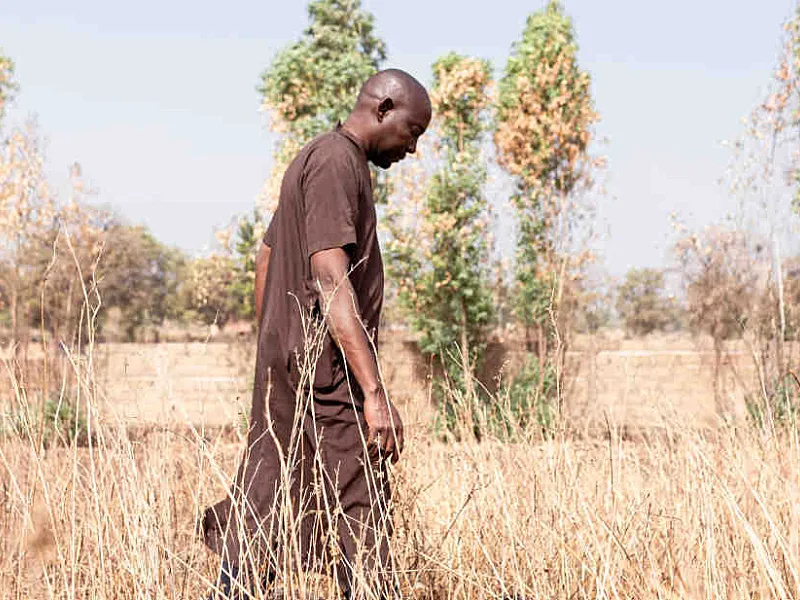
For African borrowers, the idea is highly practical. A farmer investing in drought-resistant seeds, a factory installing backup power or a property owner improving drainage may become safer over time.
However, conventional credit models can record only the additional debt, not the losses avoided.
Correcting that imbalance could determine whether adaptation becomes investable or remains an unfunded necessity.
Banks Are Pricing Yesterday’s Climate
The decade from 2015 to 2024 was the warmest recorded. Since 2000, drought events have risen by about a third, extreme-temperature events have tripled, and flood-related disasters have increased by 134% compared with the previous two decades. Credit systems, however, remain calibrated on historical defaults and one-year risk horizons.
This creates a structural mismatch. A major flood may be statistically rare within a single capital year but highly material over a 10- or 20-year loan, while gradual water stress or declining agricultural productivity can accumulate unnoticed in recent accounts.
Historical models assume past loss patterns remain useful even as climate change alters frequency and severity.
Industry adoption remains limited. A 2025 survey found only 18% of banks integrated physical risk into internal ratings-based models, with capital-level use largely exploratory.
Regulatory compliance drove 62% of climate assessments, suggesting analysis remains separate from everyday credit decisions.
The financing gap is stark: developing countries may need up to $359 billion annually for adaptation; however, for every $1 spent on resilient infrastructure, $87 goes to non-resilient projects.
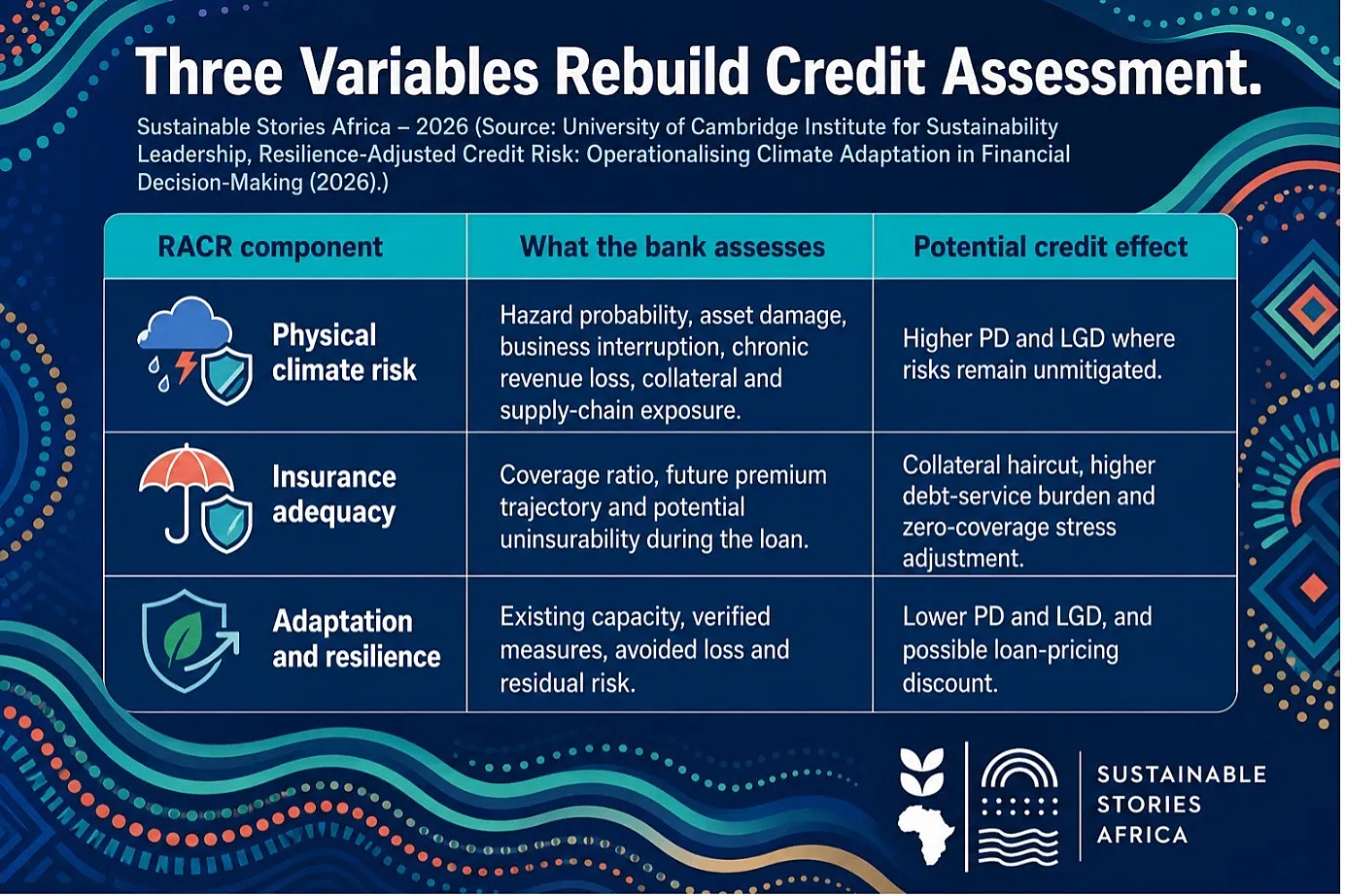
Physical-risk analysis maps hazards to financial consequences. Direct damage can increase loss-given-default (LGD), while business interruption or chronic revenue impairment raises the probability of default (PD).
Banks should assess conditions at origination, mid-tenor and maturity—not rely on broad sector labels.
Insurance analysis tests whether coverage remains available, adequate and affordable. Premium inflation weakens debt-service capacity, underinsurance leaves residual losses, and withdrawal impairs recovery and collateral value.
In African markets with low insurance penetration, zero coverage may be the baseline rather than a future stress, so risk-adjusted credit rating (RACR) must accommodate informal assets, small businesses and farmers lacking policies or granular hazard data.
The third component makes resilience credit-positive: flood barriers preserve property value, batteries prevent revenue interruption, and drought-resistant crops stabilise repayment.
Verified PD or LGD reductions could support lower pricing or grace periods, addressing the "revenue paradox" where adaptation prevents losses without raising EBITDA. This matters because business-interruption risk can be 14 times asset-damage risk.
Resilience Investment Can Become Bankable
If banks can recognise verified risk reduction, adaptation can move from a sustainability label into mainstream credit economics.
Resilience-linked loans could reduce margins when borrowers complete agreed measures; mortgages could reflect location-specific flood or heat protection; insurance-linked credit could trigger repayment relief when hazard thresholds are breached.
Institutions are already testing this logic. Bank Negara Indonesia may link agricultural eligibility for a coastal loan to irrigation or mangrove measures, bundling credit with index insurance.
Rabobank integrates yield-based crop cover into lending, while Standard Chartered has supported weather-resilient solar modules through trade-finance guarantees.
For African banks, this opens opportunities across agriculture, housing, transport, power and small enterprise, improving portfolio quality, giving relationship managers stronger advisory grounds, expanding insurers' coverable asset pools, and offering investors resilience-linked instruments in an underfinanced market.
Better-priced adaptation can help farms survive drought, keep clinics powered and preserve jobs, interrupting the cycle in which disasters destroy collateral and force distress sales.
However, the framework carries an inclusion risk.
Pricing physical exposure without funding adaptation capacity could raise rates or trigger credit withdrawal in vulnerable communities, a form of climate redlining. RACR must therefore pair risk reduction with public investment and concessional support.
Build Local Data, Prevent Exclusion
African banks can begin with portfolio triage rather than wait for perfect models.
- They should map floodplains, drought-exposed agriculture, heat-sensitive industries and vulnerable supply routes, then convert material exposures into borrower adaptation plans.
- Pricing discounts, longer tenors or dedicated drawdowns should follow verified improvements, rather than promises.
Banks and insurers need structured data-sharing.
- Insurance registers, anonymised claims and joint uninsurability stress tests can reveal where coverage is deteriorating and connect hazards to repayment losses.
Regulators should establish common hazard scenarios and proportionate methods for smaller institutions.
- The report proposes one-in-100-year and one-in-200-year stress events.
- Central banks must avoid abrupt rules that encourage lenders to abandon exposed regions rather than finance adaptation.
Development financiers and governments must address cases where avoided social losses exceed private returns.
- Guarantees, blended finance and public hazard mapping can make resilience affordable.
- Taxonomies and certification should reflect African buildings, crops, infrastructure and data, rather than importing European models.
The report is a conceptual scaffold, not a calibrated model. It draws on 20 expert interviews across seven institutions, while its regulatory analysis is mainly UK- and EU-focused.
Pilots, loss data and independent evaluation remain essential before RACR influences capital requirements.
Path Forward – Price Risk, Reward Verified Resilience
Resilience-adjusted credit can help African finance move beyond recording climate damage after it occurs.
Banks should start with hazard screening, insurance visibility and verified adaptation measures, while regulators and development partners build shared data, certification and risk-sharing infrastructure.
The objective is not simply to charge exposed borrowers more. It is to make risk reduction financially visible, preserve access to credit and direct capital towards assets, businesses and communities capable of surviving a harsher climate without transferring every loss to society.