Global M&A generated an estimated $1.3 trillion in Q2 2026; however, 34 megadeals accounted for about 42% of that value while overall transaction numbers barely moved.
The split matters for African markets seeking cross-border capital.
Strategic buyers are pursuing energy, healthcare and AI-linked scale; however, high financing costs and selective appetite for risk leave debt-dependent and midmarket transactions with a harder route to completion.
Megadeals Return, But Confidence Remains Uneven
Global mergers and acquisitions reached an estimated $1.3 trillion in the second quarter of 2026, rising 35.3% from a year earlier but falling 18.4% from Q1.
Estimated deal count held broadly steady at 11,880, up 3.4% year-on-year and down 2.4% quarter-on-quarter, revealing a market that remained active but was far less buoyant beneath its largest transactions.
The data comes from PitchBook’s Q2 2026 Global M&A Report, published on July 9, 2026, which uses transaction information available through June 30 and estimates for late-reporting deals.
Its central finding is not simply that dealmaking recovered, but that value became exceptionally concentrated.
For African companies, investors and regulators, that concentration is the real signal. Capital has not disappeared; however, it is favouring scale, strategic necessity and assets linked to power, healthcare, artificial intelligence and minerals.
Businesses without clean data, resilient cash flows or a defensible growth story face a more demanding market.
Thirty-Four Deals Reshaped The Quarter
Only 34 transactions valued at $5 billion or more generated $553 billion in Q2, close to 42% of total global M&A value, with thousands of remaining transactions sharing roughly 58%.
The top of the market moved decisively while the middle held steady or weakened.
Corporate buyers led the shift. Strategic M&A value reached $892.7 billion, more than three times the $287.3 billion recorded for buyouts, as private-equity buyout value fell 35.7% from Q1 amid elevated debt costs.
Corporations instead used cash, balance-sheet capacity and highly valued shares to fund acquisitions.
North America remained the megadeal centre at $787 billion, down 24.3% from Q1, with deals worth $5 billion-plus contributing $424.4 billion.
Europe proved comparatively resilient, with deal value falling just 6.4% and count rising 0.9%. The quarter showed scale can offset uncertainty, but only for buyers able to finance it.
Strategic Buyers Hold The Advantage
Valuations did not collapse with activity. The trailing 12-month median EV/EBITDA multiple held at 10.2X across North America and Europe, while the year-to-date average stood higher at 14.5 times, reflecting the premium attached to large transactions.
Sellers have resisted broad repricing, while buyers proceed only where they can defend entry prices.
Private-equity deals carried a median 12.2X multiple versus 9.3X for corporate deals, a gap reflecting sponsors' preference for mature assets, though expensive borrowing makes that premium harder to justify.
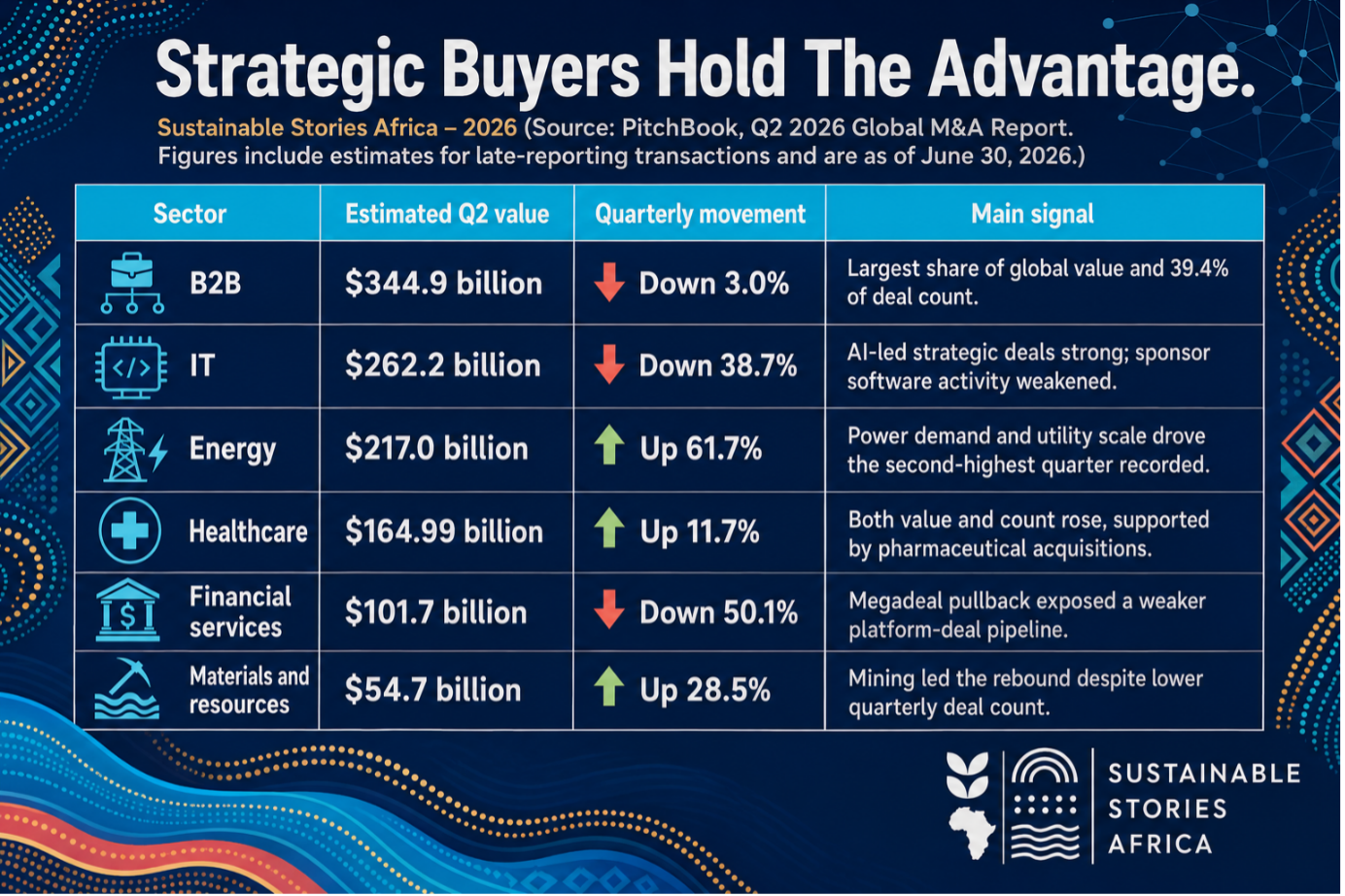
Sector performance was uneven.
- Energy delivered the clearest structural story: deal value reached $217 billion, up 385.5% year-on-year, driven by AI-data-centre electricity demand making generation and transmission strategic.
- Healthcare value rose 71.6% to $164.99 billion, with a 12.6X median multiple, the highest among sectors, as patent expirations push drugmakers toward late-stage assets.
- Technology showed a sharp divide: strategic IT value held at $213.6 billion while sponsor-led IT value dropped 60.5%, suggesting markets are repricing legacy software rather than rejecting technology outright.
- Materials and resources offer an African lens, with value up 44.5% year-on-year to $54.7 billion, led by metals and mining amid gold, coal and electricity-linked demand.
Africa Can Convert Selective Global Capital
Africa is not quantified separately in the report, so the global recovery should not be mistaken for a continent-wide boom in deal-making.
Its value lies in showing where international buyers currently see urgency: reliable power, critical materials, healthcare capacity, digital infrastructure and scalable business services.
For African companies in those sectors, strategic buyers may offer a more realistic route than highly leveraged sponsors.
A utility platform with bankable demand, a healthcare business with defensible data, or a mining services company tied to productivity can fit the corporate search for capability and supply security.
Strong local knowledge and distribution can also become acquisition assets rather than background advantages.
Well-structured transactions can bring technology, capital, export access and management capacity.
They can help founders realise value, expand businesses across borders and finance infrastructure that domestic balance sheets cannot carry alone.
Carveouts can release noncore assets to more focused owners, while consolidation can create regional companies capable of competing globally.
However, concentration carries risks. Strategic control of power, data, health services or minerals can affect prices, jobs, tax revenues and national resilience.
A high headline valuation is not automatically sustainable development.
Regulators and boards must assess competition, local value creation, labour effects, environmental liabilities and the buyer’s capacity to invest after closing.
Build Deal Readiness Before Capital Arrives
African companies should prepare for a selective market before launching a process.
- Audited financials, ownership records, material contracts, tax positions and ESG data must be complete and internally consistent.
- Buyers paying for scale will still discount uncertainty, especially where foreign-exchange exposure, permits or related-party arrangements are unclear.
Boards should frame value creation around operational evidence:
- Customer retention, energy reliability, margins, compliance systems, workforce capability and realistic integration synergies.
- For energy and mining deals, diligence should include emissions, water, land, community obligations and rehabilitation liabilities, rather than leaving them as post-signing discoveries.
Artificial intelligence can accelerate document review, sanctions screening and contract analysis, but the report’s insurer perspective stresses transparency and expert validation. Deal teams should disclose where AI was used, protect proprietary data and retain qualified human judgement for tax, legal, financial and technical conclusions.
Governments should strengthen competition review, beneficial-ownership transparency and predictable approval timelines without turning public-interest tests into discretionary barriers.
Development financiers can support credible midmarket transactions through local-currency funding, guarantees and blended capital, helping viable African deals compete in a market otherwise tilted towards cash-rich global strategics.
Path Forward – Target Value, Protect Long-Term Impact
Q2’s $1.3 trillion headline confirms that global M&A capital remains available, but its concentration demands realism.
African companies should target sectors with strategic demand, strengthen data and governance, and enter negotiations with credible plans for integration, jobs and local value.
Regulators and financiers must keep the midmarket investable while scrutinising concentration in essential sectors.
The best transaction will not merely close at a high valuation; it will leave a stronger business, fair competition and durable development value after ownership change.