The January 2026 update of the Global Financial Safety Net Tracker, a co-production of Boston University's Global Development Policy Centre, Freie Universität Berlin, UNCTAD, and Hochschule für Technik und Wirtschaft Berlin, is the most detailed map ever produced of the world's crisis finance resources.
It reveals, with greater precision than ever before, that the $4.5 trillion architecture of global financial safety is not equitably distributed, and that sub-Saharan Africa is the continent most systematically excluded from its benefits.
This is an opinion on why that must change, and why Africa itself must be the agent of that change.
A $4.5 Trillion Net With Too Many Holes for Africa
Let us begin with the most striking fact in the January 2026 GFSN Tracker Methodology Guidebook: the global crisis finance architecture has at least $4.5 trillion in resources as of the end of 2025.
That figure is not contested. It is documented, sourced, and updated by one of the most credible development economics research consortia in the world.
Now let us state what that figure conceals: for the vast majority of sub-Saharan African nations, that $4.5 trillion is largely inaccessible under crisis conditions.
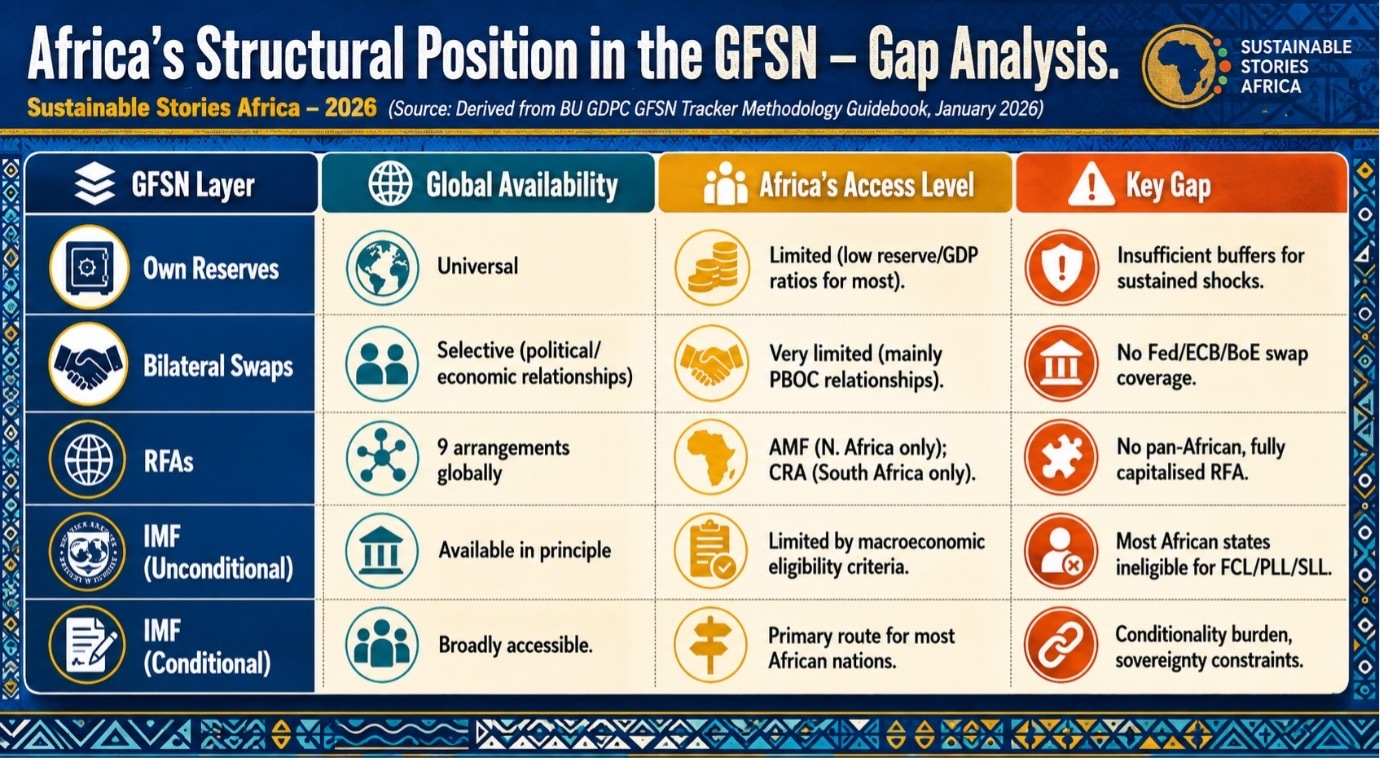
Of the nine Regional Financial Arrangements tracked in the Tracker, only the Arab Monetary Fund covers any African nations (and only in North Africa).
Only South Africa, via its BRICS membership and the Contingent Reserve Arrangement, is connected to any of the other eight RFAs.
No dedicated sub-Saharan African RFA capitalised, operationalised, and accessible at scale exists.
This is not an unfortunate gap. It is a structural failure. And the GFSN Tracker, for the first time, gives us the data architecture to prove it in granular, country-by-country detail.
The IMF Dependency Trap Is a Governance Problem
The IMF's five unconditional lending lines, the RFI, RCF, FCL, PLL and SLL, are theoretically accessible without heavy conditionality.
In practice, though, the most flexible options (FCL, PLL, SLL) demand "very strong ex-ante macroeconomic fundamentals" or "sound policy frameworks."
Most African nations, grappling with the compounded legacies of colonial underdevelopment, volatile commodity revenues and climate vulnerability, routinely fail to meet these criteria, not through mismanagement.
However, because of structural conditions the global financial system itself helped create.
The result is a doom loop: countries most in need of unconditioned emergency finance are least likely to qualify for it.
They are pushed toward conditional programs, which impose austerity. Austerity weakens growth, and weakened growth further destabilises macroeconomic fundamentals, repeating the cycle.
The IMF's crisis finance architecture thus functions as both lender of last resort and a structural reinforcement of the very vulnerabilities it claims to resolve.
Bilateral Swaps – A Partial and Unequal Bridge
The GFSN Tracker's methodology exposes another layer of disadvantages for Africa's crisis finance.
Bilateral swaps between an EMDE and an Advanced Economy central bank are counted only once, on the EMDE side, since the EMDE is assumed to be the sole active drawer.
This is methodologically sound, but it has significant political implications: African central banks need swap lines with major reserve-currency issuers, such as the Fed, ECB, Bank of Japan, Bank of England or PBOC, to tap this dimension of the safety net.
The PBOC has been the most active EMDE swap partner, with South Africa, Kenya, Nigeria and others engaging in swap discussions as part of broader China-Africa ties.
However, these arrangements are no substitute for the deep, unlimited swap lines linking the Fed to European, Japanese and Canadian counterparts, activated within days during the COVID-19 shock.
African central banks received no equivalent backstop, relying instead on limited reserves already strained by capital outflows and commodity price volatility.
The Related Research Is Already Writing the Reform Agenda
The GFSN Tracker is not produced in an analytical vacuum. Its related research publications, cited in the Guidebook, form a coherent body of evidence for why reform is urgent.
A 2023 policy brief, Closing the Global Crisis Finance Gap, argues explicitly that the IMF must address structural weaknesses in the GFSN.
A 2022 journal article, No One Left Behind? Assessing the GFSN Performance During COVID-19 documents how low- and middle-income countries received disproportionately less crisis support per unit of economic need than advanced economies.
A companion UNCTAD research paper examines specific shortcomings for low- and middle-income countries during COVID-19.
These publications do not merely describe the problem. They point toward solutions: stronger IMF quota reform, dedicated technical support for RFA development in underserved regions, improved bilateral swap access for EMDEs, and a reformed global reserve system that reduces dependence on the dollar-denominated international financial architecture.
For African finance advocates, this body of research is an intellectual arsenal, and the GFSN Tracker database is its empirical foundation.
Africa Must Build, Not Just Borrow
The opinion this article advances is simple: Africa cannot afford to remain a passive recipient in a global crisis finance system designed primarily for the interests of advanced economies and the major emerging markets that have built their own RFAs.
The continent must invest in building its own safety net architecture, and the GFSN Tracker now provides the data framework to design that architecture with evidence, not aspiration.
The elements of an African financial safety net are not absent.
- The Arab Monetary Fund partially covers North Africa.
- The East African Community has discussed reserve-pooling arrangements.
- The African Development Bank's Crisis Response Facility has provided some emergency finance.
- The African Export-Import Bank's trade finance tools have bridged some gaps.
However, these instruments are fragmented, undercapitalised, and not integrated into a single, comprehensive African Regional Financial Arrangement that could function as a genuine crisis backstop.
The African Union's Agenda 2063 imagines an African Monetary Fund. The time to build it with the institutional architecture, capitalisation commitments, and governance frameworks that would make it credible and accessible is not after the next crisis. It is now.
Use the Mirror Before the Window Closes
The GFSN Tracker Guidebook is a mirror. It shows Africa exactly where it stands in the global crisis finance architecture, and the reflection is uncomfortable.
However, mirrors are also the first tools of transformation: you cannot change what you cannot see clearly.
African governments, regional economic communities, central banks, development finance institutions, civil society organisations, and think tanks should use the GFSN Tracker's data actively, in budget planning, in multilateral negotiations, in domestic advocacy, and in building the case for an African RFA that would change the continent's position in this architecture fundamentally and permanently.
Path Forward – Build the African Safety Net Now
The GFSN Tracker's January 2026 update confirms what Africa's development finance community has long known and the data now proves: the continent is structurally underserved by the global crisis finance system. The reform agenda is clear: pan-African RFA development, IMF quota reform, bilateral swap line expansion, and active engagement in the methodology and governance of global financial databases.
The tools of analysis are available. The political will must now match the intellectual evidence.