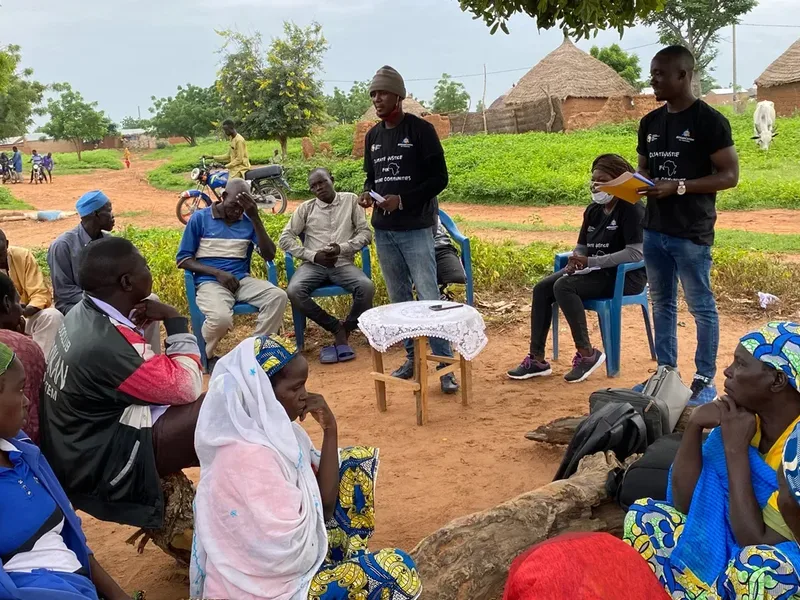
South African farmers producing for the European market comply with the EU's strict pesticide residue limits because they must.
However, the same producers who grow food for South African consumers face substantially weaker standards that permit residues that Europe deems unacceptable. This is not a failure of farming. It is a failure of governance.
The ACB's June 2026 independent testing study places on the table the evidence that South Africa's food safety architects can no longer ignore: the country is maintaining a two-tier system of consumer protection, one for export, one for home.
The Double Standard in Plain Sight
There is an uncomfortable truth embedded in South Africa's food safety system
It is a truth that the country's pesticide regulators, food safety authorities, and agribusiness sector have been able to avoid confronting, the issue not because the evidence was absent, but because no one was systematically collecting it in the public interest.
The African Centre for Biodiversity changed that in June 2026. Commissioning independent laboratory testing of 43 everyday supermarket food products, from Impala Maize Meal and Snowflake Cake Flour to Purity baby food and Nestlé Nido Baby Milk, the ACB generated verifiable, publicly available data on the pesticide residue profile of the South African diet.
What the data reveals is not simply a food safety problem. It is a governance problem, a constitutional problem, and at its core, an equity problem.
South African consumers, including infants and toddlers, are being systematically afforded lower levels of pesticide protection than consumers in Europe, despite identical biological vulnerabilities.
The cause is not agricultural. It is political and regulatory. And it is fixable.
Two Countries, One Farm, Two Standards
Consider this scenario: a South African apple farmer grows fruit for export to the EU and for sale in local supermarkets.
The export batch must comply with EU maximum residue limits and the EU's approved pesticide list.
- Novaluron, a pesticide highly toxic to aquatic organisms?
- Not permitted on EU-bound crops. Imidacloprid, the neonicotinoid banned across Europe?
- Restricted. Dichlorvos, a WHO Class 1b highly hazardous pesticide?
- Prohibited.
- The local batch?
All three can legally remain. And this study found exactly that: Novaluron in fresh apples, Imidacloprid in baby milk and toddler food, Dichlorvos in cake wheat flour.
South Africa's own producers have already proven that meeting EU standards is technically and commercially viable.
The question the ACB's data forces into the open is: why is that standard applied only when European consumers are the buyers?
Why is the protection of South African lives, including those of infants, treated as a lesser priority?
Unpacking the Regulatory Architecture of Inequality
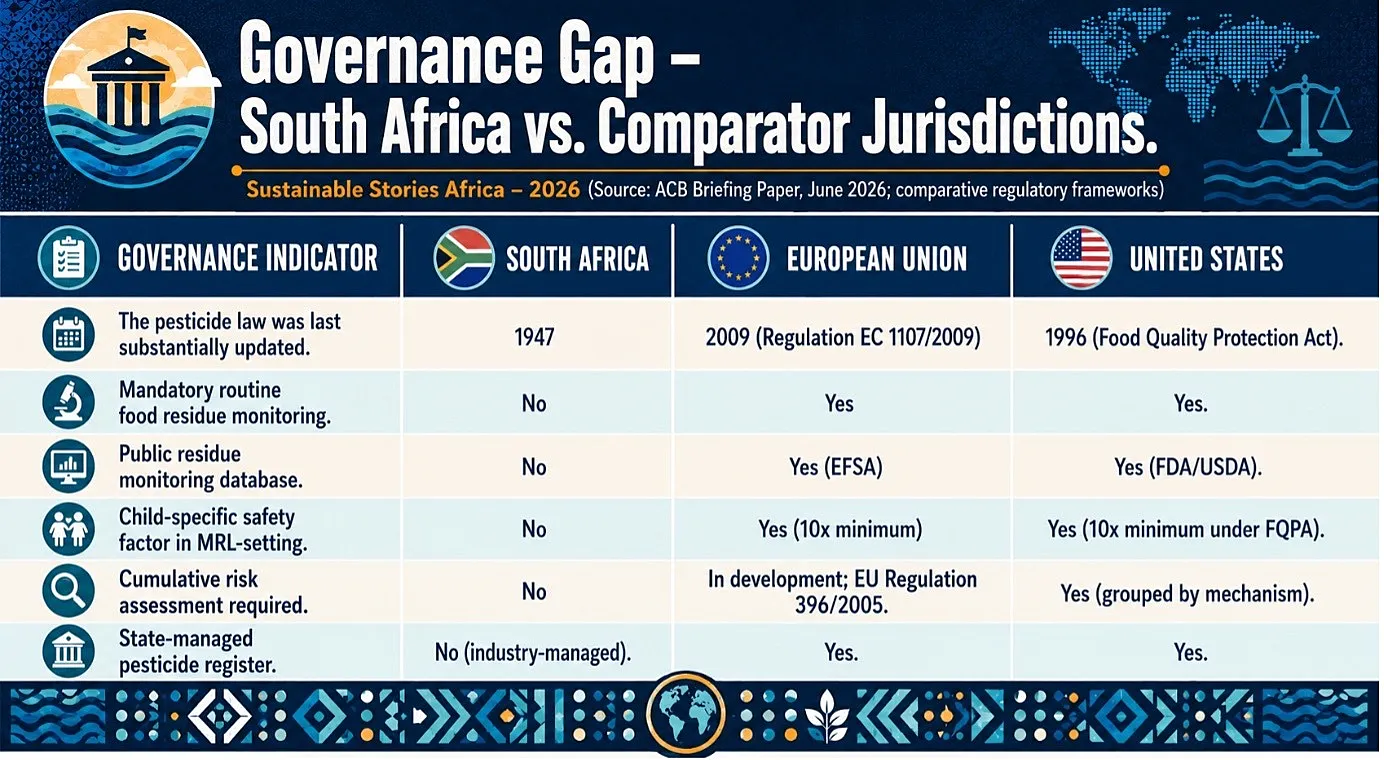
South Africa's pesticide regulatory framework has a structural design problem. Its MRL regime is governed by legislation enacted in 1947, built for a different era of agricultural chemistry. Over 3,000 pesticides remain registered, yet a 2019 expert report found many hadn't been re-evaluated for years, while the Office of the Registrar operates with just five to seven staff and no in-house toxicology expertise.
The result is a system in which:
- MRLs are set without child-specific safety factors, despite international consensus on children's disproportionate vulnerability.
- Cumulative and aggregate risk from multiple residues is not assessed at all.
- The pesticide register is maintained by CropLife SA, an industry association, a conflict of interest unacceptable in the EU, US, or Canada.
The ACB study found South Africa's Malathion MRL in maize was 160 times higher than Codex standards.
Classified as a Group 2A probable carcinogen by IARC, it was detected in five staple products, including baby cereal, all fully legal under current law.
What Reform Would Actually Look Like
This is not an argument for zero pesticides, nor for dismantling South African agriculture.
It is an argument for regulatory architecture that matches the country's constitutional values, its international obligations, and the current state of toxicological science.
Countries that have undertaken meaningful pesticide governance reform have not seen agricultural collapse.
The EU's progressive restriction on HHPs has driven innovation in integrated pest management, biological controls, and precision agriculture.
South Africa, with its extraordinary agricultural biodiversity and climate variability, is well-positioned to lead Africa in sustainable pest management; however, not under a 1947 legislative framework that was designed before DNA was discovered.
A reformed South African pesticide governance system, with a state-managed transparent register, mandatory routine testing and public disclosure, child-protective MRL standards, and cumulative risk assessment, would deliver four interconnected benefits:
- Improved public health outcomes
- Enhanced constitutional compliance
- Alignment with export market standards (reducing two-tier production complexity)
- Positioning South Africa as a credible leader on food safety governance in the African context.
Six Reforms, One Clear Mandate
The ACB's briefing paper closes with six well-argued, evidence-grounded recommendations. This opinion piece argues that they are not merely desirable; they are constitutionally necessary and politically overdue.
Apply a 0.01 mg/kg MRL default to all infant and toddler foods immediately.
- No new legislation required.
- The default already exists.
- Extend it as a categorical requirement to the foods consumed by the most vulnerable population group.
Introduce child-specific 10-fold safety factors
- Into all MRL-setting and review processes, consistent with FAO/WHO guidance and the South African Constitution's Section 28 commitment to the best interests of the child.
Initiate a mandatory, time-bound phase-out of HHPs
- From the food system, beginning with the seven priority pesticides identified in the ACB study: Malathion, Dichlorvos, Glyphosate, Imidacloprid, Carbendazim, Epoxiconazole, and Amitraz.
Transfer the pesticide register
- From CropLife SA to a fully resourced, publicly accessible state-managed authority, consistent with Section 33 of the Constitution (just administrative action) and the Promotion of Administrative Justice Act.
Mandate routine, publicly disclosed food residue monitoring
- On a schedule comparable to South Africa's trading partners, and publish results in open-access formats accessible to researchers, journalists, and citizens.
Modernise the legislative base.
- A country whose pesticide governance runs on a 1947 law is not governing a 21st-century food system.
- The Fertilisers, Farm Feeds, Agricultural Remedies and Stock Remedies Act must be replaced with legislation fit for the current scientific and constitutional landscape.
PATH Forward – One Standard for All South Africans
The evidence is now on the table, placed there not by government or industry, but by an independent civil society organisation performing the public-interest function a well-resourced regulator should provide. That itself is an indictment.
South Africa can close this governance gap; the reforms are documented, internationally tested, and constitutionally grounded.
The only question is political will. Every day of inaction leaves a South African child less protected than a European consumer, unacceptable, unconstitutional, and unsustainable.