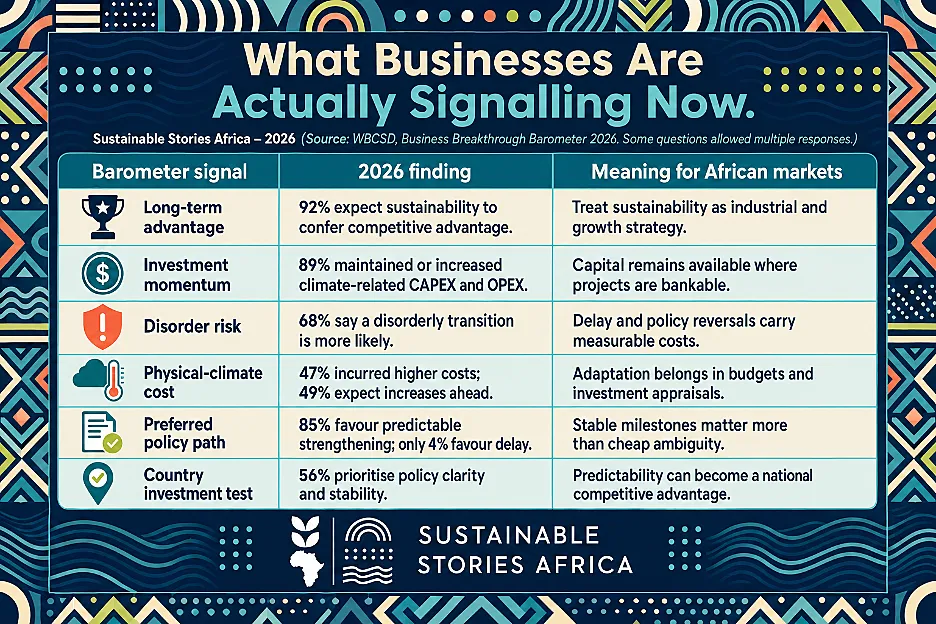
Global business has not retreated from sustainability: 92% of leaders expect competitive advantage, while 89% maintained or increased climate-related investment.
However, 68% now believe a disorderly transition is more likely.
The message for Africa is urgent. Climate ambition will attract capital only when governments pair it with predictable rules, affordable clean power, resilient infrastructure and credible markets that make implementation commercially possible
Sustainability’s Business Case Has Crossed Over
The most important line in the Business Breakthrough Barometer 2026 is not that companies remain committed to climate action.
Sustainability is starting to pay for itself. Among 508 business leaders surveyed from February to May, 92% expected their strategy to create a competitive advantage over five to ten years; 89% maintained or increased climate-related investment.
That confidence sits alongside a warning:
- 68% see a disorderly transition as more likely than a year ago.
- 47% face higher physical-climate costs.
- 15% feel fully prepared.
The obstacle is no longer mainly corporate disbelief. It is the unstable system around investment.
For Africa, this is both caution and invitation. The continent should neither copy a transition designed elsewhere nor confuse disclosure with delivery.
It should build rules, grids, markets and financing structures that turn sustainability into cheaper energy, secure food, productive industry and durable jobs.
The Real Threat Is Policy Whiplash
Africa’s green premium is often a policy-risk premium. A project that appears costly under unstable rules can become competitive once tariffs, permits, grid access, taxation and offtake are clear enough for capital to price the future.
Picture a manufacturer outside Lagos, Nairobi or Casablanca weighing a solar-and-storage contract against another decade of diesel exposure. The equipment may be proven and the operating savings persuasive. Yet the investment committee must also price currency volatility, uncertain grid-connection timelines, changing import duties, weak contract enforcement and the possibility that a new administration rewrites the rules. The climate solution has not failed; the investment environment has.
That distinction is the Barometer’s defining lesson. Businesses are not asking governments to protect them from every cost. Some 85% prefer predictable policy strengthening to delay, and 37% would accept higher near-term costs to reduce disruption. As one power-sector executive put it, “We need long-term, stable policies, which can ensure that our investments will actually be profitable.” The blunt conclusion is that policy certainty is now economic infrastructure.
What Businesses Are Actually Signalling Now
The headline figures describe a transition that is commercially stronger but operationally more fragile.
Regulatory compliance and resilience management each led as sustainability drivers at 52%, followed by future growth opportunities at 46%, rather than corporate virtue replacing profit.
However, climate exposure and energy security are becoming embedded in profit itself.
Solution rankings sharpen the African opportunity:
- Power generation and storage attract 80% of relevant respondents
- Transmission and grids73%
- Regenerative agriculture 72%
Mapping directly onto the continent's power deficits, costly self-generation and food-system vulnerability.
The report also shows what coherent policy achieves, citing;
- India's auction-backed renewable-ammonia market and carbon-credit scheme.
- Mexico's EV-linked investment package.
- Morocco's low-cost renewables paired with European hydrogen proximity.
- Ethiopia's vehicle-import restrictions.
The lesson is not to copy individual instruments, but to combine direction, infrastructure, demand and finance so policies reinforce each other.
An important limit remains: the Barometer covers leaders from over 50 countries and $2 trillion in combined revenue; however, it does not separately report sub-Saharan Africa.
This is a leading indicator, not an African sentiment survey, strengthening the case for an Africa-specific transition barometer that tracks local capital costs, grid bottlenecks and community outcomes.
Africa Can Turn Certainty Into Advantage
Africa does not need to choose between development and decarbonisation. It needs to make development more resilient, productive and investable.
Predictable rules can lower perceived risk; lower risk can reduce financing costs; lower financing costs can make clean power, efficient buildings, electric mobility and climate-smart agriculture competitive without permanent subsidy.
The gains would be tangible.
- Manufacturers would face less diesel and fuel-price exposure.
- Utilities could plan generation, storage and transmission as one system.
- Farmers could adopt soil, water and crop practices backed by patient finance and reliable buyers.
- Cities could screen infrastructure for flood, heat and insurability risks before assets are built, rather than paying repeatedly after failure.
- Exporters could prepare for carbon-sensitive markets without discovering new standards at the border.
The alternative is an expensive holding pattern:
- Businesses run dual systems
- Consumers pay for inefficiency
- Promising projects remain stranded in approval queues
- Governments announce targets that infrastructure cannot deliver.
In that world, sustainability becomes a premium label for a few large companies while small businesses, informal workers and vulnerable communities bear the costs of disruption.
A credible transition must reduce that inequality, not repaint it green.
Build Rules That Make Transition Investable
First, governments should publish 5- to 10-year transition compacts with annual milestones, transparent review clauses and clear institutional ownership.
- Power, transport, industry and urban resilience cannot be governed through disconnected circulars.
- Policy must survive election cycles without becoming immune to evidence, explaining in advance how rules tighten and how affected communities will be supported.
Second, regulators and utilities must turn infrastructure access into a measurable service.
- Grid-connection queues, permitting timelines and tariff methodologies should be visible and time-bound.
- Clean generation without transmission is stranded capital, and integrated planning must account for new demand from data centres and industry.
Third, finance should match the risks African projects actually face.
- Development finance institutions and commercial lenders should expand local-currency facilities, guarantees and foreign-exchange tools, with concessional capital paying for risk reduction rather than sustaining weak projects indefinitely; smaller suppliers and distributed-energy developers need dedicated channels beyond conventional thresholds.
Fourth, governments and large buyers;
- Must create demand through procurement standards, bankable power-purchase agreements and longer farmer contracts, while regional bodies pursue mutual recognition of standards.
Finally, businesses must move beyond;
- Target announcements, connecting sustainability to capital allocation and disclosing near-term results, public support isn't a communications afterthought but part of the investment case itself.
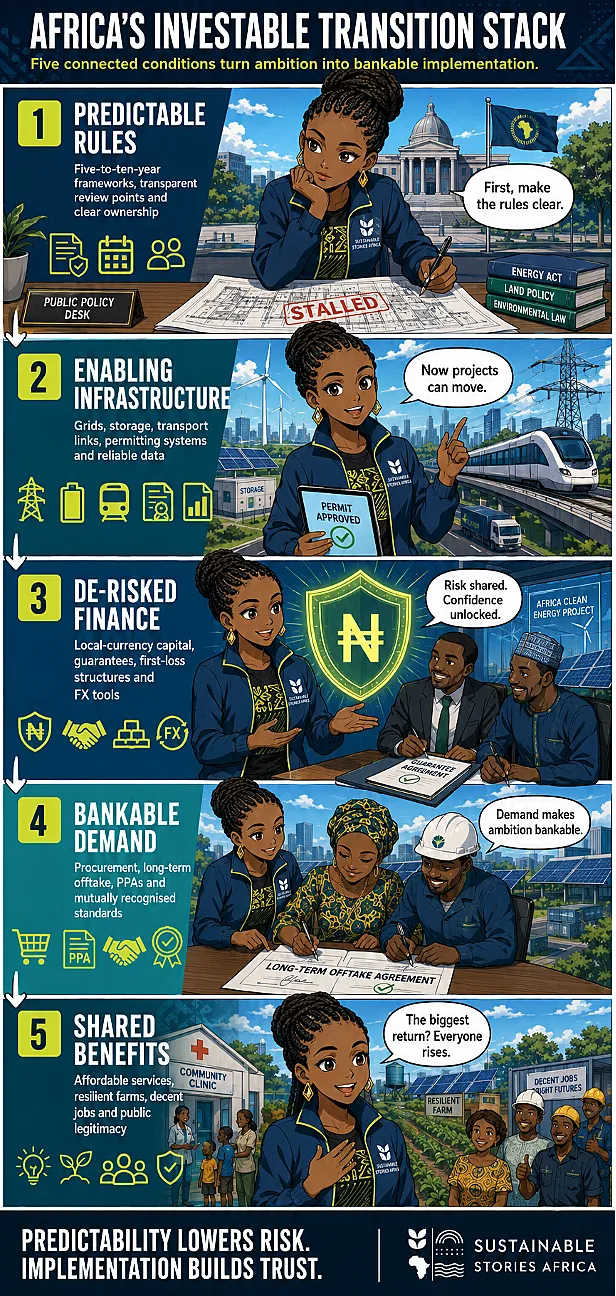
PATH FORWARD – Make Predictability Africa’s Next Competitive Asset
Africa’s transition will advance when governments replace policy surprises with investable milestones, financiers target real local risks, and businesses convert climate promises into capital, procurement and resilient supply chains.
The objective is not greener paperwork, but stronger economies.
The next step is practical: measure bottlenecks, publish delivery timelines, harmonise standards and centre citizens in the benefits.
Sustainability has made its business case. Africa must now build the system that lets that case scale.