PitchBook's 2025 Annual Global Private Market Fundraising Report delivers a sobering verdict: venture capital is contracting and concentrating, raising just $122.1 billion globally, the lowest since 2015, with 55% of US VC flowing to Bay Area firms and North America claiming 55.3% of new commitments, its highest share since 2008.
This is a structural realignment, not a cycle. Africa's tech ecosystem, once a record-setting recipient from 2019 to 2022, now needs resilient domestic LP infrastructure rather than waiting for Silicon Valley or London's recovery.
Stop Waiting for Foreign Capital. Build Yours.
Let us be direct about what the PitchBook data shows. In 2025, global VC fundraising collapsed to a decade low. Asia's share of VC commitments fell to 30.6%, the lowest since 2012. China closed just 205 new funds, down from 1,522 in 2021.
- Southeast Asia saw only 14 new VC fund closures, versus 102 in 2022.
- India managed 35, versus 105 in 2022.
- The median time between fund closings by the same firm grew to 2.7 years, a full year longer than in 2022 and the highest since 2014.
The pattern is unmistakable: when global liquidity tightens and distributions from VC funds stall, LP capital retreats to perceived safety; the frontier, emerging and developing-market VC ecosystems that flourished during the cheap-money era are left exposed.
Africa has felt this acutely. After peak years of $5 to $7 billion in annual tech funding in 2021 to 2022, African tech funding has retrenched significantly.
The PitchBook data makes clear: a structural return to those peaks will not be driven by foreign LP capital alone.
Concentration Crisis in Global VC
The PitchBook data on VC concentration is startling. In 2025:
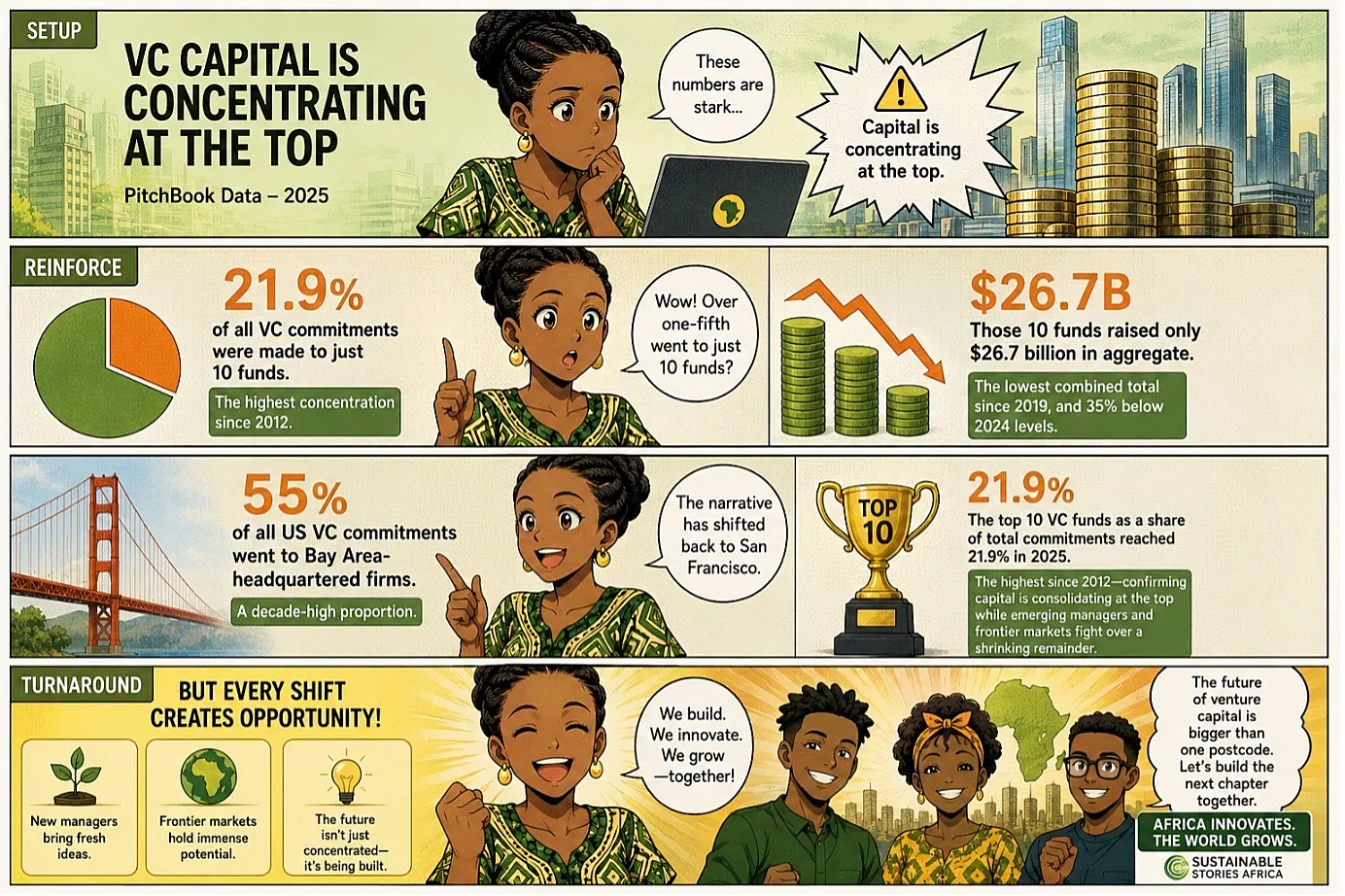
- 21.9% of all VC commitments were made to just 10 funds – the highest concentration since 2012.
- Those 10 funds raised only $26.7 billion in aggregate – the lowest combined total since 2019, and 35% below 2024 levels. Even the largest funds are feeling the pressure.
- 55% of all US VC commitments went to Bay Area-headquartered firms, a decade-high proportion. The PitchBook report notes: "The narrative has shifted back to San Francisco."
- The top 10 VC funds as a share of total commitments reached 21.9% in 2025, the highest since 2012, confirming that capital is consolidating at the top while emerging managers and frontier markets fight over a shrinking remainder.
For Africa, the direct implications are clear; even if the largest VC firms in the world, including those in the US and Europe, are struggling to raise capital in 2025, the continent's VC fund managers face a structural wall, not a temporary obstacle.
The capital that flooded African tech from 2020 to 2022 was largely driven by a global low-interest-rate environment that made risk-taking affordable for foreign LPs.
That environment is gone. The rebuild must come from different sources.
Africa's VC Dependency Problem
During the African tech boom of 2019 to 2022, foreign capital, primarily from US and European LPs, family offices, and development finance institutions, dominated the LP base of Africa-focused VC funds.
This created a structurally fragile ecosystem: one whose capital flows were determined more by conditions in San Francisco, London, and New York than by the economic fundamentals and innovation potential of Lagos, Nairobi, Cairo, or Johannesburg.
The PitchBook data documents what happens to markets with fragile LP bases when global conditions tighten.
Southeast Asia, which "received global interest during the low-rate era, has been unable to sustain that interest by realising value from the companies built by those investments."
The same dynamic has played out in parts of Africa's tech ecosystem. Investors came for the opportunity but left when the macro environment shifted, because they had no structural commitment to the continent beyond return-seeking opportunism.
The solution is not to reject foreign capital; it remains essential at the current market scale.
However, it is to develop a domestic and continental LP base that provides ballast when foreign conditions change.
This means African pension funds, sovereign wealth funds, insurance companies, development finance institutions, high-net-worth individuals, and corporate treasury departments must become meaningful, structurally committed participants in the African VC ecosystem.
What a Self-Sustaining African VC Ecosystem Looks Like
The PitchBook data offers a template, paradoxically, from one of the world's most developed VC markets.
The US VC market has survived and concentrated because it has deep domestic LP infrastructure: pension funds (CalPERS, Yale Endowment, Harvard Management Company) have multi-decade commitments to VC as a strategic asset class.
They do not exit when conditions deteriorate; they rebalance and wait.
Africa's equivalent infrastructure is being built.
The continent's pension assets under management exceed $1.8 trillion, concentrated primarily in South Africa, Nigeria, Kenya and Egypt.
Regulatory frameworks in several markets now explicitly permit VC and private equity allocations.
The Africa Pension Investors Forum is building cross-border pension investment cooperation. Several sovereign wealth funds, such as Nigeria's NSIA, Botswana's Pula Fund, and Ghana's GIA, are developing private market allocation frameworks.
If Africa's VC ecosystem can attract just 2% and 3% of continental pension AUM into VC and growth equity allocations, it would unlock $36 to $54 billion in structurally committed domestic capital, transforming the LP landscape from foreign-dependent to continentally anchored.
Building the Domestic LP Architecture
The argument is clear. The opportunity is evident. The actions required are specific:
Reform pension fund regulations
- Remove barriers preventing African pension funds from investing in VC and growth equity. Introduce prudent investor standards to align with global best practice.
Develop an African LP community
- Create formal networks of African institutional investors committed to private capital allocation: a structured equivalent of the US National Venture Capital Association's LP community.
Establish anchor fund programmes
- African governments and DFIs should establish anchor LP programmes that co-invest alongside domestic VC funds to signal quality and reduce perceived risk for other institutional LPs.
Build track records through co-investments
- African fund managers should develop co-investment programmes that give domestic institutional investors exposure to specific deals, building familiarity and confidence in VC as an asset class.
Measure and publish VC performance data
- Africa lacks credible, standardised VC performance data comparable to global benchmarks. Building this data infrastructure is essential for compelling domestic LP allocations.
Path Forward – Africa's VC Resilience Must Be Built From Within
The PitchBook 2025 data make the case that global VC capital concentration and contraction are structural, rather than cyclical.
Africa's VC ecosystem cannot be built or sustained on the hope that foreign LPs will return in force when the macro environment improves.
The depth, resilience and impact of African venture capital must be built from within: from domestic pension capital, sovereign wealth allocation, DFI anchor commitments, and the growing wealth of African high-net-worth investors who have a stake in the continent's innovation economy.
The data has drawn the map. African stakeholders must make the journey.