(Based on Section 3.2 – Transition Readiness: Finance, Regulation, Innovation, Infrastructure, Education)
In 2026, the World Economic Forum's Energy Transition Index recorded its first decline in transition readiness in over a decade, signalling that the enabling conditions driving global clean energy progress are weakening.
While advanced economies, Emerging Asia, Latin America and the Middle East all saw readiness fall, Sub-Saharan Africa moved in the opposite direction, improving by roughly 3.3%, led by finance and investment (+8.6%), education (+5.6%) and innovation (+5.0%): the strongest regional performance worldwide.
As global enablers erode, Africa is quietly building them. The real question is whether global finance will recognise this shift before the opportunity narrows.
The Readiness Revolution Nobody Noticed
Transition readiness is the WEF ETI's measure of the future. It tracks whether a country has the policy frameworks, investment climate, innovation capacity, infrastructure quality and human capital to sustain progress in energy transition over time.
For a decade, improvements in readiness have driven most of the ETI's overall gains. In 2026, readiness fell globally for the first time in over a decade.
Four of five readiness sub-dimensions deteriorated: finance and investment (-1.8%), regulation and political commitment (-1.2%), innovation (-1.1%), and infrastructure (-0.2%). Only education and human capital improved (+2.0%).
The reasons are familiar: geopolitical fragmentation, tightening financial conditions, policy instability in key advanced economies, and a growing disconnect between the scale of global capital and the conditions that determine where and at what cost it is deployed.
However, in Sub-Saharan Africa, all five readiness dimensions either improved or held steady.
The region's 3.3% gain in readiness is not a rounding error. It is a structural signal. It demands a response from the global climate finance community that is yet to arrive.
The Readiness Divergence Is Stark and Growing
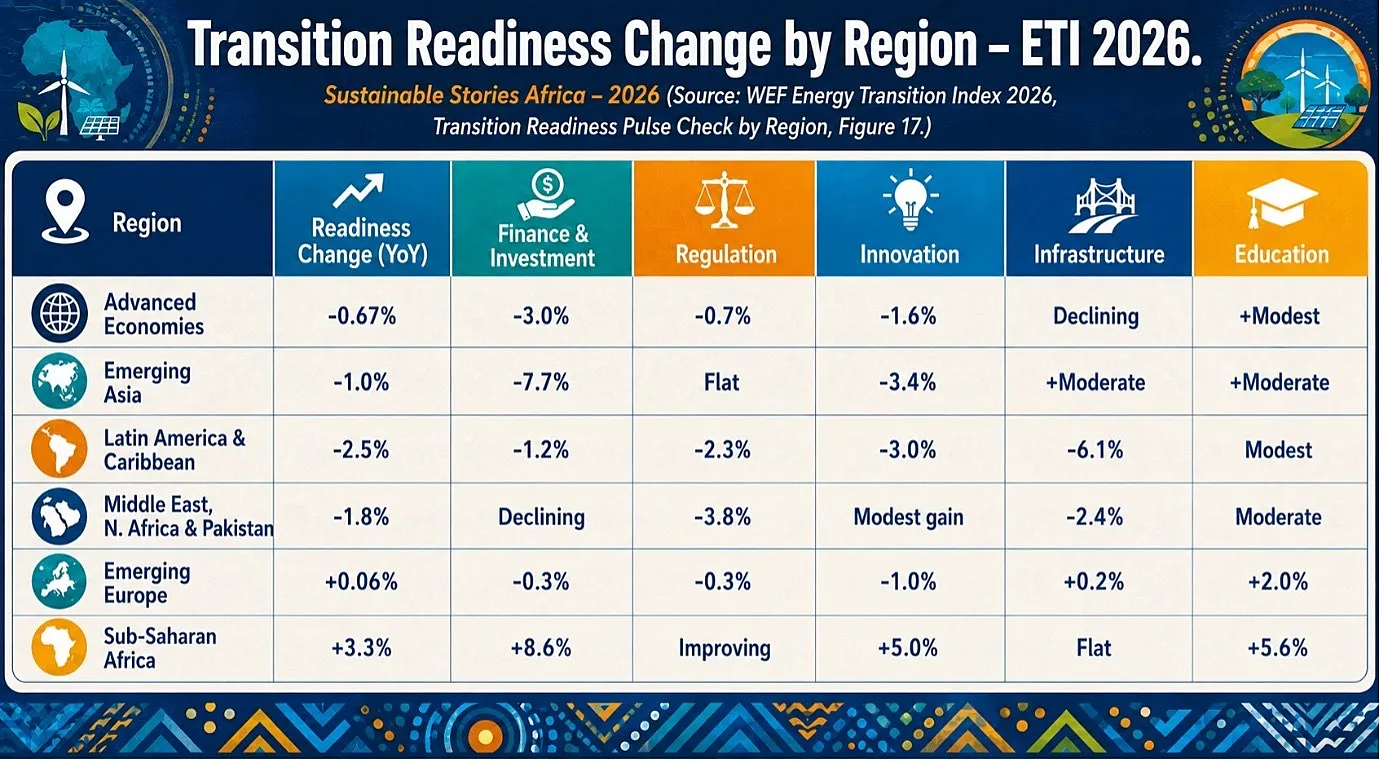
The contrast could not be sharper. Latin America's readiness declined by 2.5%, driven by infrastructure collapse (-6.1%), regulatory deterioration (-2.3%) and innovation decline (-3.0%).
The Middle East, North Africa and Pakistan fell by 1.8%, with regulation plummeting by 3.8%. And the global average for finance and investment readiness, the single most important enabler for scaling the transition, fell by 1.8%, its sharpest decline in the ETI's history.
Meanwhile, Sub-Saharan Africa's finance and investment readiness rose by 8.6%. Its innovation score rose by 5.0%.
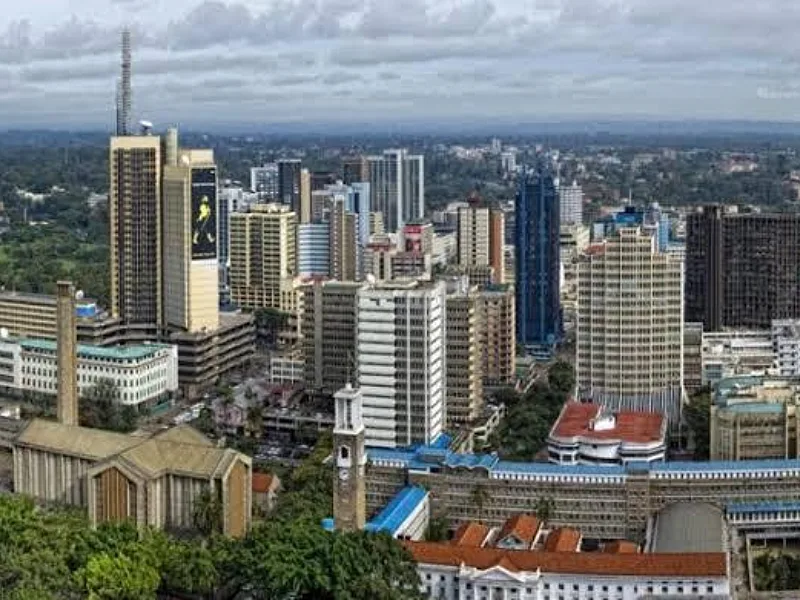
Its education and human capital index rose by 5.6%. Namibia's readiness score rose significantly. Kenya's readiness score jumped 8.7%.
This is not an incremental improvement. This is a trajectory change.
What Is Driving Africa's Readiness Surge?
The WEF's data points to three interlocking drivers of Sub-Saharan Africa's readiness improvement:
Driver 1: Capital Inflows Are Growing, Even as Global Conditions Tighten
- Although 75% of global clean energy investment still flows to the US, China, and Europe, Africa's marginal gains in finance and investment readiness reflect real, if still insufficient, capital entering the continent's clean energy sector.
- Kenya’s renewable investment surge, South Africa’s Independent Power Producer programme, Namibia’s green hydrogen pipeline and Nigeria’s off-grid solar expansion are all driving score improvements that, though starting from a low base, signal genuine momentum.
Driver 2: Human Capital Is Being Built, Deliberately
- WEF data highlights rising talent competitiveness and clean technology job creation across the continent.
- Ethiopia's renewable energy workforce is expanding, while Ghana and Nigeria's technical education sectors are producing more energy engineers.
- Meanwhile, the IEA and multilateral development banks are increasingly co-investing in regional skills development, gains now beginning to show in human capital metrics.
Driver 3: Innovation Is Accelerating From a Low Base
- Sub-Saharan Africa's 5.0% innovation readiness improvement reflects rising R&D investment, technology adoption and entrepreneurial activity.
- Kenya's R&D expenditure doubling from 0.4% to 0.8% of GDP stands out, alongside a growing wave of clean energy startups and digital mini-grid platforms reshaping the region's innovation ecosystem
What Happens If the Global Financial System Actually Meets Africa Here
The case for redirecting global climate finance toward Africa is strategic and economic, not just moral.
Africa holds 17% of the global population but only 3.4% of primary energy supply and 2.1% of CO₂ emissions, with per-capita consumption far below the global average, even as it is set to drive a disproportionate share of future population and economic growth.
A financing architecture matching Africa's rising readiness with proportionate capital would:
- Accelerate decarbonisation at a fraction of the cost of retrofitting fossil infrastructure elsewhere
- Deliver returns that justify the risk premium currently priced into African clean energy projects
- Diversify global critical mineral supply chains through ESG-aligned development, strengthening long-term security
- Build a clean energy industrial base delivering jobs, growth and energy access
Denmark, Finland and Sweden built their top ETI rankings over decades of consistent policy and investment.
Africa lacks that time. It has readiness and a narrowing window and needs capital that recognises this moment.
Five Demands Africa Must Make of the Global Climate Finance System
This opinion is not a lament. It is the agenda:
Concessional capital calibrated to readiness trajectory, not just current score:
- The global climate finance architecture must stop allocating capital based primarily on risk-adjusted returns derived from current conditions.
- Countries with rising readiness trajectories, such as Kenya, Namibia, South Africa and Senegal, should receive preferential access to development finance to lock in and accelerate their momentum
African representation in global clean technology supply chain governance:
- As export controls now cover more than half of critical transition minerals, and Africa holds significant reserves of many of them, the continent must demand a seat at the table in global minerals governance frameworks rather than remaining a raw material supplier to other countries' transition strategies
IFC and AfDB blended finance at scale for readiness infrastructure:
- The infrastructure, regulatory and innovation deficits that constrain Africa's readiness score are not insurmountable; they require patient, concessional capital structured for long-horizon returns that commercial markets will not currently provide
A just transition premium in global carbon markets:
- African countries must advocate for a premium price for carbon credits generated by African clean energy projects, reflecting the disproportionate climate vulnerability of African populations and the additionality of African decarbonisation contributions
Data sovereignty and ETI co-production:
- The WEF ETI should establish an African research and data partnership, co-producing the continent's transition assessment with African institutions, rather than relying solely on international data sources that systematically underrepresent African clean energy activity
Path Forward – Africa Is Ready for Its Transition Moment
The Readiness Is Real, The Finance Must Follow
The WEF Energy Transition Index 2026 offers the strongest data-driven case yet for redirecting global climate finance toward Sub-Saharan Africa.
As global readiness declines, Africa is building the finance flows, human capital and innovation ecosystems the world's transition needs.
Its 3.3% readiness gain is not a headline; it is an investment signal. Every month global finance fails to respond, the window for a transformative African energy transition narrows. The data is in. The capital must move.