South Sudan is urbanising faster than almost any country on Earth, yet its cities remain underfunded, flood-prone and institutionally hollow.
This piece argues that Juba, Wau and Bor are not peripheral to national recovery; they are its foundation.
For African and emerging markets watching fragile-state transitions, South Sudan's choice between chaotic sprawl and deliberate urban investment carries lessons far beyond its borders.
Cities Carry What Oil Cannot
South Sudan's oil wells generate roughly 90% of government revenue. However, the country's true recovery bet is being placed, largely by default, on its cities.
Since the 2018 peace deal, urban dwellers have grown by an estimated 590,000, even as national GDP losses from civil war total $81 billion.
This is not the story of a nation modernising by design; it is a nation urbanising by necessity, and the difference matters enormously for how policymakers respond.
A Fragile Boom Nobody Planned
South Sudan is now urbanising faster than the Sub-Saharan African average, at a compound annual growth rate of 4.3% between 2019 and 2024, compared to the region's 3.8%.
However, only 22% of its population lives in urban areas, among the lowest rates globally, trailing Sudan (36.8%) and the Sub-Saharan African average (43.5%).
That paradox is rapid growth from a tiny base, which is the central fact editors and investors keep missing: South Sudan's cities are exploding in relative terms while remaining institutionally invisible in absolute terms.
The thesis here is blunt: without deliberate, sequenced investment in urban systems now, South Sudan risks converting a demographic inevitability into a permanent crisis of informality, flooding and unrest.
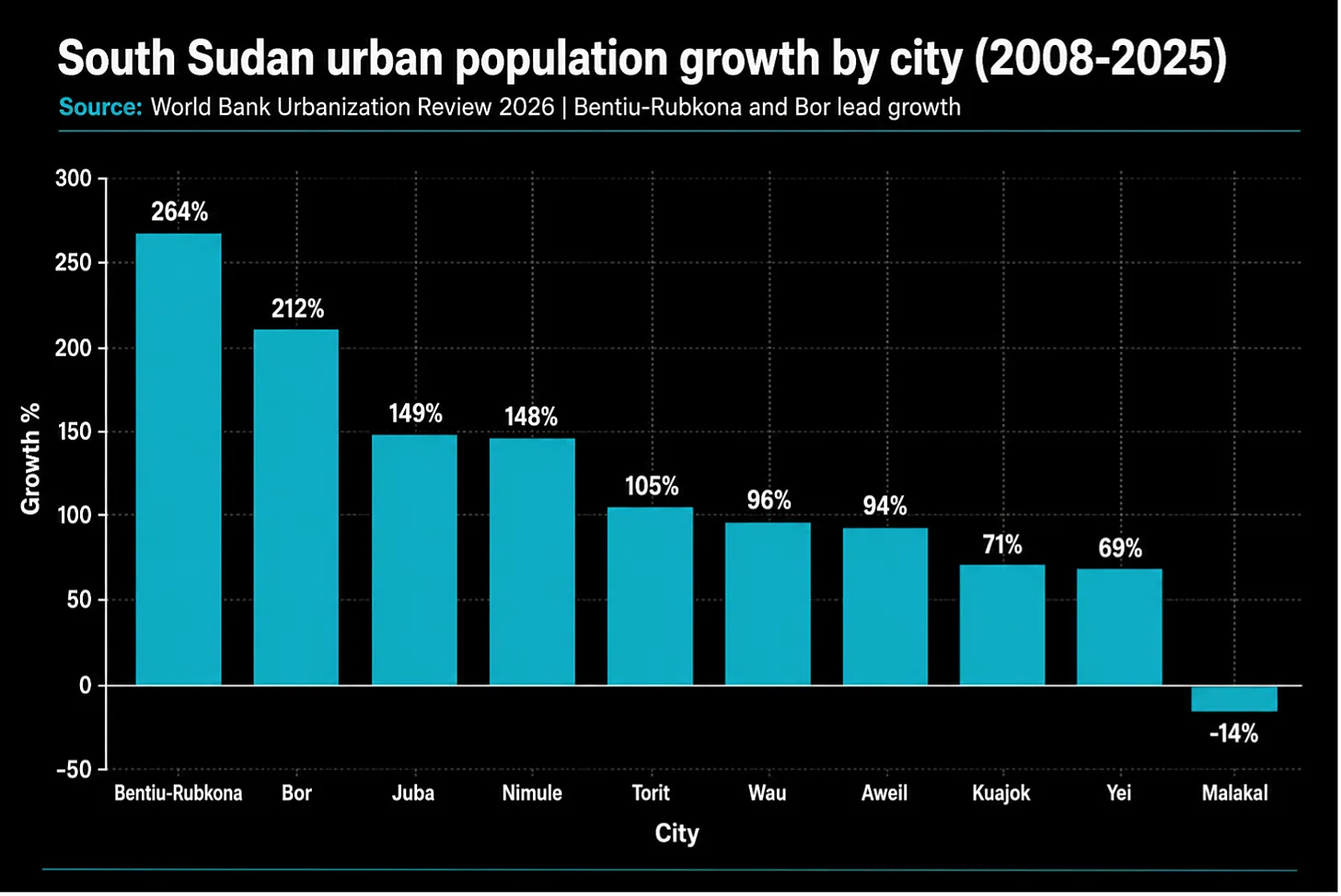
Cities like Bentiu-Rubkona have grown 264% since 2008, and Bor by 212%, not because of jobs or industry, but because conflict, floods and displacement pushed people there with nowhere else to go.
Growth Without a Plan
The numbers tell an uncomfortable story. Juba's population nearly tripled from 285,609 in 2008 to roughly 710,000 today, while smaller towns like Nimule and Torit more than doubled, and Malakal, once a vital trading hub, actually shrank by 12% due to repeated urban warfare.
This is displacement urbanisation, not development urbanisation: people arrive fleeing floods or fighting, not chasing factory jobs, which is precisely why the productivity gains seen in Asian or Latin American cities have failed to materialise here.
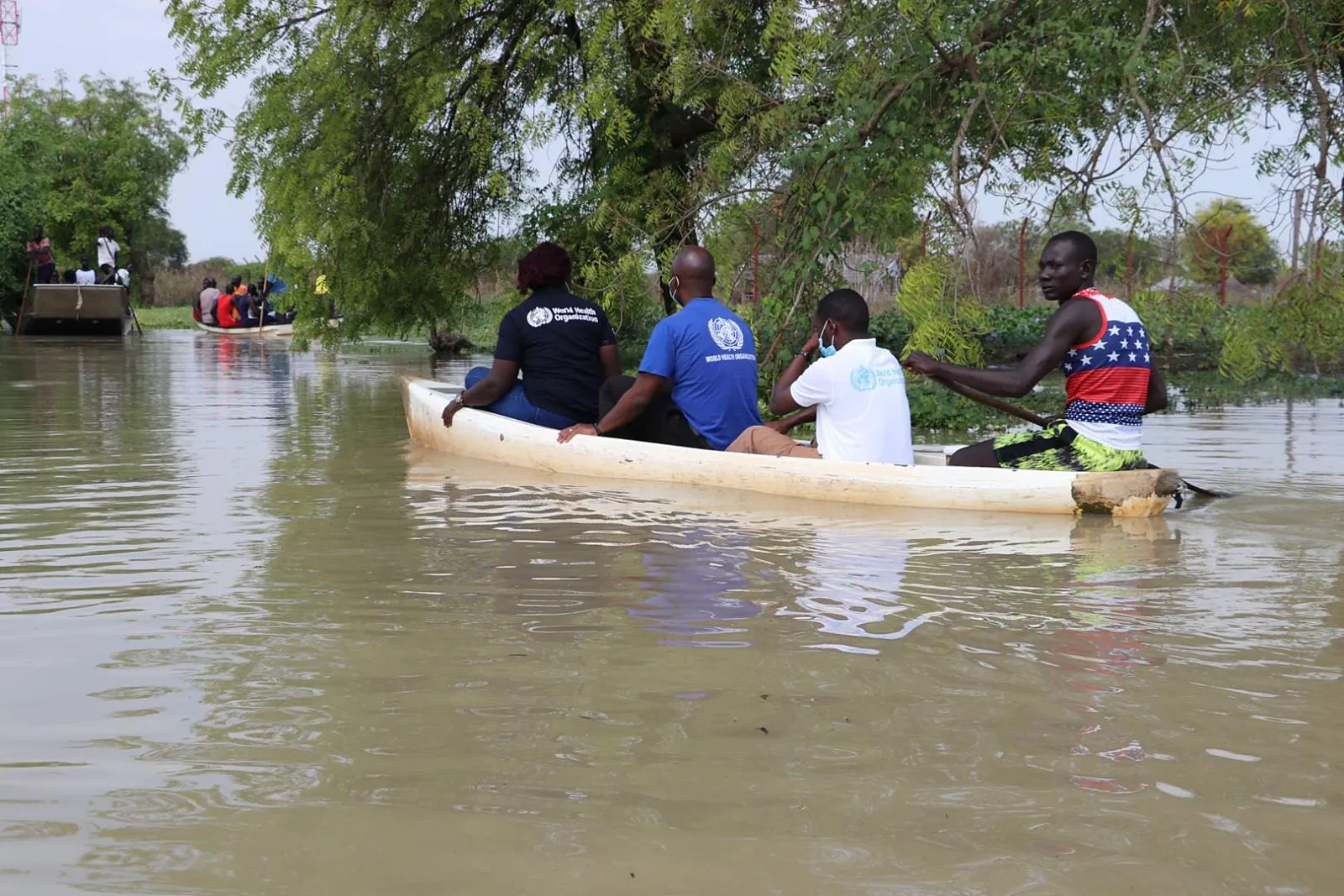
Nearly half the population has faced repeated flooding in recent years, and heat stress now disrupts schooling and productivity across every major city.
- Networked water and sanitation services remain rare outside parts of Juba, and even there, coverage is patchy.
- Land governance compounds the problem: overlapping statutory and customary systems, combined with elite capture, have created widespread tenure insecurity that disproportionately excludes women, youth and displaced populations.
The chart below shows just how uneven this urban expansion has been across South Sudan's ten largest cities.
What Functioning Cities Could Deliver
Imagine a Juba where drainage prevents seasonal flooding, where municipal revenue funds waste collection rather than relying on donor trucks, and where displaced families gain formal land tenure instead of informal, contested plots.
The World Bank's own review argues that well-sequenced urban investment can transform cities from "sites of vulnerability into anchors of stability and growth," enabling livelihoods, restoring services and strengthening social cohesion.
The alternative is already visible in Malakal, a city that shrank because urban warfare gutted its markets, hospitals and population, leaving what one field report called "a ghost town". Multiply that outcome across secondary cities, and South Sudan loses not just infrastructure but the social fabric that makes recovery possible.
A Sequenced Agenda, Not a Wish List
The report's own three-phase pathway offers a credible template, and it deserves faster political backing than it has received.
The infographic distils what each phase demands from government, financiers and citizens.
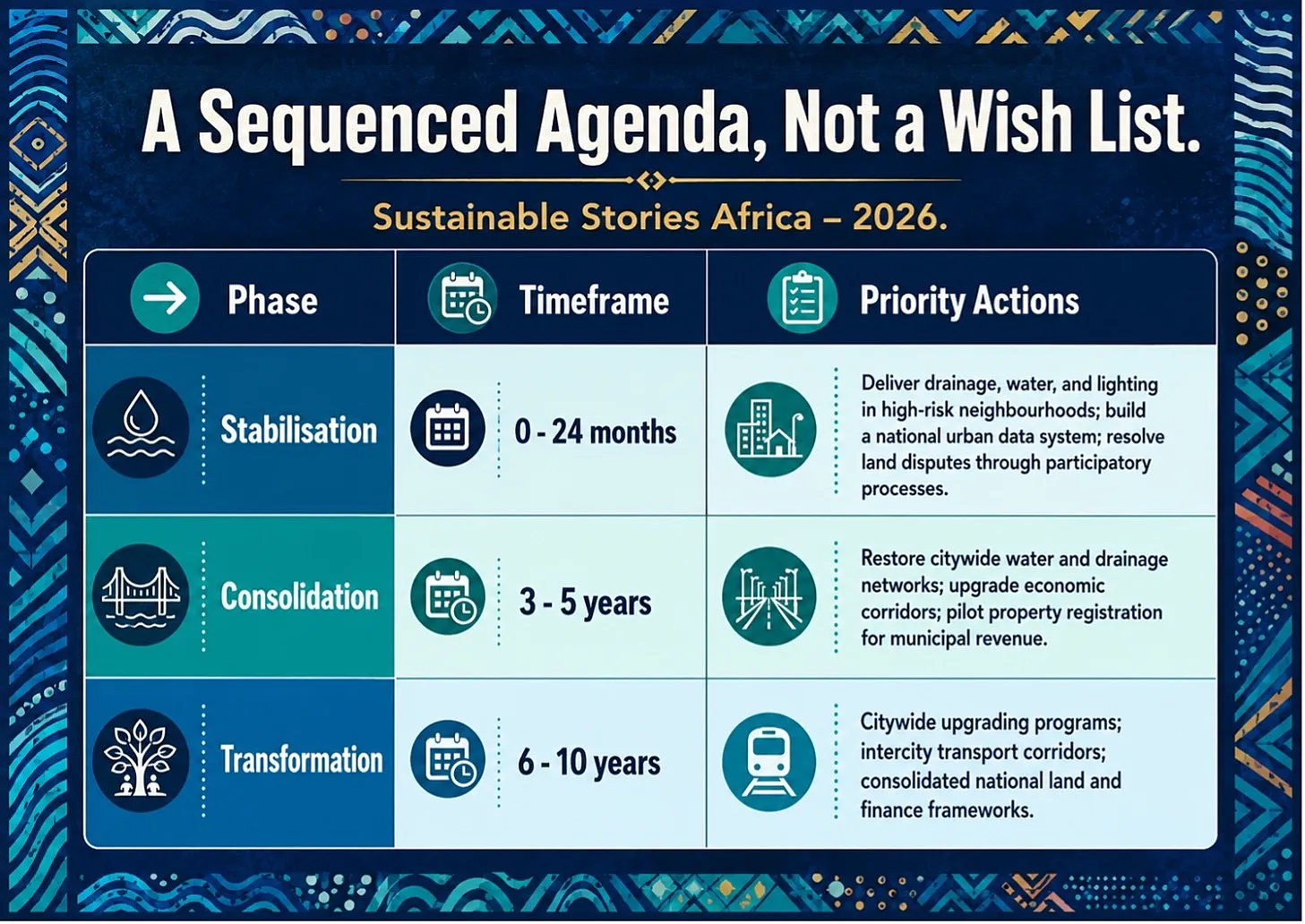
Policymakers must resist the temptation to skip straight to transformation-phase megaprojects; the report’s message is explicit.
- Co-investment should be tied to demonstrated government leadership and institutional readiness.
- Financiers and donors, meanwhile, should prioritise the national urban data system first
- Without reliable population and land data, every subsequent investment is a guess.
Path Forward – for South Sudan (Six Priorities for Cities)
South Sudan's window to convert crisis-driven urbanisation into planned recovery is narrow but real, anchored in the Intergovernmental Technical Committee's collaborative model between national ministries and local authorities.
Success depends on directing scarce public revenue, rather than donor funds, toward drainage, land reform and municipal finance in the cities absorbing the most displaced people.
The government's own endorsement of a sequenced, performance-linked pathway signals political will; the test now is whether implementation matches ambition before the next flood season or displacement wave arrives.