
ESG ratings promise clarity for investors but often deliver confusion for companies, which spend enormous resources chasing scores that shift with each provider's methodology.
This piece argues the real failure isn't the ratings themselves; it's treating them as strategy rather than a single, limited input.
For African and emerging-market firms with thinner compliance budgets, getting this distinction right could save millions in wasted disclosure effort.
The Score That Isn't The Point
ESG ratings have become boardroom obsessions across global markets; however, a new WBCSD member debate concludes something uncomfortable: the score itself rarely determines a company's access to capital.
What actually matters is the underlying data feeding investor scorecards, not the composite number vendors publish.
This distinction should reshape how African corporates, often stretched thin on sustainability staff, allocate their limited ESG resources.
The debate matters now because ISSB S1 and S2 standards are setting a new baseline for global disclosures. Even as mandatory reporting has, paradoxically, not reduced the burden on companies.
For emerging markets watching global standards harden, the lesson is that compliance volume is not the same as investor credibility.
Friend Or Foe – The Rating Is Not The Strategy
Here is the uncomfortable truth WBCSD's member companies have arrived at: ESG ratings are neither inherently friend nor foe; their value depends entirely on how investors and intermediaries use them.
The real risk isn't a low score; it's a company mistaking a vendor's composite rating as a proxy for enterprise value when methodologies change, and errors persist long after they're identified.
Companies that treat ratings as management targets are optimising for the wrong metric. As the report bluntly states, in most cases, a rating should be treated "as an external reference that helps you prioritise engagement topics, not as a proxy for strategy".
Duplication, Divergence, and Disclosure Theatre
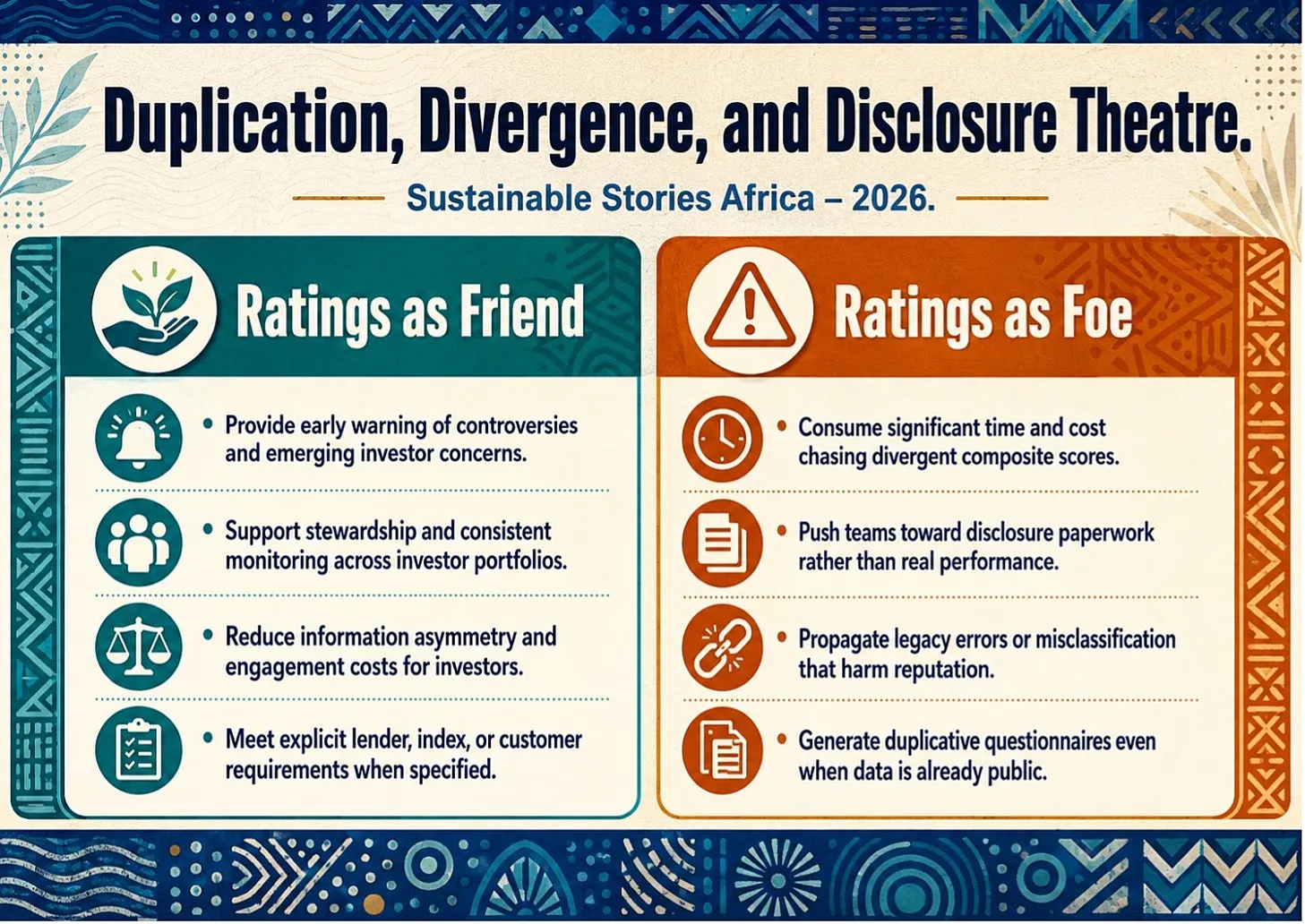
The friction is real and well-documented. Two rating agencies can score the same company differently even using identical public information because scope, assigned weighting, and estimation methods diverge across providers.
This forces many investors to build internal overlays that normalise vendor data, meaning the composite score companies chase so hard may not even be the number investors ultimately rely on.
Compounding this, rating methodologies often reward disclosure volume over real-world outcomes, particularly in judgment-heavy areas such as social topics and supply-chain due diligence.
Companies face repeated, different questionnaires across multiple business units, consuming staff time that could go toward operational improvement rather than score management.
Meanwhile, legacy errors and stale controversies can take too long to correct, damaging the reputations of data teams that have already fixed them on paper.
What Discipline Over Score-Chasing Actually Buys
Picture a sustainability team that stops firefighting five different vendor questionnaires and instead builds one recognised, publicly accessible dataset, a single source of truth investors and raters can pull from without bespoke requests.
That data discipline reduces investor reliance on inconsistent estimates, thereby freeing corporate resources for the metrics that actually move capital: transition allocation milestones, operational performance indicators, and asset-level exposure data.
The alternative, continuing to lobby for a marginally higher headline score, delivers no proven valuation upside, according to the WBCSD's own member findings.
For African corporates competing for scarce green financing, that distinction is the difference between spending on real decarbonization progress versus spending on paperwork that satisfies nobody.
A Governance Playbook, Not a Scramble
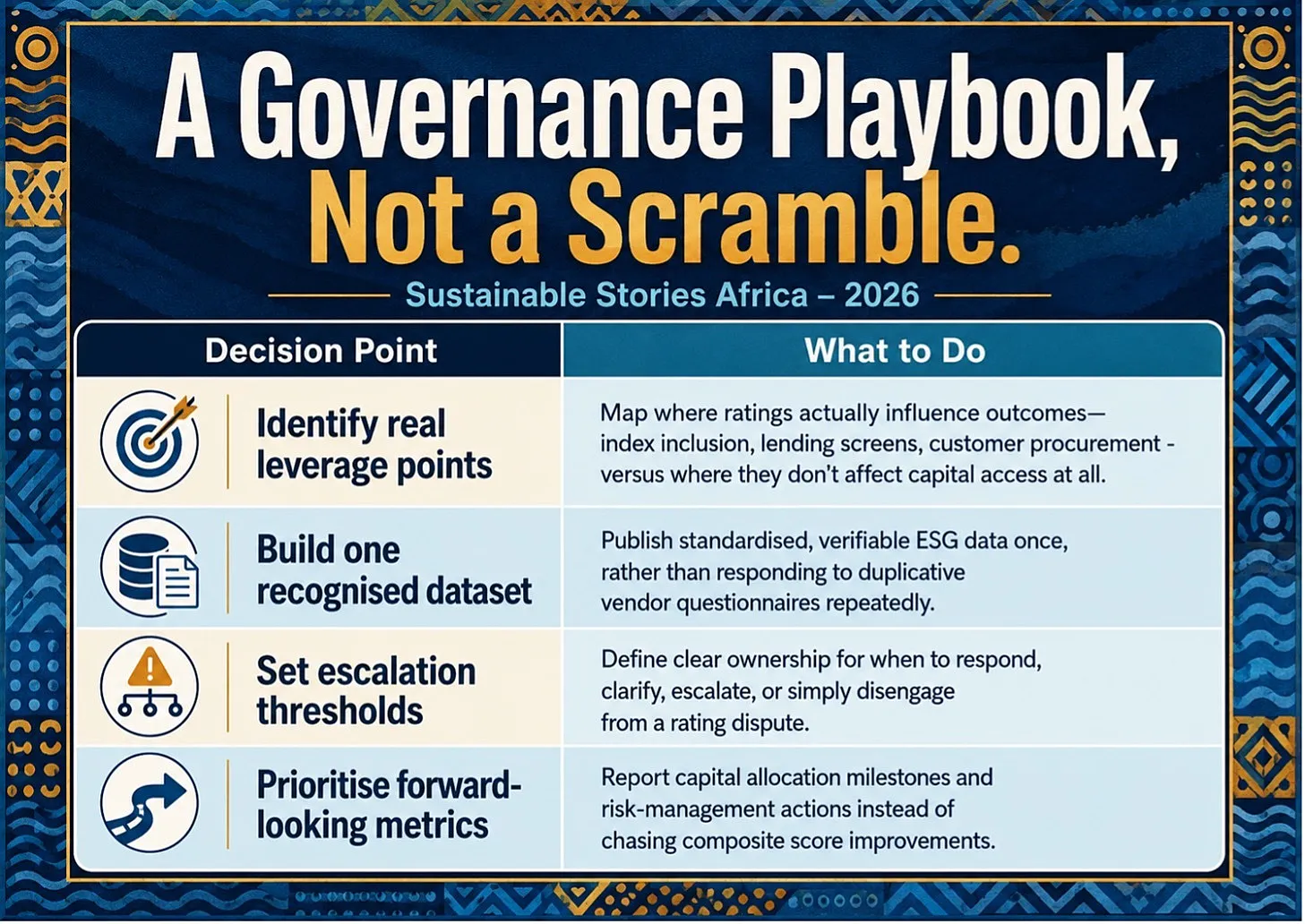
The WBCSD framework gives corporate leaders four concrete decision points. Which they translate directly into an African context where compliance teams are often under-resourced.
Regulators are moving in a similar direction; the EU's ESG Ratings Regulation now ask for transparent methodologies and conflict management from rating providers.
African regulators and stock exchanges developing their own ESG disclosure frameworks should watch this closely: transparency obligations belong on rating agencies, not just on the companies they assess.
Path Forward – Data Discipline, Not Score-Chasing
The path forward for corporations, including African firms, is to stop treating ESG ratings as report cards; rather, they should be treated as a single input among many, governed by clear internal thresholds.
Build the recognised dataset, fix real errors fast, and reserve rating-specific investment only where a lender, index, or customer explicitly demands it.
Structured reporting, digital tagging, and AI-assisted disclosure will ease some friction over time, but human judgment and accountability remain non-negotiable.
Companies that internalise this now will spend less on disclosure theatre and more on the outcomes that actually build enterprise value.