The January 2026 Global Financial Safety Net Tracker Methodology Guidebook—produced by Boston University's Global Development Policy Centre, Freie Universität Berlin, UNCTAD, and Hochschule für Technik und Wirtschaft Berlin - offers the most detailed public account of metrics behind the world's most comprehensive crisis finance database.
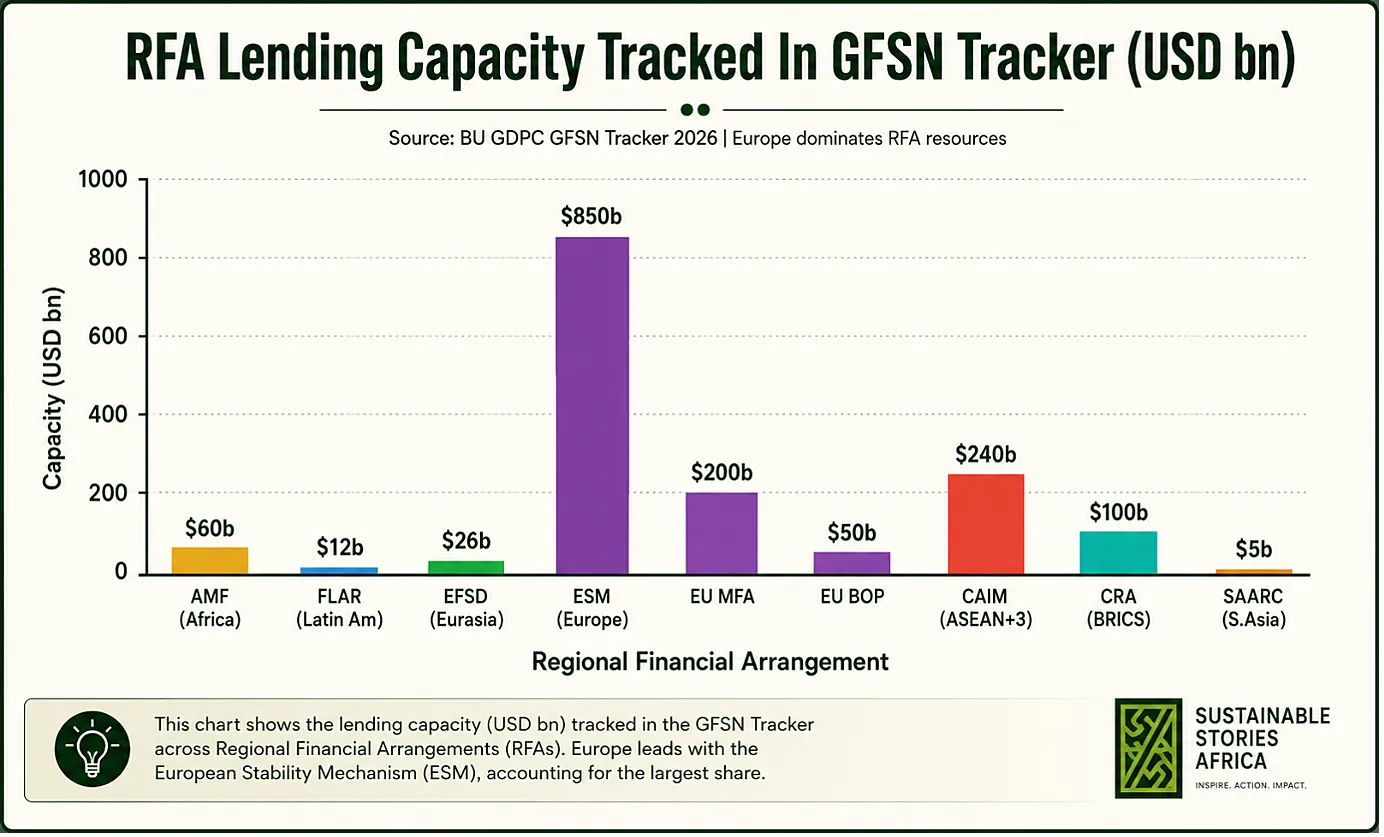
Its findings reveal that global crisis finance architecture favours countries with large quotas, existing swap relationships, and membership in well-capitalised regional pools.
This article unpacks that data and what it means for Africa's financial resilience.
The Architecture Speaks in Numbers
Numbers, in development finance, are never neutral. When the GFSN Tracker reports that at least $4.5 trillion in crisis finance resources exist globally, that figure carries an implicit caveat: most of it is not available to most countries under most circumstances.
Understanding who can access what and under what conditions requires unpacking the three primary source categories that the Tracker measures: the IMF, Regional Financial Arrangements (RFAs), and bilateral central bank swap arrangements.
The January 2026 Guidebook is, at its core, an act of financial transparency, a detailed explanation of how each variable is defined, calculated, and sourced.
For readers committed to understanding African financial governance, it is also a diagnostic manual on the continent's vulnerability in financing crises.
The Metric That Changes Everything
The single most important metric in the GFSN Tracker is the Annual Lending Capacity, the maximum crisis finance a country can access in a given year from the IMF, RFAs, and central bank swaps combined.
This figure tells policymakers not only what a country could borrow in a crisis, but also what it cannot access, a gap that, for many African nations, is enormous.
The Tracker calculates lending capacity using a cumulative three-year access standard, the maximum volumetric access period under IMF norms.
This means that the figures displayed represent the largest possible support package a country could theoretically access, not the amount likely to be approved.
For countries with small IMF quotas and no RFA membership, that maximum may be a fraction of what a severe balance-of-payments crisis would actually require.
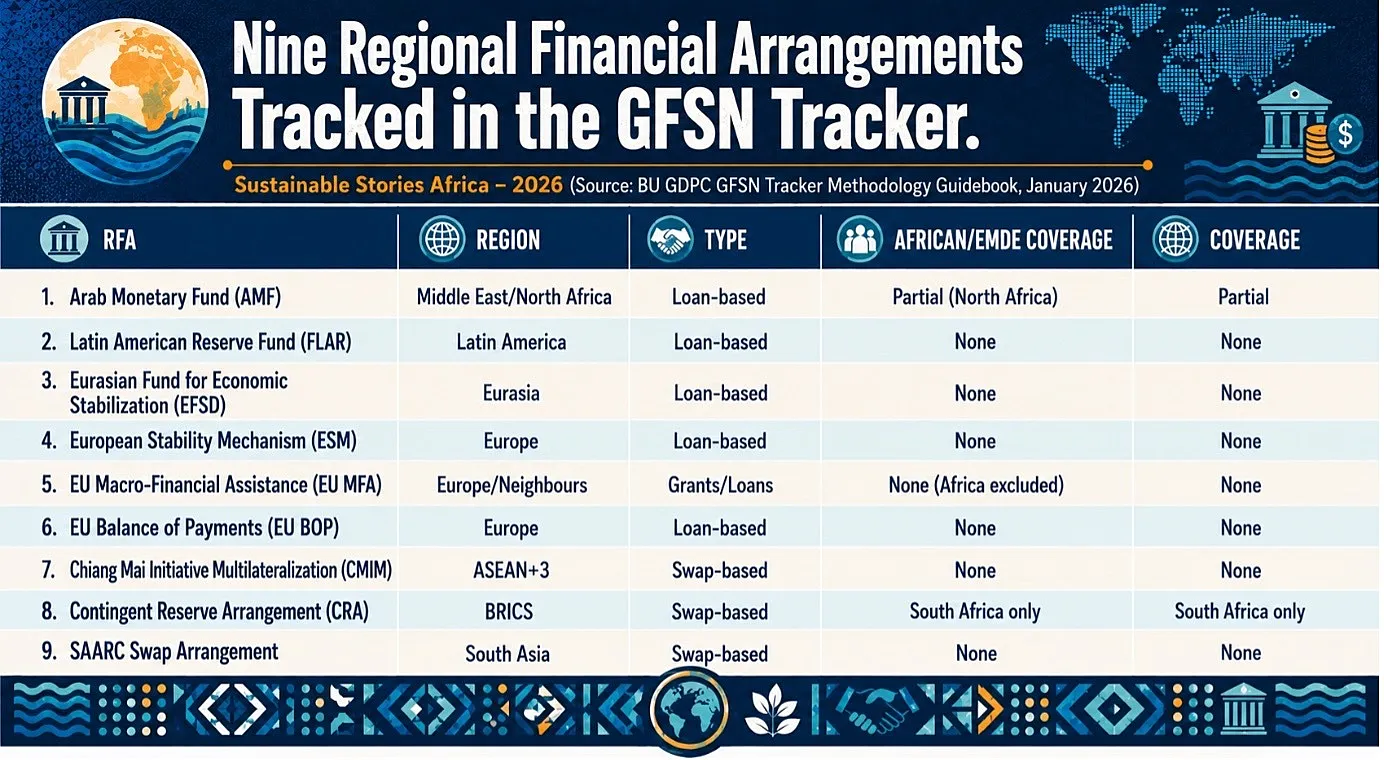
The critical observation from this table is that of the nine RFAs tracked, only the Arab Monetary Fund provides meaningful coverage to African nations (North Africa), and only the CRA includes South Africa among BRICS members.
Sub-Saharan Africa, home to 54 of the 195 countries on earth, has no dedicated, fully capitalised Regional Financial Arrangement of its own.
The IMF Variables and What They Conceal
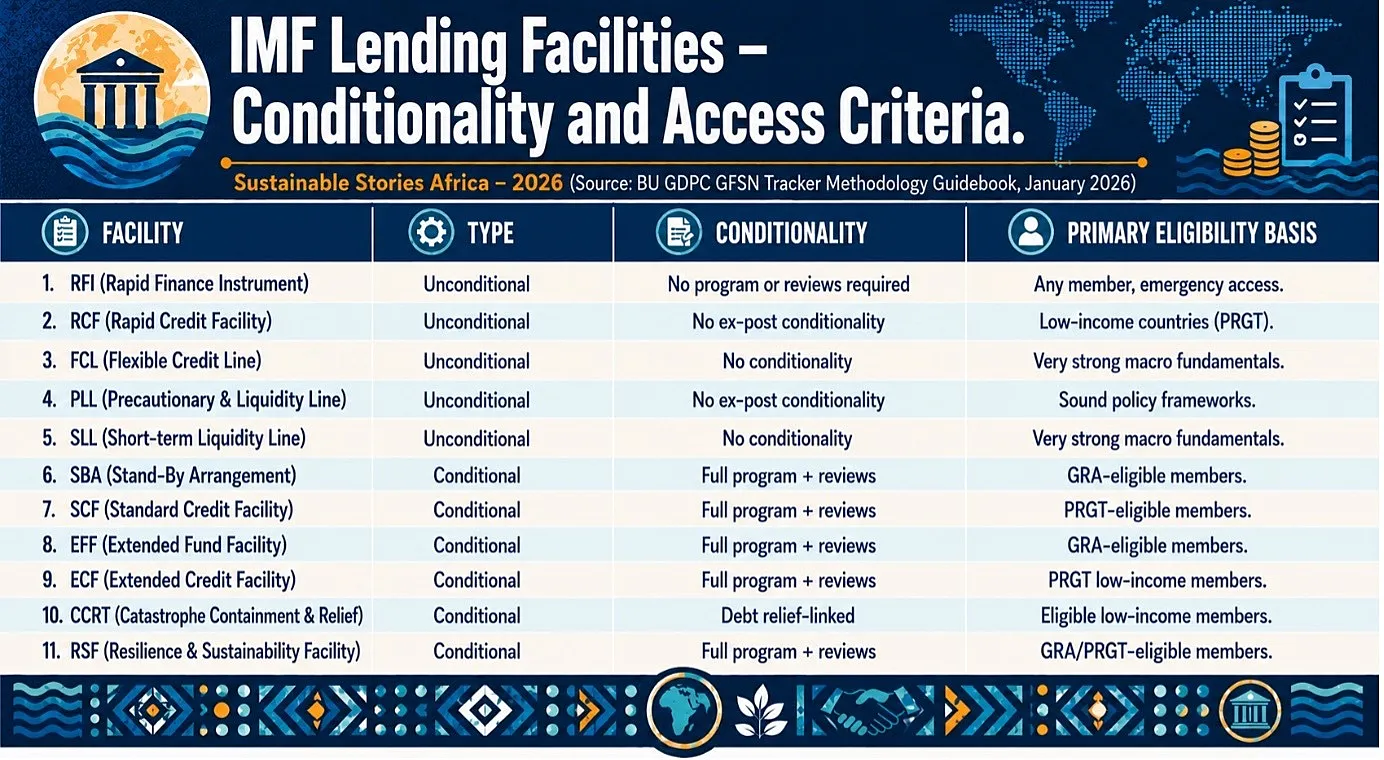
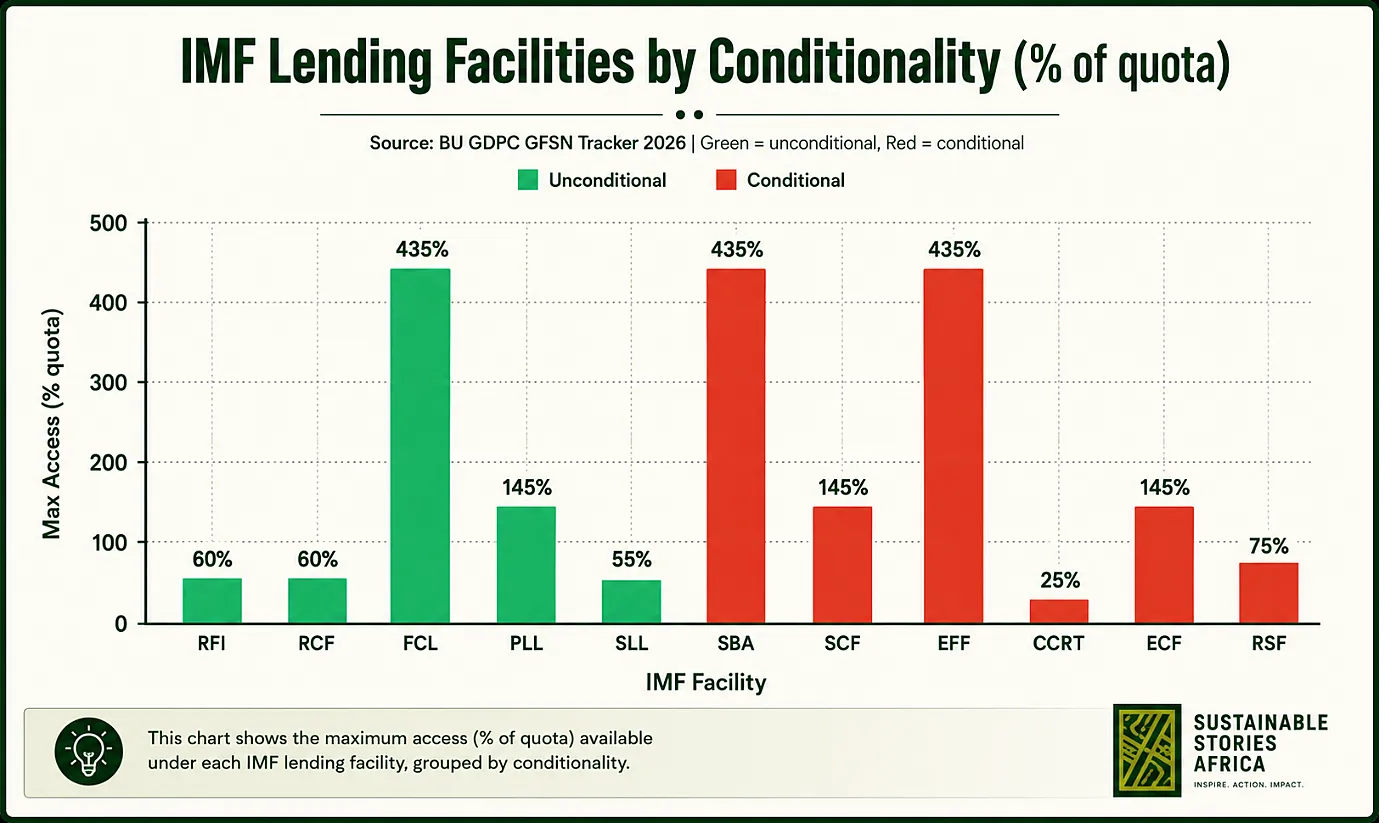
The GFSN Tracker tracks 11 distinct IMF lending facilities, divided into two categories: unconditional and conditional.
The five unconditional facilities;
- The Rapid Finance Instrument (RFI)
- Rapid Credit Facility (RCF)
- Flexible Credit Line (FCL)
- Precautionary and Liquidity Line (PLL)
- Short-term Liquidity Line (SLL)
Can be accessed without full program reviews or ex-post conditionality.
The six conditional facilities, including the
- Stand-By Arrangement (SBA)
- Extended Fund Facility (EFF)
- Extended Credit Facility (ECF)
- Standard Credit Facility (SCF)
- Catastrophe Containment and Relief Trust (CCRT)
- Resilience and Sustainability Facility (RSF)
Require program reviews and extensive policy commitments.
For African nations, this distinction is critical.
The FCL, PLL, and SLL, the most flexible unconditional lines, are only accessible to countries with "very strong ex-ante macroeconomic fundamentals" or "sound policy frameworks".
In practice, this effectively excludes most low-income and fragile African states from the most accessible emergency finance tools, precisely the countries that need unconditioned liquidity most urgently.
 |  |
What Equitable Coverage Would Look Like
If the GFSN were equitably designed, every country, regardless of income group, geographic location, or geopolitical alignment, would have access to at least one RFA, one unconditional IMF lending line, and a bilateral swap arrangement with a major reserve currency central bank.
None of these three conditions holds for the majority of sub-Saharan African nations.
Consider the swap arrangements dimension.
The Tracker counts bilateral swaps between Emerging Market and Developing Economies (EMDEs) and Advanced Economies (AEs) only once, on the EMDE's account, recognising that these are directionally asymmetric, with the benefit flowing to the developing economy.
However, most African central banks hold no bilateral swap lines with the US Federal Reserve, the European Central Bank, or the People's Bank of China.
The result is a continent that must either rely on the IMF (with its conditionality burden) or deplete its own limited reserves to manage balance-of-payments pressures.
The GFSN Tracker Guidebook's data reveal that the PBOC has been one of the most active bilateral swap partners among EMDEs globally, with its agreements observed in the RMB Internationalisation Reports and Monetary Highlights.
For African nations deepening economic ties with China, this represents one of the few available bilateral swap pathways, one that should feature prominently in both financial diplomacy and reform advocacy.
What Africa's Finance Leaders Must Do with This Data
Three immediate actions emerge from the GFSN Tracker's metrics:
Establish Africa's own RFA.
- The AMF covers North Africa partially. A fully capitalised pan-African RFA, potentially housed within the African Union's financial architecture, would provide the continent's most transformative upgrade to access crisis finance.
Negotiate bilateral swap lines.
- African central banks should prioritise bilateral swap-line negotiations with the PBOC and advocate for inclusion in expanded Federal Reserve swap networks, an advocacy agenda that should be elevated in G20 reform discussions.
Reform IMF quota allocations.
- Africa's IMF quota shares are systematically underweight relative to the continent's share of global population and growth contributions.
- Quota reform is the single most powerful lever for expanding African access to unconditional lending facilities.
Metrics as a Map, Not Just a Mirror
The GFSN Tracker's methodology is not merely an academic exercise; it is a navigation tool for the reform agenda. Every variable defined in the Guidebook, from the SDR-USD exchange rate conversion methodology to the treatment of extended swap agreements, reflects a deliberate choice about what gets counted and what visibility is given to underserved countries.
Africa's finance community should engage with this data actively, using it to benchmark current access, identify gaps, and build the evidence base for structural reform.
Path Forward – Count What Counts, Then Change the Count
The GFSN Tracker Guidebook is a transparency milestone.
However, visibility alone is not equity. Africa needs not only to understand its position in the global financial crisis architecture but to actively reshape it through RFA development, swap line advocacy, quota reform, and coordinated engagement in multilateral financial governance forums.