At UNILAG, Sahara Power Group chief Kola Adesina told more than 2,500 students that effort can launch a venture, but only value, financial discipline, systems, character and adaptability can make it endure.
His BUILD framework arrives as small firms dominate African work yet struggle with informality, low productivity, financing and infrastructure.
The question is no longer whether young people can start businesses, but whether those businesses can outlive their founders.
Young Founders Confront the Durability Test
More than 2,500 students gathered at the University of Lagos were given a message that cut against entrepreneurship’s most marketable mythology: hustle may start a business, but it cannot carry one indefinitely.
Kola Adesina, Executive Director of Sahara Group and Group Managing Director of Sahara Power Group, used his keynote at the Student Entrepreneurship Programme to recast resilience as an organisational capability, rather than a founder’s willingness to absorb endless strain.
Strategy must choose the destination; structure must coordinate people; systems must make quality repeatable; and character must preserve trust.
That distinction matters well beyond the JF Ade Ajayi Auditorium. Across Africa, small economic units are where livelihoods are made; however, many operate without the records, cash buffers, controls or formal protections needed to withstand price shocks, power failures, climate stress or the founder’s absence.
The development question is not simply how Africa creates more entrepreneurs. It is how their ventures become productive, responsible institutions.
Hustle Creates Motion, Not Durable Enterprises
"A business that depends completely on the founder's personal energy is not yet an enduring enterprise," Adesina told the audience, describing it as a demanding job owned by its founder.
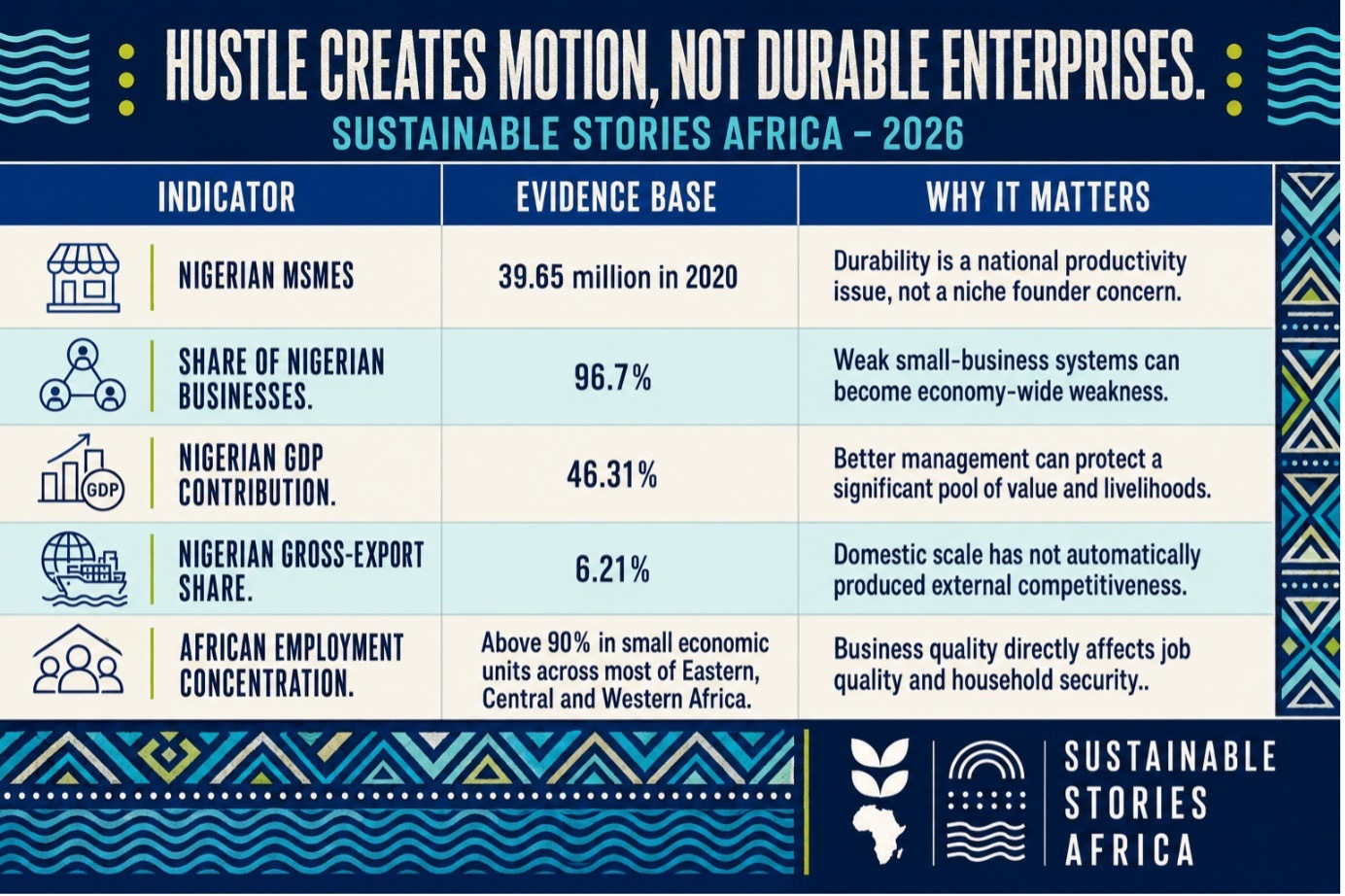
The warning lands in an economy where enterprise is already enormous. Nigeria's 2020 national MSME survey counted 39.65 million micro, small and medium enterprises, representing 96.7% of businesses and 46.31% of GDP; however, only 6.21% of gross exports, still the latest SMEDAN-NBS benchmark, per PwC Nigeria's 2024 MSME Survey.
The wider labour picture matters too. The ILO notes small economic units account for over 90% of employment across most Eastern, Central and Western African countries, meaning fragile firms produce fragile household incomes and supplier networks.
Recent evidence confirms the gap. In PwC's survey of 567 Nigerian MSMEs, over half linked declining demand to higher prices and weaker purchasing power, while more than 60% depended on grid and alternative energy sources.
Adesina's sharpest point: revenue attracts attention; disciplined cash flow sustains value.
BUILD Turns Ambition Into Operating Discipline
Adesina's answer was BUILD:
- Be clear about value
- Understand the numbers
- Institutionalise the work
- Lead with character
- Design for durability.
A framework that converts a motivational idea into five management tests.
- Value comes first. A durable enterprise begins with a painful problem, reachable customer, and credible solution, not a logo or applause.
Founders should interview customers, test before investing heavily, and treat payment, not compliments, as evidence of commitment.
- Numbers come next: price, delivery cost, margin, customer acquisition cost, payment timing and working-capital needs.
A profitable order can still weaken a company if suppliers are paid before customers settle. Records turn confidence into investor-ready information.
Institutionalisation bridges self-employment and enterprise. Documented work, defined roles, reconciled accounts and approval limits clarify who decides and who checks when the founder is unavailable.
Character gives structure legitimacy through fair pay, kept promises and early disclosure of problems, building governance long before any sustainability report.
Durability means preparing for change through diversified suppliers, reserves, learning routines and purposeful use of technology, as AI can sharpen decision-making or scale a broken process.
Systems Convert Small Ventures Into Institutions
The opportunity is a company that can deliver its promise without heroic intervention.
In Adesina’s food-business example, the product is not simply a meal. It is consistent taste, hygiene, speed, packaging, cost control and customer experience across an interconnected chain.
- Once that chain is visible, founders can identify where waste and errors occur, then decide what to standardise, delegate, automate or stop.
- Employees understand the standard; customers receive reliable value; lenders see cleaner information; and founders recover time for strategy.
The gains extend to climate and infrastructure resilience. A 2025 World Bank working paper found that small and medium firms and start-ups in low- and lower-middle-income countries were especially exposed to abnormal heat: a 0.5°C rise above historical averages was associated with a 12% revenue decline.
The operational lesson is clear. Resilience needs contingencies for people, energy, logistics, data and cash, not only determination.
Delay carries a different compounding effect.
A founder-centred business may remain busy yet unfinanceable, vulnerable to a single supplier, customer, password or an exhausted decision-maker.
It may create work without improving job quality, and revenue without building transferable value.
The transition is from the founder being the system to becoming the designer of a system.
Five Decisions Move Founders Beyond Survival
For founders;
- The first decision is to define, in a single sentence, the problem, customer and measurable outcome.
- The second is to build a weekly financial dashboard covering sales, cash collected, variable costs, margins, receivables, payables and runway. What is not visible cannot be managed early.
- The third is to document one critical process at a time, beginning where failure most damages the customer promise.
- The fourth is to assign roles, decision rights and controls, including clear arrangements among co-founders on ownership, performance, disputes and exits.
As Adesina cautioned, friendship is not a governance system.
- The fifth is to run a quarterly durability review: identify dependence on a single customer or supplier; test access to records and systems; examine energy, cyber, climate and regulatory exposure; and agree on what should be diversified, insured, automated or held in reserve.
Institutions must also move.
- Universities can connect student ventures to customer discovery, simulation, mentors and multidisciplinary teams.
- Financiers can pair capital with management support and accept credible digital records.
- Governments should simplify formalisation and taxation while improving infrastructure and contract enforcement.
- Large companies can strengthen suppliers through predictable payments, standards and procurement access.
The objective is to make good businesses legible, financeable, responsible and repeatable.
Founders need energy, but the ecosystem should reward evidence and institution-building, not exhaustion performed as ambition.
Path Forward – Enterprises Built to Outlast Founders
Africa’s founders should pair urgency with BUILD: verified customer value, financial command, repeatable systems, trusted leadership and deliberate adaptation.
These practices strengthen governance, protect people and make resilience operational.
Universities, financiers, regulators and large buyers must reinforce that shift through training, patient capital, simpler rules, reliable infrastructure and fairer supply chains.
The test is whether ventures create dignified work and dependable value after founders stop pushing.