
From January 2026, Nigeria’s tax overhaul exempts dividends distributed by authorised collective investment schemes, provides trustees with clearer computation rules, and preserves conditional relief for real estate investment companies.
For more than 800,000 mutual-fund investors, the change promises greater neutrality.
However, uncertainty over unit disposals, redemptions and withholding treatment means fund managers must translate statutory reform into careful classification, records and investor communication.
New Tax Rules Reshape Pooled Investments
Nigeria has redrawn the tax map for collective investment schemes, replacing a fragmented framework with rules that recognise trustees, unitholders and fund distributions in a single consolidated statute.
The Nigeria Tax Act 2025 and Nigeria Tax Administration Act 2025 took effect on January 1, 2026.
The most investor-facing change is straightforward: dividends distributed by an authorised CIS are exempt from income tax.
Behind that headline sit more technical rules governing scheme profits, tax credits, real estate investment companies, withholding, unit disposals and stamp duties.
An analysis by Udo Udoma & Belo-Osagie lawyers Joseph Eimunjeze, Lisa Esamah, Halima Adeola-Bello and Jemima Dan-Auta argues that the reform improves neutrality between corporate and individual unitholders.
But it also warns that funds must continue to distinguish dividends from interest, rent, foreign income, portfolio gains and redemption proceeds.
In pooled investing, tax outcome still follows legal character.
Tax Clarity Meets a Trillion-Naira Market
At the end of 2024, Nigeria had 184 registered mutual funds with N3.84 trillion in net assets and more than 800,000 unitholders, according to the Securities and Exchange Commission. That was 96% of the N4 trillion CIS target set for 2025.
The broader ecosystem was larger still: 82 active firms oversaw ₦8.53 trillion across mutual funds and private products.
Tax treatment affects household savings, fund pricing, distributions and long-term capital for businesses, housing and infrastructure.
Before 2026, CIS taxation was spread across three principal tax statutes and did not align neatly with every regulated vehicle.
The Investments and Securities Act 2025 recognises unit trusts, open- and closed-ended companies, real estate vehicles and specialised schemes.
The NTA supplies a unified tax architecture; however, favourable treatment depends on SEC authorisation.
What Changes Across Funds and Investors
Section 63 provides the operating logic: trustees are treated as a company, unitholders’ rights as shares and available income as dividends. An authorised CIS deducts management expenses, including managers’ remuneration, when determining taxable profit.
Tax deducted from a payment, other than franked investment income, becomes an advance payment creditable against the scheme’s assessment. This reduces the risk of source deductions being ignored in the final calculation.
Section 163(1)(b) supplies the decisive relief: dividends distributed by an authorised CIS are income-tax exempt. UUBO argues that such distributions should not attract withholding unless legislation or regulations say otherwise. Funds should still monitor Nigeria Revenue Service guidance rather than treat every payment as exempt. (Nigeria Tax Act 2025)
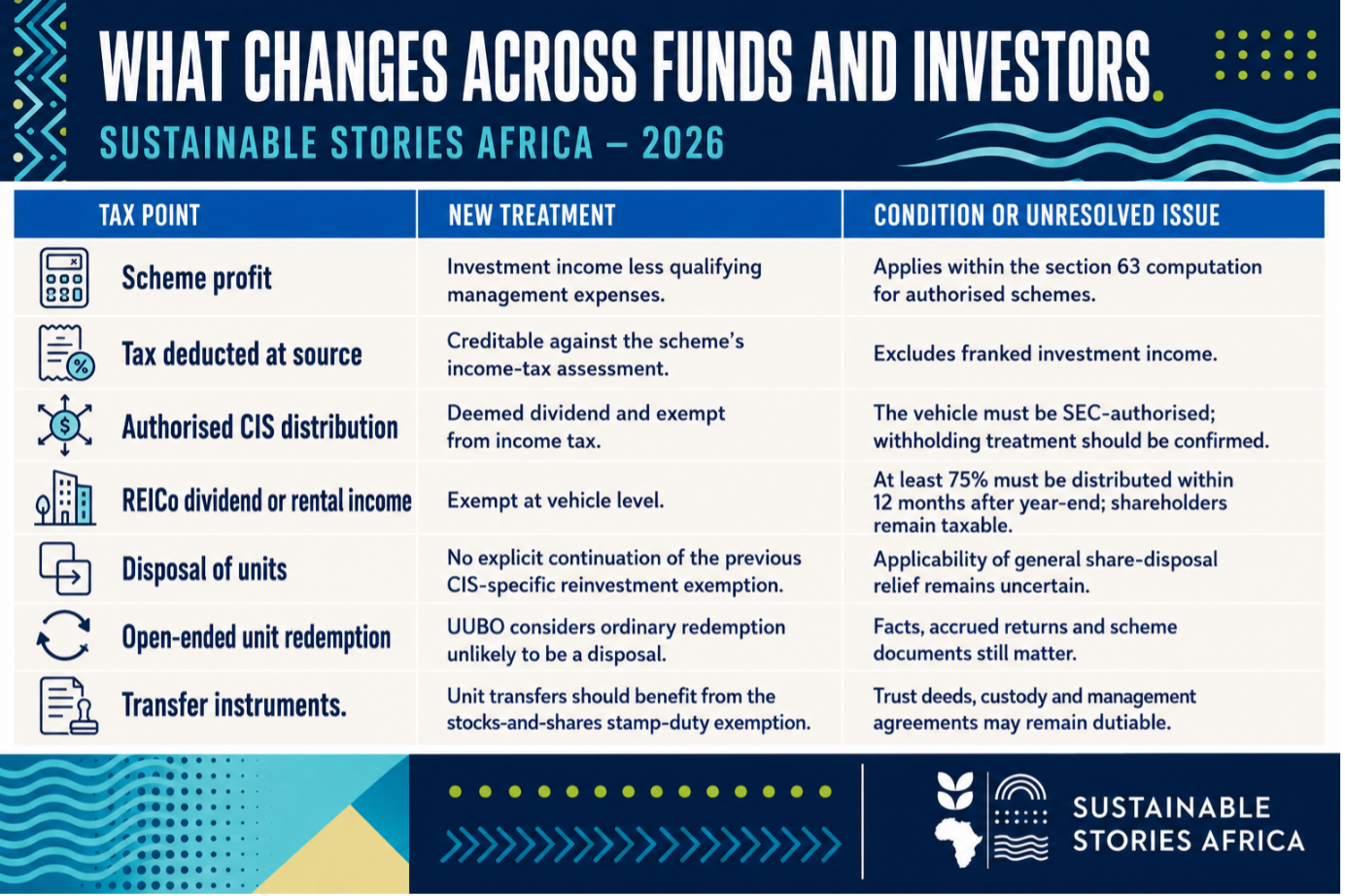
Real estate investment companies receive narrower treatment. Dividend or rent received for shareholders is exempt only if at least 75% is distributed within 12 months after year-end. Shareholder receipts, management fees and the REICo’s own income remain taxable.
The largest grey area concerns exits. The repealed regime exempted certain reinvested unit-disposal proceeds; the NTA does not repeat that relief. General share relief covers aggregate proceeds below ₦150 million with gains not exceeding ₦10 million within 12 consecutive months, or proceeds reinvested in Nigerian shares within the same assessment year. The Act does not clearly extend those rules to CIS units.
There is also a technical numbering issue. The UUBO paper cites sections 162(1)(b) and 184(h). In the gazetted NTA reviewed by Sustainable Stories Africa, the corresponding CIS-dividend and stamp-duty provisions appear in sections 163(1)(b) and 185(h). The substantive rules described are unchanged, but compliance documents should cite the gazetted numbering.
Neutral Taxation Could Deepen Inclusive Capital
The reform’s promise is neutrality:
- Savers should not suffer avoidable disadvantage because capital is pooled through a regulated fund.
- Exempt CIS dividends can improve retail returns and remove the earlier difference between individual and corporate unitholders.
- Clearer computation can improve product design.
- Managers gain a firmer view of expenses and tax credits; trustees gain a stronger oversight basis; investors can see whether returns are dividends, interest, rent or gains.
Well-regulated funds can aggregate modest savings for government securities, corporate finance, real estate and infrastructure while widening access to diversification.
Confidence will suffer, however, if “tax-free return” is marketed too broadly, redemptions are misclassified, or REICos miss the 75% test.
Transparent policies, protected records and accurate statements determine whether citizens can understand returns, compare products and trust the market.
Managers Must Rebuild Compliance Before Distributions
- Managers and trustees should map dividends, interest, rent, foreign income, gains, fees and redemptions.
- Each stream needs a documented tax position, withholding treatment, owner, and evidence trail consistent with investor communications.
- Managers must confirm SEC authorisation, review trust and custody arrangements, and ensure section 63 expenses are supported and attributable to the scheme.
- REICos need a calendar that protects the 75% threshold and 12-month deadline.
Open-ended funds should document redemption pricing and seek advice where payments include gains.
Reliance on share-disposal thresholds or reinvestment relief requires caution until guidance confirms that units qualify.
Regulators also have work to do.
- The Nigeria Revenue Service and SEC should issue coordinated guidance on withholding, disposal and redemption, backed by worked examples for retail, corporate and non-resident investors.
- Standard disclosure language would reduce inconsistent interpretation across funds.
Investors, meanwhile, should ask three questions before acting:
- Is the scheme SEC-authorised?
- What type of return am I receiving?
- What tax or withholding appears on my statement?
The dividend exemption improves the framework, but it does not turn every fund return into tax-free income.
Path Forward – Certainty Must Follow Statutory Reform
Nigeria has created a clearer tax framework to regulate pooled investments, but implementation must now resolve unit disposals, redemptions and withholding.
Fund managers should classify every return, strengthen records and communicate limits without ambiguity.
Joint NRS-SEC guidance can convert reform into investor confidence, deeper participation and more accountable long-term capital.
The objective is not simply tax relief; it is a transparent market in which savings can support productive and sustainable investment without hidden or duplicated burdens.