Residential energy use is no longer a side issue in the clean-air debate. The World Bank’s latest deep dive argues that what households cook with and how they heat their homes now sits at the centre of the global air-pollution challenge.
That matters for Africa and other emerging markets because residential energy is tightly linked to poverty, health, gender inequality and climate resilience.
Cleaner household energy is becoming both a public-health necessity and a development strategy.
Why Household Energy Now Matters
The most important insight in the World Bank’s Residential Energy Use deep dive is simple: cleaner air will be impossible without cleaner homes.
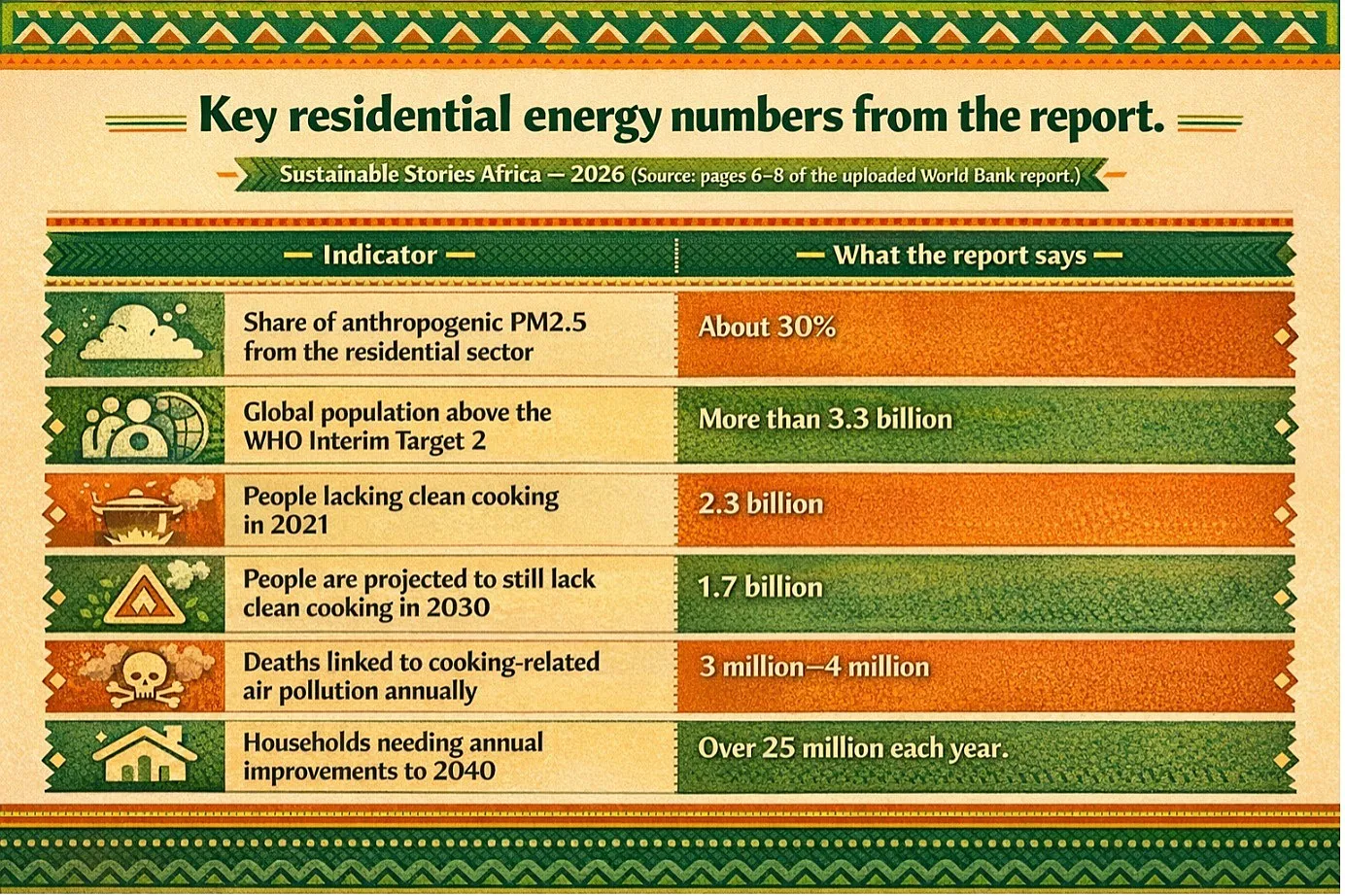
The report says that the residential sector accounts for about 30% of anthropogenic PM2.5 worldwide, making it the single largest anthropogenic contributor to fine particulate exposure in the base year 2020. Cooking and space heating are identified as the primary culprits.
That makes residential energy a bigger systems issue than it often appears in policy debates.
Poor household energy choices are not only a private welfare problem. They shape outdoor air quality, public health, deforestation pressures, women’s time use, energy poverty and climate outcomes.
The report frames this as a dispersed but powerful source of harm: unlike a coal plant, millions of small household combustion points are harder to regulate, monitor and clean up.
For African and other low- and middle-income markets, the implications are especially severe.
Household decisions about wood, charcoal, LPG, electricity, biomass or coal often reflect income constraints, infrastructure gaps and indeed access to finance.
That means residential energy transition is not only about technology. It is about affordability, distribution, behaviour and institutional design.
The Air Pollution Starts At Home
One finding stands out: more than 3.3 billion people are exposed each year to PM2.5 levels above the WHO Interim Target 2 threshold of 25, with serious risks to health and survival
Residential energy use is a major driver. Household cooking alone accounts for about 12% ambient PM2.5 exposure globally, showing how everyday energy choices have become a major public health issue.
The clean-cooking gap remains vast. In 2021, 2.3 billion people were still relying on polluting fuels and inefficient stoves, and under current trajectories, 1.7 billion could still lack access to clean cooking by 2030.
The report estimates that ambient and household air pollution linked to cooking with solid fuels causes between 3 million and 4 million deaths each year, exceeding the combined toll of malaria and tuberculosis.
In Africa, the burden is particularly severe. Sub-Saharan Africa recorded the world’s highest share of solid-fuel users for cooking in 2020 at 81%, while the number of people without access to clean cooking rose from 750 million in 2008 to 890 million in 2018.
The report also notes that household air pollution in Africa exceeds the combined contribution of industry, power generation and transport to ambient PM2.5 by at least twofold.
Crucially, the report frames air pollution as a story of inequality. Of the 7.3 billion people exposed to unsafe annual PM2.5 levels, 80%live in low- and middle-income countries.
LPG and natural gas remain important transition fuels, while electricity is the long-term goal with a reliable and affordable supply.
Heating adds another layer to the story. In Europe and Central Asia, space heating accounts for 24% of energy demand, with households using 72% of it.
Fossil fuels supply 83% of building heating, driving major emissions, including 1,499 kilotons of PM2.5 and 678 MtCO2.
The contrast is stark: firewood and coal systems emit far more than natural gas boilers. Cleaner heating transitions could cut regional PM2.5 emissions by over 90% and save $5.9 billion annually.
Cleaner Homes Could Unlock Bigger Gains
The upside is much bigger than cleaner kitchens or warmer homes.
The report argues that improving residential energy use can help reduce respiratory and cardiovascular disease, lower mortality, cut healthcare costs, reduce deforestation pressures, improve gender outcomes and strengthen poverty reduction outcomes.
In dense low-income areas, household energy reform is becoming one of the fastest ways to improve ambient air quality and household health.
For African countries, this creates a more strategic opportunity. Residential energy reform can be bundled into specific agendas to enable access to power, urban planning, public health, women’s economic participation, resilience and climate finance.
The report also notes that integrated projects across South Asia’s Indo-Gangetic Plain already point toward multi-country clean-air planning supported by substantial financing pipelines.
That broader lesson travels well: household energy should be treated as cross-sector infrastructure, rather than an issue related to a consumer product.
Finance And Scale Must Change
The report is blunt that current delivery models are too small. To help halve the number of people exposed to PM2.5 levels above 25 μg/m³ by 2040, more than 25 million households need to improve residential energy use every year between now and 2040.
However, the report notes that current World Bank clean-cooking operations reach only about 1.6 million households annually.
That gap points to the real bottleneck: scale finance. The paper argues for a new financing architecture built around blended public, private and consumer finance, because households, not governments, are often the final decision-makers.
It highlights traditional instruments such as investment project financing, results-based financing, and carbon finance, but also points to newer tools including outcomes-based bonds, risk-sharing facilities, revolving funds, ESCO partnerships and on-bill financing.
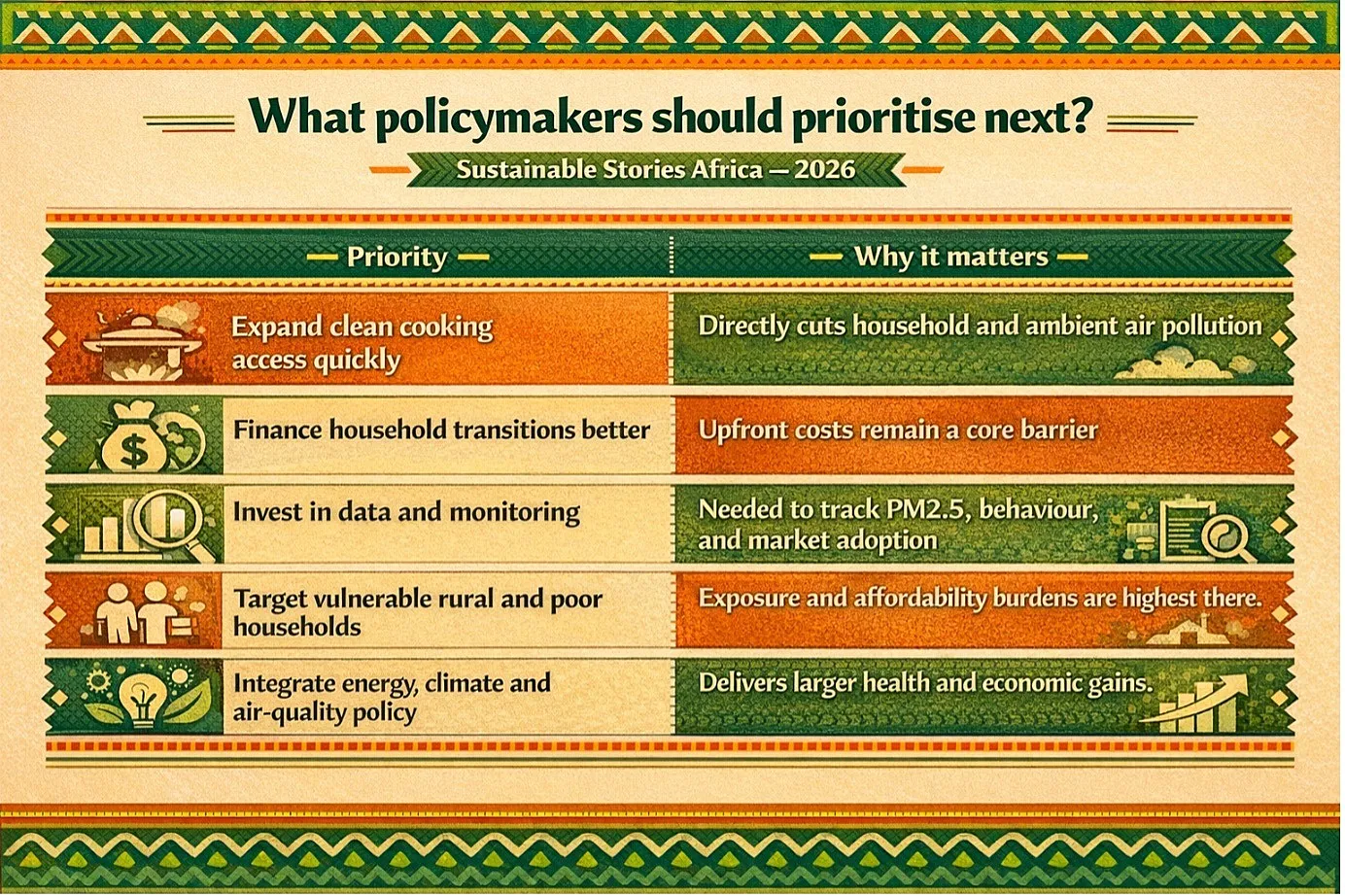
The report’s clearest message is that residential energy reform demands integrated planning and cross-sector delivery; without coordination, stronger data and finance, clean-air goals will remain theoretical, not operational for households.
Path Forward – Clean Air Needs Cleaner Homes
The report’s case is compelling: air-quality strategies that ignore household energy will fail. Residential cooking and heating now sit too close to the centre of the health, poverty and pollution challenge to be treated as secondary.
The path forward is scale with realism: cleaner fuels where possible, better stoves where necessary, stronger data, smarter finance and integrated delivery that meets households where they are. That is how clean air becomes a lived outcome, not just a policy target.