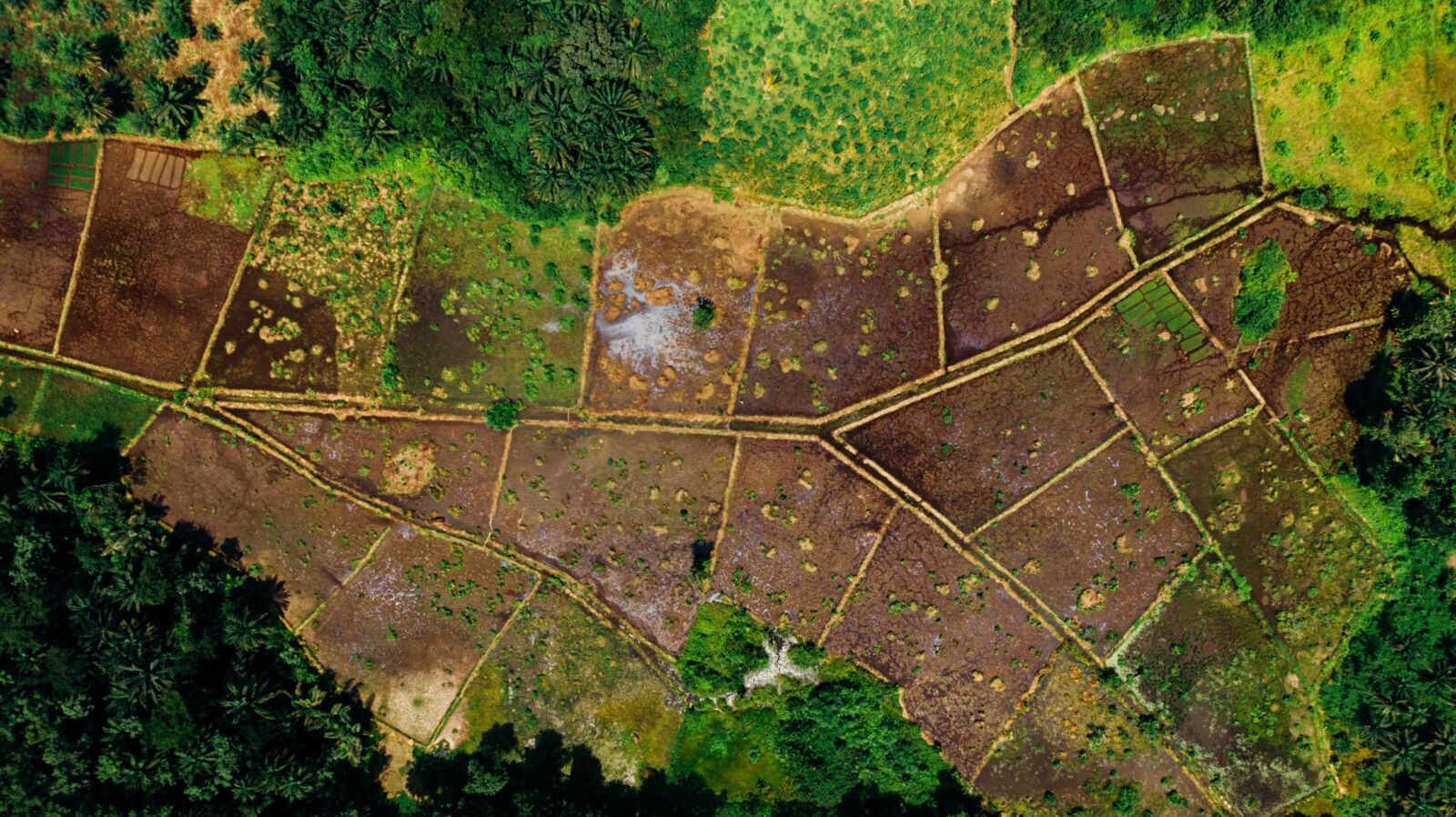
As flood losses rise, forests are returning to the centre of a hard policy question: can land cover meaningfully reduce extreme flood risk?
A review says yes and argues that the science used to dismiss forests’ role in large floods has been methodologically weak.
That matters for climate adaptation, land-use policy and public spending.
Why forests belong in flood policy
Flood management is often framed around drainage systems, levees, dams and climate adaptation budgets.
However, the review Why forests can mitigate floods of all sizes: Evaluating the scientific basis for forest-based flood mitigation argues that land cover should sit far closer to the centre of that conversation.
Its case is not sentimental. It is methodological. The authors argue that the dominant scientific tradition used to question forests’ influence on large floods relies on an ill-posed question, a self-fulfilling hypothesis and a non-causal experimental design.
That matters beyond hydrology. If the science understates the role of forests, governments may over-attribute flood damage to climate alone and underinvest in land-use measures that can reduce risk closer to the source.
The paper explicitly warns that overemphasising climate as the sole cause can divert attention from local and national land-use actions that might have delivered practical remedial gains.
For African and emerging markets, that is a familiar tension. Flood exposure is rising, public budgets are strained, and adaptation choices have to work across ecosystems, infrastructure and livelihoods.
In that context, forests are not just a conservation issue. They are increasingly a resilience asset.
A scientific argument turns policy-relevant
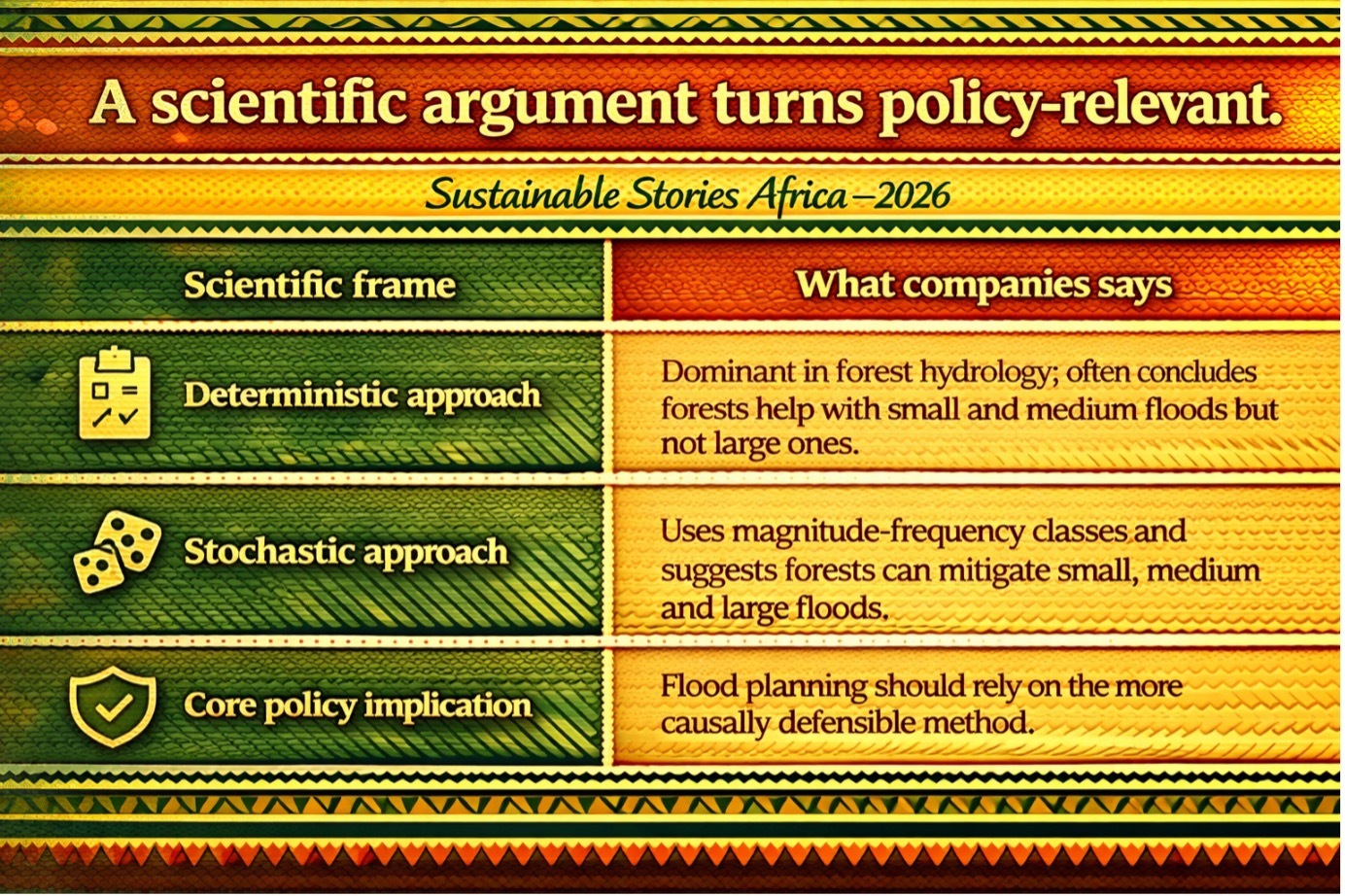
The paper’s conclusion is that a “defensible stochastic approach” should replace flawed alternatives, reopening the case that forests can help mitigate large floods.
That challenges skepticism in forest hydrology and policy that has treated forest-based flood mitigation as marginal.
The review argues that the dominant deterministic method asks the wrong question by isolating a single flood event in a system shaped by many interacting variables.
A stochastic approach instead examines classes of floods by magnitude and frequency, making causal inference stronger and prediction more realistic.
That distinction matters for policy. If forests affect only small floods, they stay peripheral.
If they influence larger floods too, watershed protection, reforestation and catchment management move much closer to mainstream adaptation strategy in practice.
What the evidence is actually saying
The review does not claim forests simply stop floods. It makes a narrower point: forest cover can alter flood magnitude and frequency by changing storage capacity, evapotranspiration, infiltration and runoff attenuation across catchments.
This is Because magnitude and frequency are inseparable in flood analysis, even small shifts in peak flows can produce much larger changes in how often damaging floods occur.
That matters because, the paper argues, deterministic methods often miss these frequency effects, while stochastic studies are better able to capture them.
The review cites cases where deforestation was causally linked to sharp rises in flood frequency, including an 18-fold increase in one study.
It also points to evidence that maintaining or restoring forest cover can reduce economic losses and populations exposed to risk, even for 500-year events.
The visual logic strengthens that case. The chart on page 9 shows how reduced forest cover can shift flood probability distributions upward, increasing the likelihood of large and record floods.
The accompanying figure similarly shows both magnitude and frequency worsening under less forested conditions, reinforcing the authors’ wider point that flood risk is about changing distributions rather than isolated storm anecdotes.
The review also highlights fragile landscapes. In British Columbia, a cited study links harvesting to a tenfold increase in the 100-year flood, underscoring how land-use decisions there can materially worsen downstream risk.
What stronger forest management could unlock
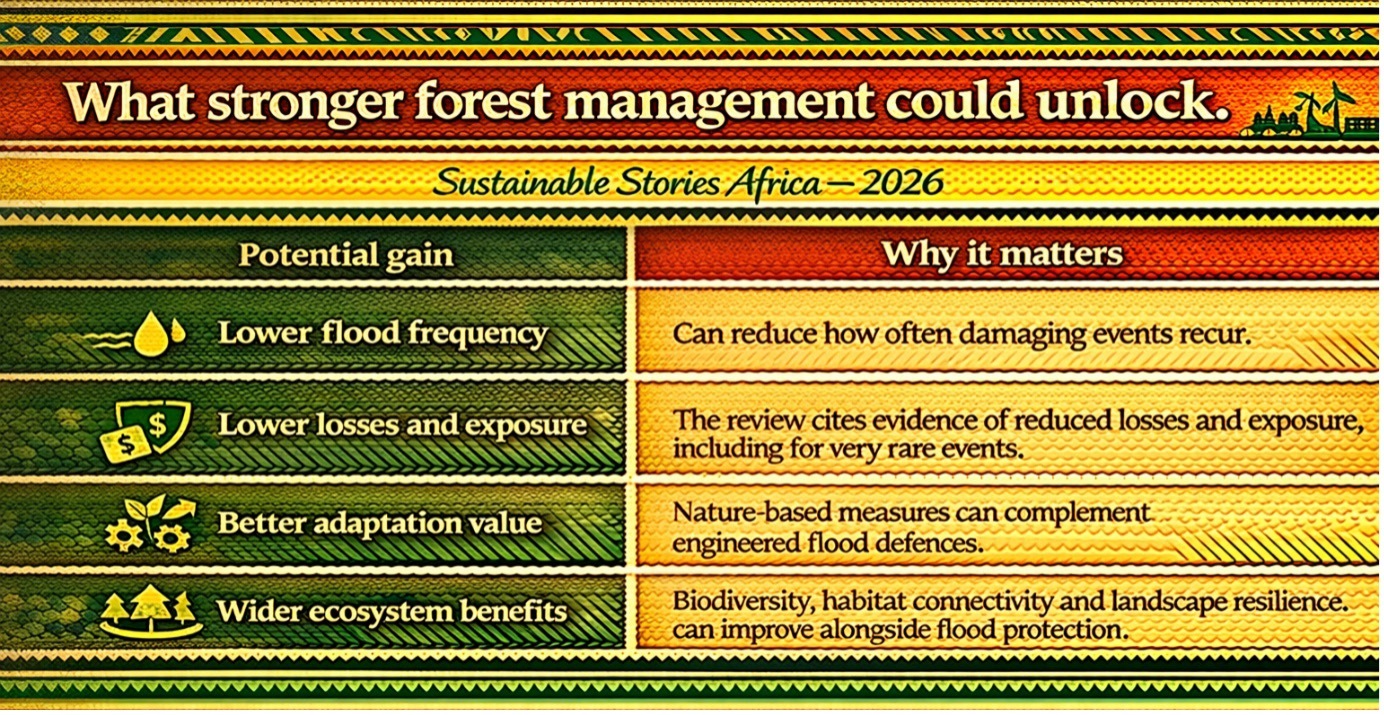
If the paper’s framing is taken seriously, forests become more than a climate co-benefit. They become part of the risk-reduction toolkit in their own right.
That opens a more attractive policy path for countries trying to manage floods without relying only on expensive downstream engineering.
The benefits are layered. Forest-based and broader nature-based solutions can increase catchment storage, reduce peak discharge, support biodiversity, strengthen habitat connectivity and deliver longer-term social and ecosystem gains alongside flood protection.
The review argues that maintaining or increasing forest cover can reduce risk at the source, especially in sensitive landscapes and in regions facing rising climate-driven flood pressure.
For African markets, that is important. Many flood-prone areas are also places where deforestation, urban expansion, wetland loss and poorly managed land conversion are already reshaping hydrology.
A stronger forest-based flood case could support more integrated resilience planning that links upstream land management with downstream urban safety, agriculture and infrastructure protection.
What policymakers should change now
The paper’s call is ultimately for better science, better planning and updated policy guidance.
It says governments and technical agencies should move away from non-causal conclusions and revise guidance that still reflects older deterministic assumptions.
More stochastic studies are needed across different hydroclimatic regimes, vegetation types and harvesting practices, especially in a changing climate.
That has practical implications:
- Flood-risk assessments should treat land-use change as a live driver, not a secondary footnote.
- Basin selection and long-term flood studies should stop assuming stationarity where forest cover is changing.
- Management should prioritise landscape-scale planning that integrates nature-based and traditional solutions, with reforestation and afforestation designed around native species, biodiversity and hydrological function rather than simple tree counts.
For businesses, insurers and developers, the message is also relevant.
- Catchment degradation is not just an ecological problem upstream.
- It can become a balance-sheet problem downstream through infrastructure damage, disrupted logistics, insurance losses and regulatory conflict.
Path Forward – Put land cover into flood math
The paper’s broader message is that forests should no longer be treated as a soft extra in flood policy.
When studied with causal, probabilistic methods, they appear capable of reducing flood risk across event sizes, not only at the margins.
The next step is practical: update guidance, fund stronger stochastic analysis, and embed forest and land-cover management into mainstream adaptation planning.