
ESG reporting is becoming less about glossy claims and more about whether companies can prove what they say.
The core question is no longer whether firms should disclose, but whether their data systems are fit for that task.
For African markets, that matters now because disclosure rules, investor scrutiny and climate risk are rising together.
Weak data can undermine trust, while better data can sharpen strategy, compliance and corporate integrity.
Why ESG Data Now Matters
The next phase of ESG reporting is not being defined by ambition alone. It is being defined by evidence.
As sustainability disclosures move closer to mainstream corporate reporting, companies are under growing pressure to show that what they publish on emissions, labour, governance and climate risk is complete, traceable and decision-useful.
The real issue is data quality.
That challenge is especially clear in Africa and other emerging markets, where firms are often navigating global reporting expectations alongside local operational constraints. Strong storytelling is no substitute for underlying records.
If the data is weak, the disclosure is fragile.
The practical question, then, is simple but consequential: what data do companies actually need to report ESG well?
The answer, as the source material makes clear, spans environmental, social and governance information, from carbon footprints and water use to workforce metrics, ethics controls and board oversight.
The Reporting Burden Is Changing
ESG reporting is no longer just a communications exercise; it is becoming a management discipline. Companies are expected to track emissions, energy use, water, waste, biodiversity, and climate risk, making the environmental pillar a significant reporting requirement.
The social and governance layers deepen that complexity. Businesses must monitor workforce inclusion, well-being, labour practices, community impact, customer responsibility, board composition, executive pay, anti-corruption controls and risk systems.
The wider message is clear: ESG data is not a single spreadsheet but an operating system.
It cuts across the business, as regulators, investors, lenders and supply-chain partners demand more rigorous, decision-useful disclosure.
What Companies Actually Need
The brief makes one point unmistakable:
ESG reporting is only as credible as the data systems behind it. Companies do not just need metrics; they need disciplined processes for collecting, validating and updating them.
That is especially true for environmental disclosures, where Scope 1 and 2 data may already be demanding; however, Scope 3 often relies on supplier and value-chain information that many firms still struggle to capture consistently.
Energy, water and waste reporting must also show quality, efficiency and control, not simply volume.
The challenge deepens across the social and governance pillars. Diversity, well-being, labour practices, supply chain ethics, product responsibility and data privacy require regular tracking and stronger internal controls.
Governance indicators such as board independence, executive pay alignment, anti-corruption systems and whistleblower protections reveal whether ESG is being governed or merely narrated.
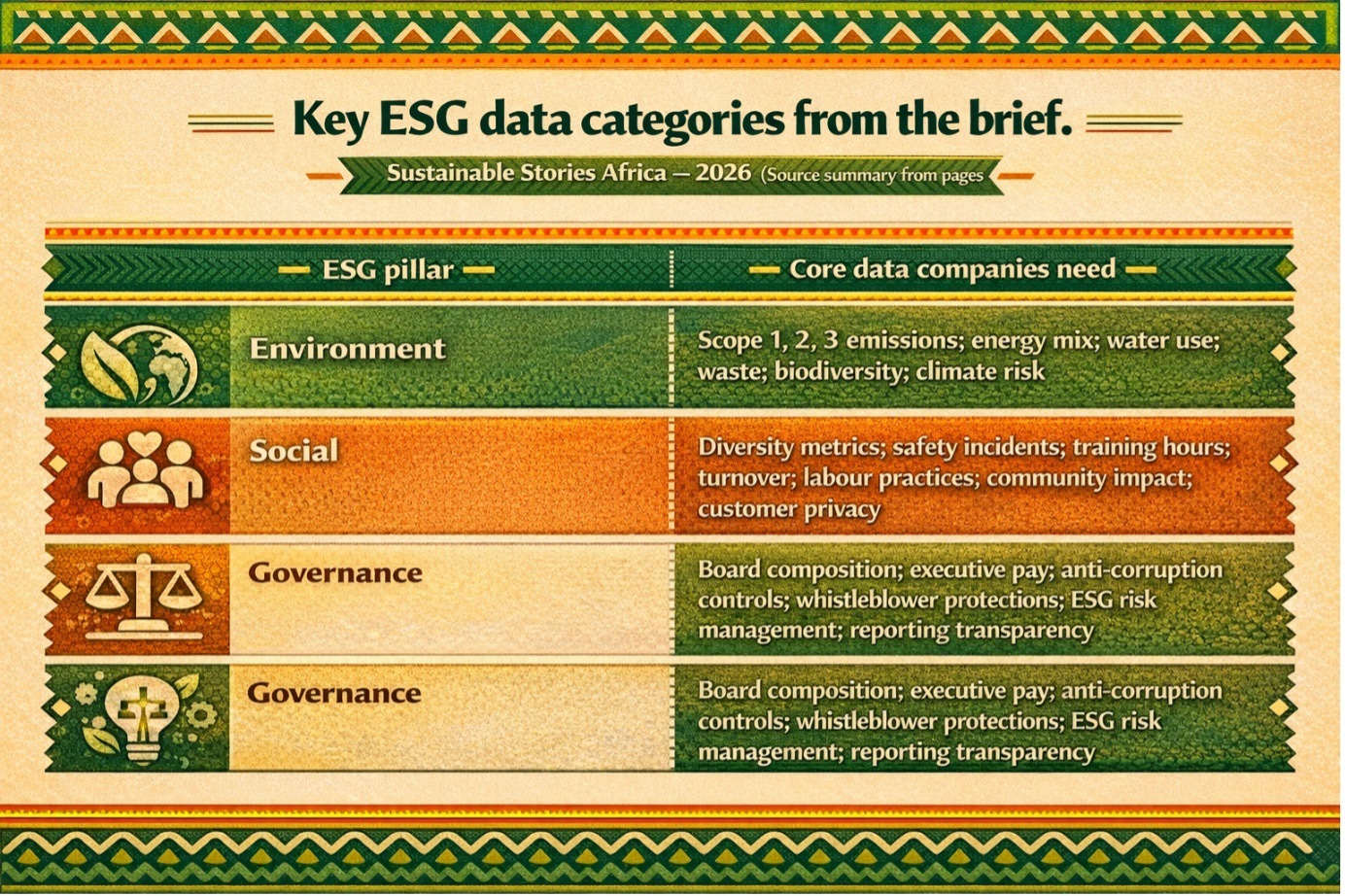
Source summary from pages 2–4 of the uploaded brief.
For African companies, that matters because disclosure expectations are increasingly converging with real operating risks across manufacturing, finance and consumer-facing sectors as regulatory pressure continues to rise.
What Better Data Can Unlock
The opportunity is larger than compliance. Better ESG data can improve how a company runs.
- When emissions, water, energy and waste are properly measured, management can identify inefficiencies and reduce costs.
- When workforce turnover, training hours and safety incidents are tracked well, firms can spot productivity and retention risks earlier.
- When governance data is strong, boards are better placed to challenge management and strengthen long-term resilience.
This is where the source’s closing message is especially useful. It argues that ESG reporting is not just about numbers; it is a commitment to “People, Planet, Prosperity.”
That framing matters because it shifts the conversation away from disclosure as paperwork and to reporting as a way to connect corporate behaviour with wider social and economic outcomes.
For African markets, the upside is practical. Better data can help firms access capital on stronger terms, respond more confidently to investor due diligence, improve supply chain positioning and reduce the risk of greenwashing claims.
It helps regulators and exchanges build trust in local markets by making sustainability reporting more consistent and comparable.
Companies that invest early in data discipline are likely to be better prepared as disclosure expectations harden.
Build Systems Before Making Claims
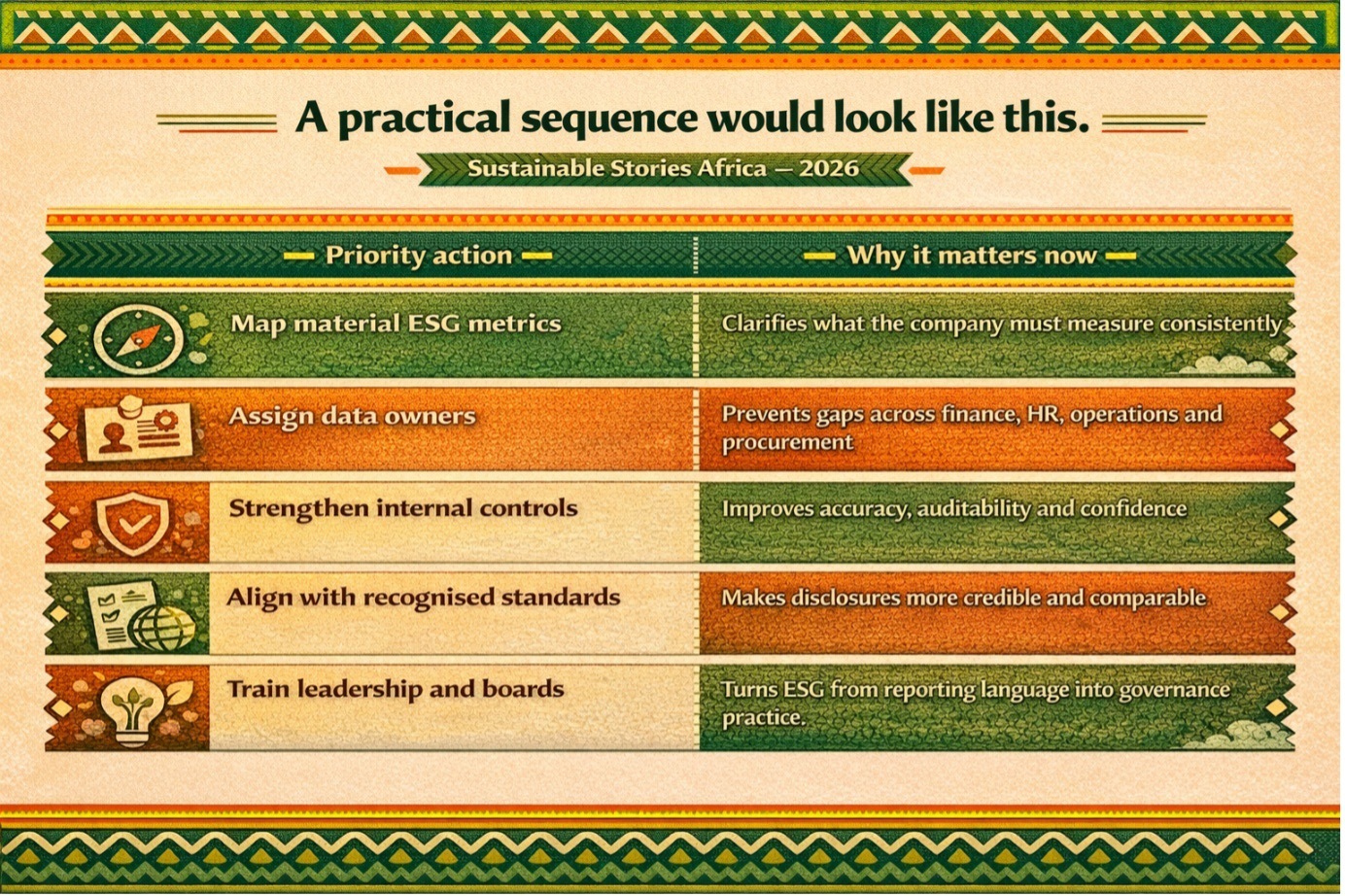
The central lesson is straightforward: companies should not begin with the report; they should begin with the records. That means mapping which ESG data points matter most, assigning ownership across departments, setting definitions, building internal controls and ensuring board-level oversight. Reporting teams cannot do this alone.
- Regulators and market institutions also have a role. They need to provide clearer guidance, phased expectations and stronger incentives for data quality rather than box-ticking.
- Investors and lenders should reward disclosure quality, not just disclosure volume.
- Companies should resist the temptation to publish impressive sustainability language unsupported by defensible evidence.
Path Forward – Integrity Depends On What Counts
African markets do not need more ESG rhetoric detached from operations. They need companies that can measure carbon, labour, governance and climate risks with enough consistency to support credible decisions and disclosures.
The priority now is execution: better systems, clearer ownership, stronger controls and disclosures grounded in proof.
That is how ESG reporting moves from performance to practice, and from narrative to trust.