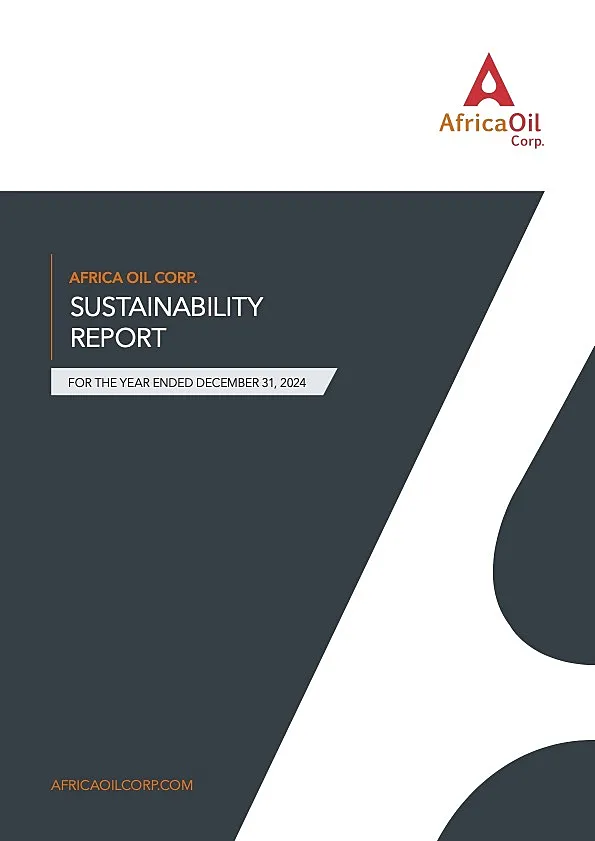
Africa Oil’s 2024 Sustainability Report: Emissions Down 8%, Flaring Cut 64%, ESG Oversight
Africa Oil Corp.’s Sustainability Report for the year ended December 31, 2024, outlines the company’s environmental, social, and governance (ESG) management approach across its deepwater assets in Nigeria and other exploration portfolios in West and Southern Africa.
As a non-operator, Africa Oil emphasises governance influence, investment diligence, and operator engagement as the primary levers for ESG performance.
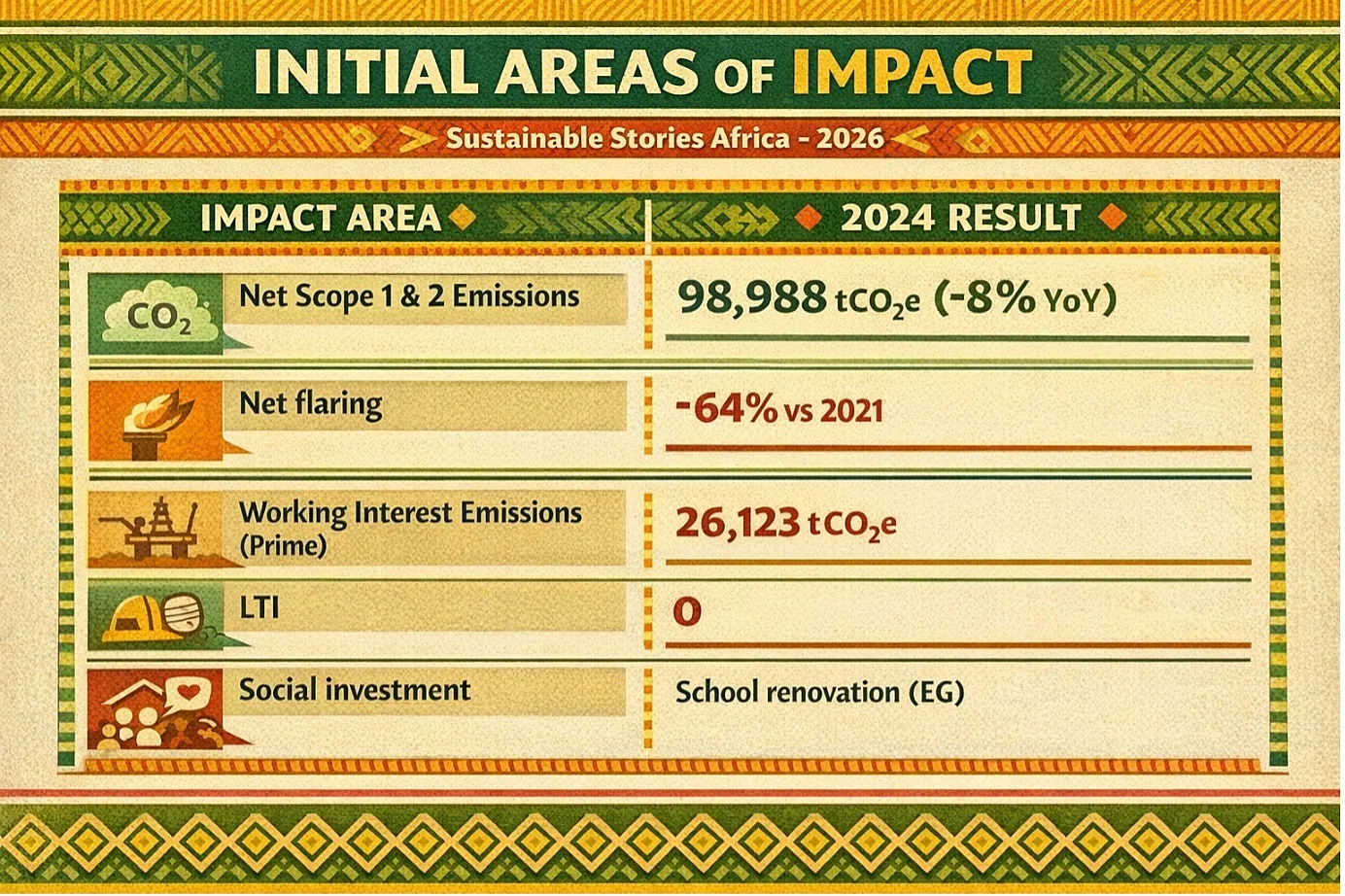
In 2024, the Company reduced net Scope 1 and 2 emissions by 8% year-on-year to 98,988 tCO₂e. Net flaring declined 64% compared to its 2021 levels.
The Company reported zero fatalities and zero lost-time injuries (LTIs) during the year, extending long-term LTI-free records at key assets (15 years at Akpo and 11 years at Agbami).
Africa Oil maintains a target to reduce working interest GHG emissions by 25% by 2025 from a 2020 baseline, with management indicating that it remains on track to achieve this objective. Net emissions attributable to Africa Oil’s working interest in Prime were 26,123 tCO₂e in 2024.
The Company applies a double materiality assessment aligned with the CSRD/ESRS principles, activating ESRS standards E1 (Climate), E2 (Pollution), S2 (Workers in the value chain), and G1 (Business Conduct). It reports in line with SASB Oil & Gas E&P and aligns climate disclosures with TCFD recommendations.
Investment governance integrates ESG screening, carbon pricing stress tests at $40/t and $100/t CO₂, and supplier due diligence via Ethixbase360. The Company received a Silver Medal from EcoVadis (top 10%).
Overall, the 2024 report demonstrates structured governance oversight, progress in measurable emissions, and enhanced due diligence systems; however, opportunities remain to expand Scope 3 transparency and scenario quantification for long-term transition.
SDG ALIGNMENT
Africa Oil explicitly links its ESG pillars to selected SDGs.
SDG Mapping by ESG Pillar
ESG Pillar | SDG | Evidence |
|---|---|---|
Trusted Partner | SDG 16 (Peace, Justice & Strong Institutions) | Anti-corruption, governance commitments |
Responsible Steward | SDG 12 (Responsible Consumption & Production) | Sustainability reporting & emissions integration |
Strong Communities | SDG 3, 4, 7 | School renovation in Equatorial Guinea: clean energy access |
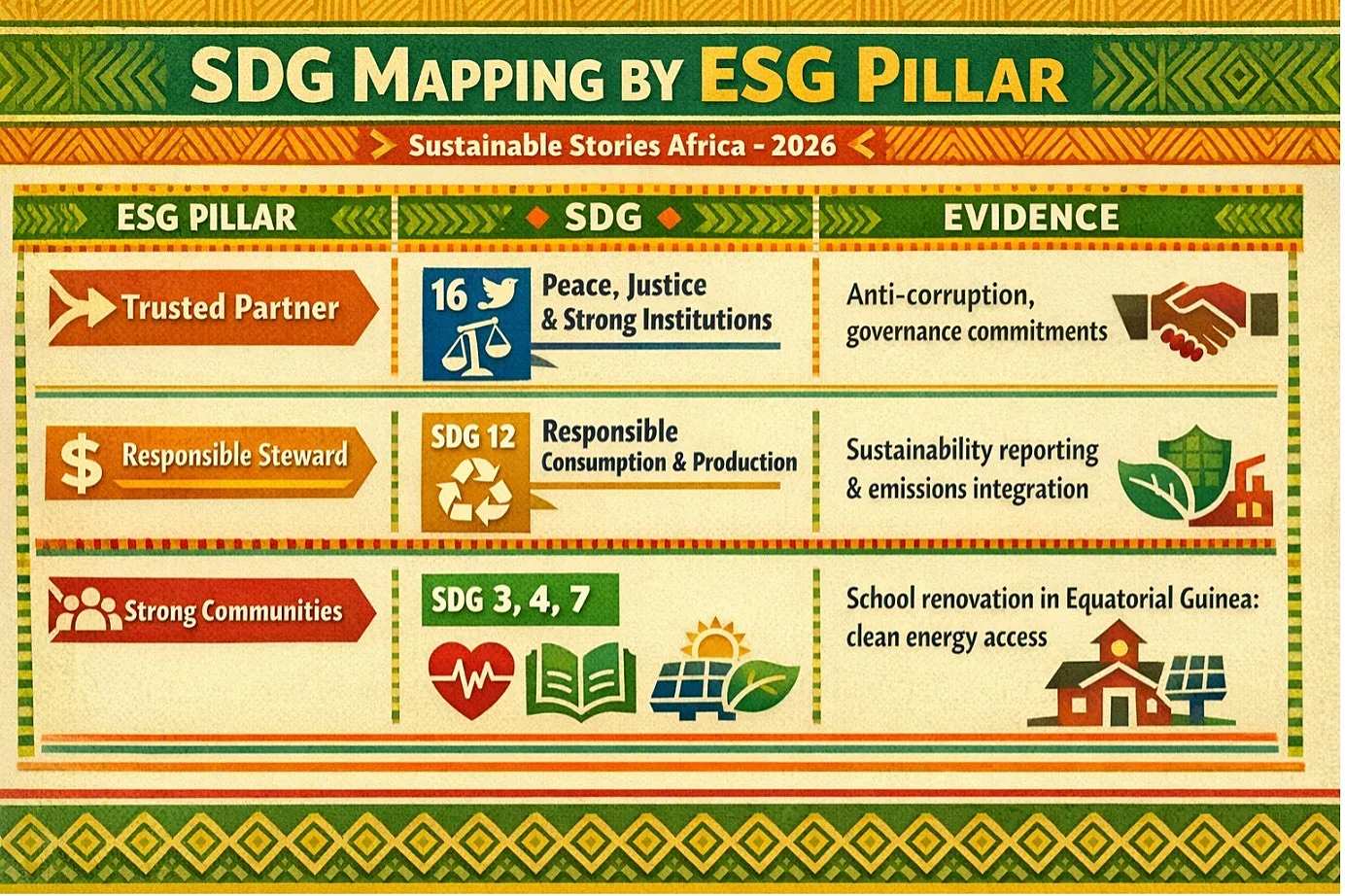
Geographic focus: Nigeria (deepwater), Namibia, South Africa, Equatorial Guinea.
ESG MANAGEMENT
Reporting Frameworks
- SASB Oil & Gas: Exploration & Production
- TCFD-aligned climate disclosures
- UN Global Compact signatory (since 2021)
- EITI supporting company
Governance Structure
- Board-level Sustainability Committee (meets quarterly)
- Environmental & Emissions Policy; Health & Safety Policy; Community Relations & Human Rights Policy
- ESG integrated into risk register and executive oversight
No reported breaches of the Code of Conduct or Anti-Corruption Policy in 2024.
INITIAL AREAS OF IMPACT
Impact Area | 2024 Result |
|---|---|
Net Scope 1 & 2 Emissions | 98,988 tCO₂e (-8% YoY) |
Net flaring | -64% vs 2021 |
Working Interest Emissions (Prime) | 26,123 tCO₂e |
LTI | 0 |
Social investment | School renovation (EG) |
METRICS FOR DEFINITION
Climate & Safety KPIs
KPI | 2024 | Target |
|---|---|---|
GHG Reduction (vs 2020) | On track | -25% by 2025 |
GHG Intensity (net to AOC) | 16 kgCO₂e/boe | – |
Net flaring reduction | -64% vs 2021 | Ongoing |
LTIs | 0 | Zero-harm objective |
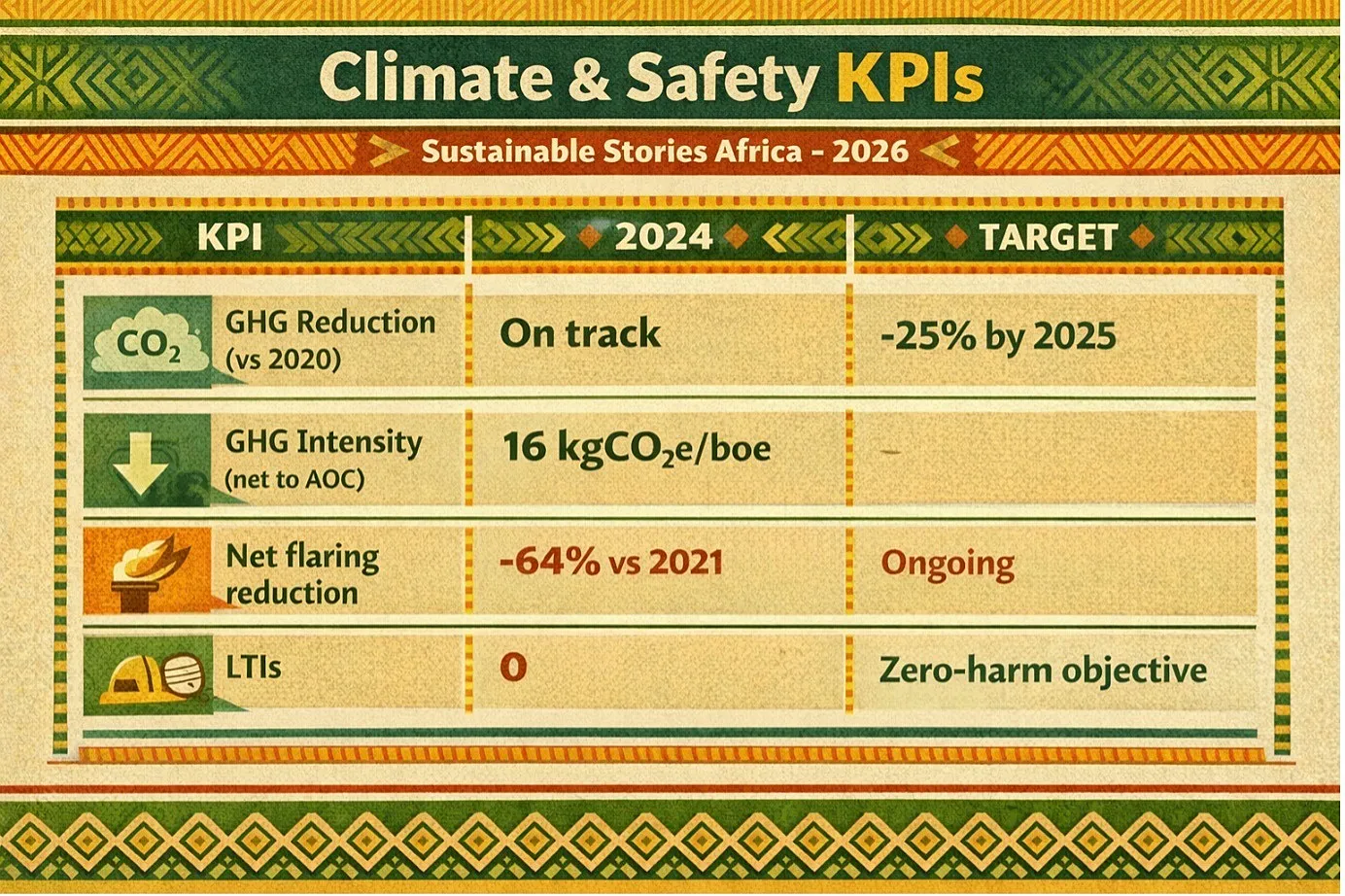
Scenario analysis includes carbon price sensitivity at $40/t and $100/t CO₂.
AREAS OF FOCUS
Strategic focus areas include:
- Deliver 25% working interest emissions reduction by 2025
- Implement consolidated HSEC Expectations document (2025)
- Expand ESG supplier screening via Ethixbase360
- Annual review of the double materiality register
MATERIALITY CONCEPTS
The double materiality assessment conducted in 2024 aligned with CSRD principles.
Activated ESRS Standards
ESRS | Status | Rationale |
|---|---|---|
E1 Climate | Activated | GHG emissions & climate risk material |
E2 Pollution | Activated | Spill risk & remediation cost |
S2 Value Chain Workers | Activated | OHS of operator contractors |
G1 Business Conduct | Activated | Governance & ethics oversight |
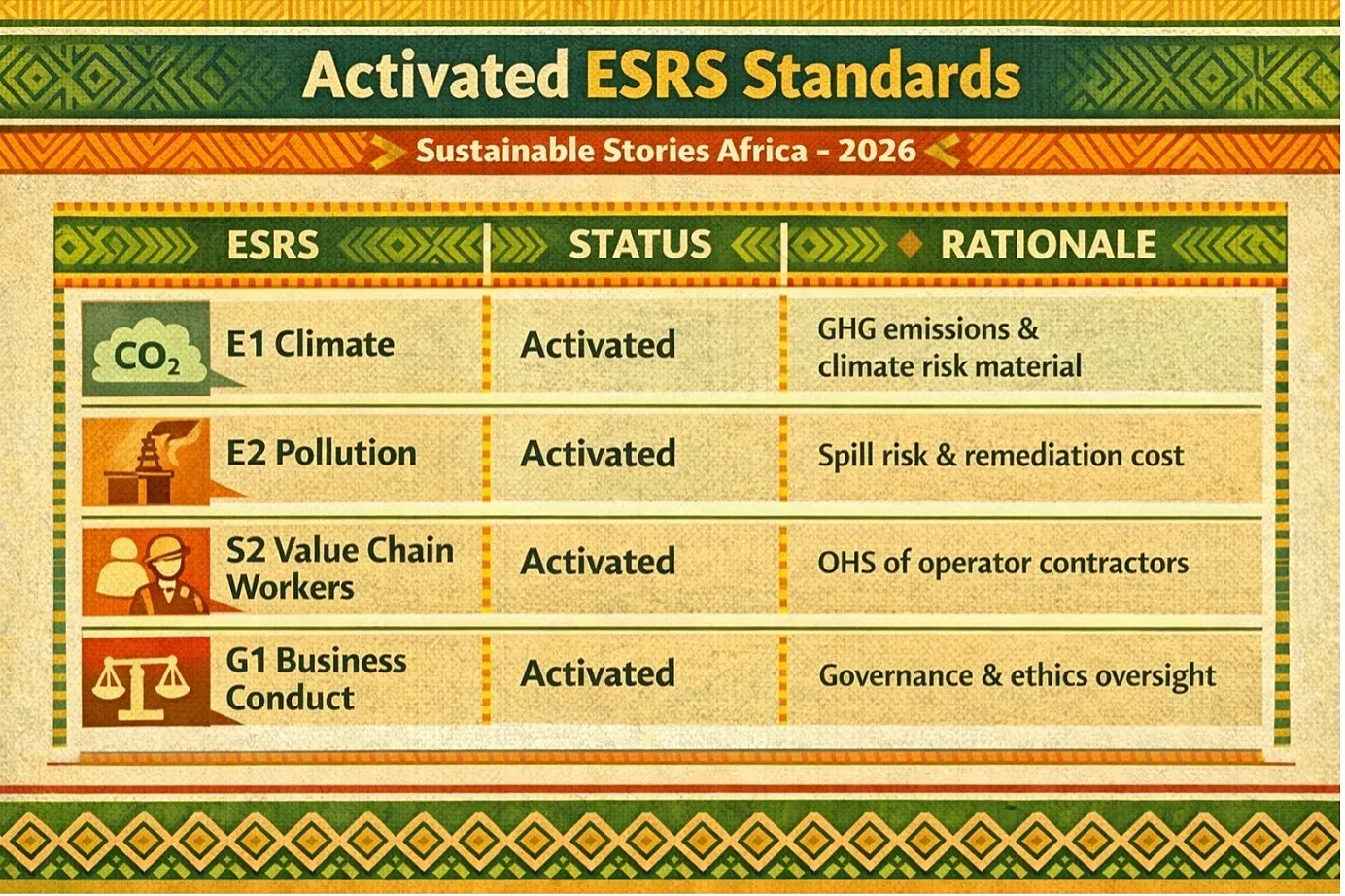
Non-activated: Water (E3), Biodiversity (E4), Resource Use (E5), Own Workforce (S1).
SUSTAINABILITY RISK MANAGEMENT
Climate-related risks assessed under:
- Transition risk (commodity volatility, regulation)
- Reputation risk (activism)
- Legal risk (climate litigation monitoring)
Mitigation includes:
- Hedging strategy (Prime)
- Carbon price stress testing
- ESIA compliance for new projects
SUSTAINABILITY STRATEGY CONCEPTS
ESG Strategic Framework
Pillar 1 – Trusted Partner – Strong governance, ethics, transparency
Pillar 2 – Responsible Steward – Climate management, emissions reduction
Pillar 3 – Strong Communities – Education, health, clean energy access
The strategy integrates climate oversight at the Board level, executive accountability, and ESG in investment screening.
Disclosure Improvements
Progress
- Zero LTIs and improved flaring reduction.
- 8% emissions reduction YoY.
- Structured double materiality alignment.
- Carbon price scenario stress testing.
- Enhanced supplier ESG screening.
Improvements
- Expand Scope 3 financed emissions disclosure.
- Publish absolute long-term (2030/2050) targets beyond 2025.
- Quantify asset-level transition glidepaths.
- Provide biodiversity monitoring data (even if non-material).
- Expand independent third-party emissions verification.
Kindly note that Sustainable Stories Africa (SSA) has conducted this review independently, without any financial, material or other inducements, to ensure objectivity, integrity and transparency in highlighting Africa Oil Corp.’s sustainability disclosures.