SPAR Group 2025: Material Impacts
SPAR Group’s Sustainability Report 2025 covers the financial year 1 October 2024 to 30 September 2025, framing sustainability disclosure around material environmental, socio-economic development, and governance impacts, with reference to a Social, Ethics and Sustainability Committee report for 2025 and supplementary alignment to evolving global frameworks.
The report defines its GHG reporting boundary as encompassing Southern Africa, Ireland, Southwest England (discontinued operations), Switzerland (discontinued operations), and corporate stores, while excluding the Sri Lanka joint venture (outside operational control) and independent retailers (who own their stores).
It notes South Africa comprises 83% of total warehousing space (excluding corporate stores), with international territories managing the balance of 17% of its remaining warehousing space. It noted that it began reporting GHG emissions in 2023.
SPAR links its sustainability strategy to a “just transition” framing, quoting the UN Global Compact definition that emphasises an “orderly, inclusive and just” transition to “net-zero emissions and climate resilience.”
Operationally, the report highlights a multi-territory footprint (licences held in eight countries in 2025: Botswana, eSwatini, Lesotho, Mozambique, Namibia, South Africa, Ireland, and Sri Lanka).
A major governance disclosure is that the Board approved the sustainability report on 12 December 2025, following committee review for integrity and a Board statement that it provides “a fair account of the sustainability-related risks and opportunities” and 2025 performance.
On materiality, SPAR states that in 2024, it conducted a double materiality assessment to support alignment with the CSRD, and this was not redone in 2025, so material issues remain as published in 2024.
The report also maps material themes/topics to ESRS categories (E1–E5, S1–S4, G1), including climate change, pollution, water, biodiversity (food production), circular economy, workforce topics, affected communities (food security), consumer rights and business conduct.
SDG ALIGNMENT
What the report explicitly says
- SPAR states it submits climate change, water security and forest disclosures to CDP and positions sustainability as integral to operations and community engagement.
- Leadership language links social initiatives to purpose (nutrition, independent retailers, GBV), but the excerpted sections do not present a consolidated SDG list or SDG-by-programme mapping table.
SDG implications visible from disclosed focus areas (inference, based on stated topics)
Because the report’s disclosed material topics include food security, climate change, water availability, recycling/reuse, training & development, and ethical business practices, the strongest SDG touchpoints appear to be those typically associated with these areas (e.g., food systems, climate, water, decent work, responsible consumption, strong institutions).
This is SSA’s interpretation derived from the report’s ESRS-mapped material topics rather than an SDG claim made explicitly by SPAR.
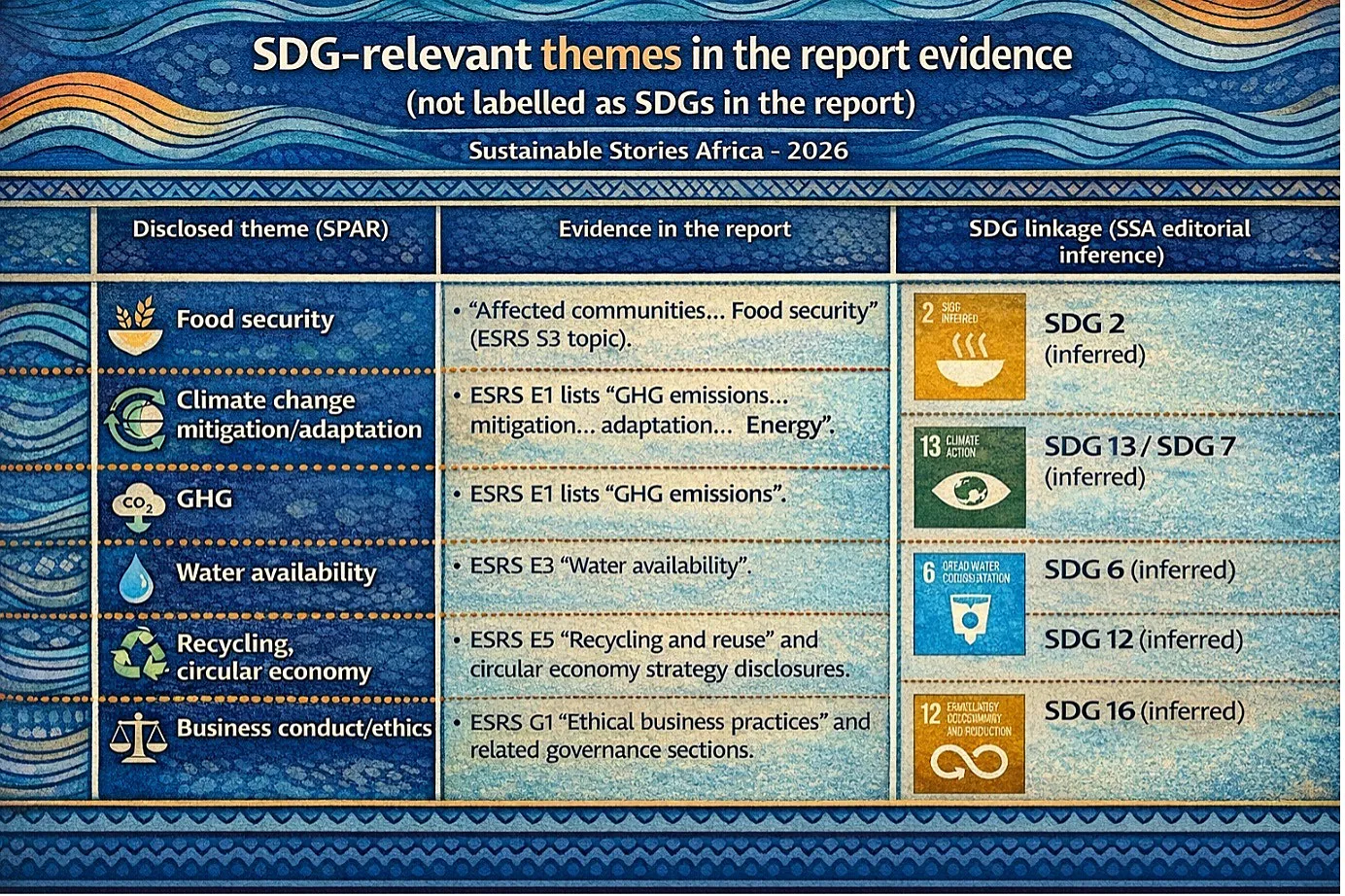
SDG-relevant themes in the report evidence (not labelled as SDGs in the report)
Disclosed theme (SPAR) | Evidence in the report | SDG linkage (SSA editorial inference) |
|---|---|---|
Food security | “Affected communities… Food security” (ESRS S3 topic) | SDG 2 (inferred) |
Climate change mitigation/adaptation, GHG | ESRS E1 lists “GHG emissions… mitigation… adaptation… Energy” | SDG 13 / SDG 7 (inferred) |
Water availability | ESRS E3 “Water availability” | SDG 6 (inferred) |
Recycling, circular economy | ESRS E5 “Recycling and reuse” and circular economy strategy disclosures | SDG 12 (inferred) |
Business conduct/ethics | ESRS G1 “Ethical business practices” and related governance sections | SDG 16 (inferred) |
Geography of impact reporting (where disclosed)
- SPAR’s operational footprint and sustainability boundary disclosures are multi-territory (Southern Africa, Ireland, with discontinued Switzerland/Southwest England included for the year), with a specific note that the Sri Lanka JV is excluded from the emissions boundary.
ESG MANAGEMENT
Governance and oversight
- The report states the relevant committee reviewed the integrity of the sustainability report and recommended it to the Board, which then approved it on 12 December 2025.
- The report’s contents include a dedicated “Social, Ethics and Sustainability Committee report for 2025”.
Reporting suite and disclosure architecture
- SPAR describes an “Our reporting suite” that includes an Integrated Annual Report 2025 and a Sustainability Report 2025, plus a reference to a Climate Change Report supplement (2022).
- It also states it submits disclosures to CDP (climate change, water security, forests).
Risk and compliance signals (as stated)
- The Board states the report provides “a fair account of the sustainability-related risks and opportunities” facing the Group.
- For plastics and packaging compliance, SPAR notes monitoring compliance with SPAR specifications through external auditing (South African Technical Auditing Services audits and supplier visits).
INITIAL AREAS OF IMPACT
Environmental and circularity interventions highlighted
- E-waste take-back pilot (Build it + eWASA): launched December 2024, collecting over 200kg of discarded electronics, refurbished for reuse or recycled into products; planned expansion to seven additional Build it stores in KwaZulu-Natal; a paint bucket return system is projected for 2026.
- EPR compliance: SPAR is classified as a brand owner under South Africa’s EPR regulations; subsidiaries (Encore, Build it, SPAR Health) are EPR-compliant and registered with eWASA since 2024.
- Packaging innovation: disclosed as diverting over 124 tonnes from landfill; examples include shifts to mono-material packaging, HDPE with 30–50% post-consumer waste, and SPAR plastic carrier bags made from 100% post-consumer waste since 2025.
Social/community-facing areas (leadership framing)
- CEO quote connects priorities, including “advance nutrition… empower independent retailers… address societal challenges, including GBV,” describing alignment with purpose.
METRICS FOR DEFINITION
Boundary, baselines and year-on-year elements
- The report defines the 2025 reporting period and provides a clear GHG boundary and inclusion/exclusion basis.
- It includes multi-year data in some disclosures (e.g., packaging waste across 2023–2025).
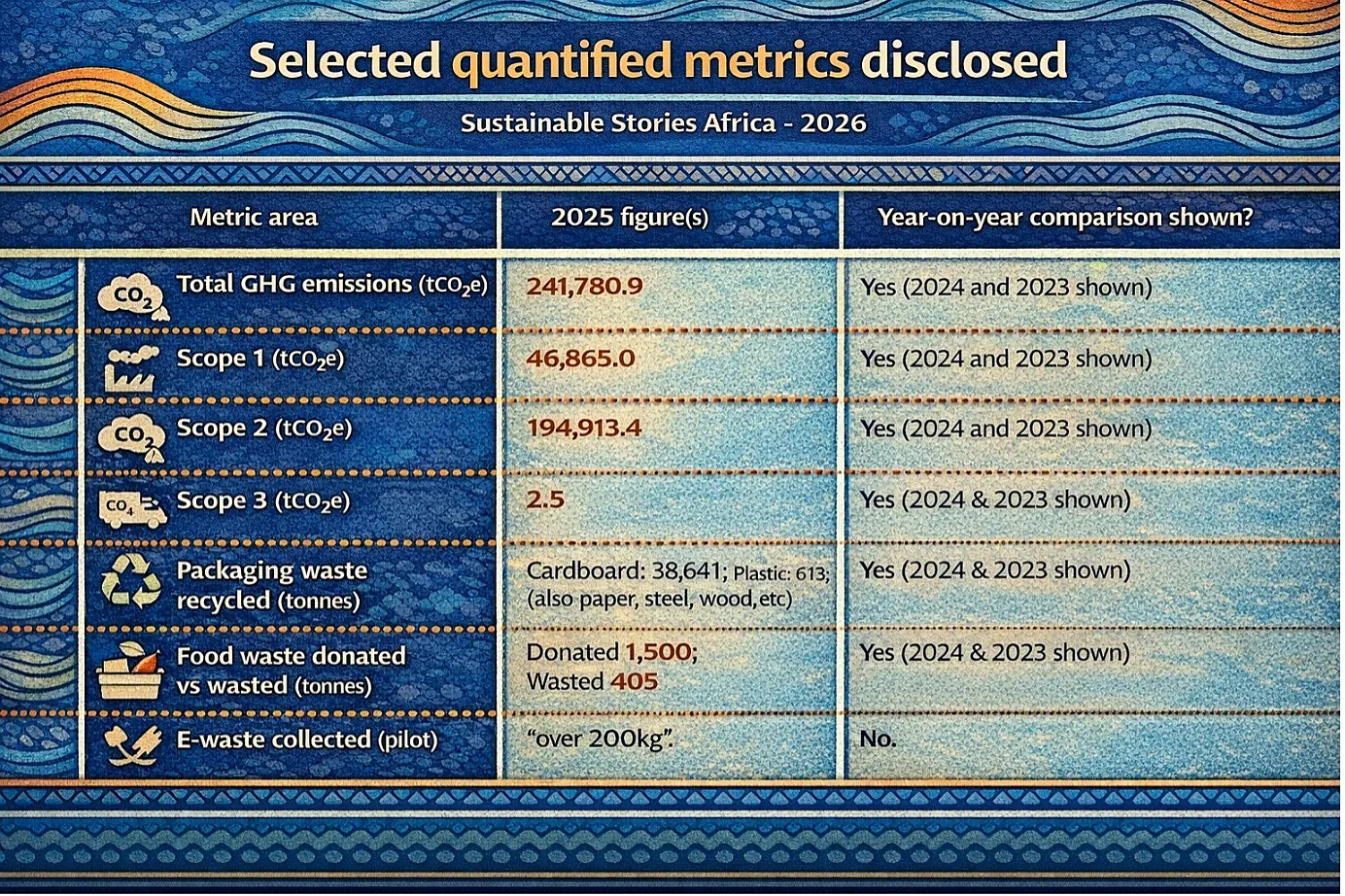
Selected quantified metrics disclosed
Metric area | 2025 figure(s) | Year-on-year comparison shown? |
|---|---|---|
Total GHG emissions (tCO₂e) | 241,780.9 | Yes (2024 and 2023 shown) |
Scope 1 (tCO₂e) | 46,865.0 | Yes |
Scope 2 (tCO₂e) | 194,913.4 | Yes |
Scope 3 (tCO₂e) | 2.5 | Yes |
Packaging waste recycled (tonnes) | Cardboard 38,641; Plastic 613; (also paper, steel, wood, etc.) | Yes (2024 & 2023 shown) |
Food waste donated vs wasted (tonnes) | Donated 1,500; Wasted 405 | Yes (2024 & 2023 shown) |
E-waste collected (pilot) | “over 200kg” | No |
Verification/assurance signals
- The excerpted sections do not show a standalone external assurance statement for sustainability metrics; however, the report notes external audits and supplier visits for compliance with SPAR packaging specifications in South Africa.
- It also states 2025 B-BBEE verification was independently evaluated by mPowerRatings.
AREAS OF FOCUS
Forward priorities and commitments stated
- Net-zero ambition: SPAR states it has a target to achieve net zero emissions by 2050 (noted as a basis for the Group’s climate strategy and transition pathway).
- Food waste target: SPAR references a goal to halve food waste by 2030, aligned with SDG 12.3 framing.
- Scale-up of circularity pilots: e-waste initiative expansion to seven additional stores and a planned 2026 paint bucket return system.
MATERIALITY CONCEPTS
What SPAR published
- SPAR reports it conducted a double materiality assessment in 2024 to support alignment with the CSRD, and that it was not redone in 2025, with material issues remaining the same as those published in 2024.
- It lists material themes and topics mapped to ESRS categories (E1–E5, S1–S4, G1), including:
- E1: GHG, mitigation, adaptation, energy
- E5: recycling & reuse, sustainable sourcing
- S3: food security
- G1: ethical business practices, corporate culture, supplier-partner relations
- E1: GHG, mitigation, adaptation, energy
Practical implication (how it shapes reporting): The report’s chapter structure mirrors these material areas (Environmental impacts, Socio-economic development impacts, Governance impacts).
SUSTAINABILITY RISK MANAGEMENT CONCEPTS
Risk framing and oversight (as stated in the report)
- Board-level statement: the Board is satisfied that the report provides “a fair account” of sustainability-related risks and opportunities facing the Group.
- The report also cautions on forward-looking statements and associated uncertainties.
Risk themes evident from disclosed material topics (risk lens)
Based on SPAR’s ESRS-mapped material topics, the main sustainability risk categories signposted include:
- Climate transition and physical risk (E1: mitigation/adaptation; energy; GHG).
- Resource/circularity and regulatory compliance risk (E5; EPR compliance; packaging targets aligned to Plastics Pact and EPR frameworks).
- Social risks in communities and value chain (S2/S3 topics including health & safety, diversity, food security).
SUSTAINABILITY STRATEGY CONCEPTS AND MANAGEMENT
How SPAR defines the strategy
SPAR states its sustainability strategy (referenced as being on page 16 of the report) is inspired by the UN Global Compact just transition framework, quoting: “A just transition ensures, leaving no one behind, transition to net-zero emissions and climate resilience, orderly, inclusive and just.”
Strategy pillars implied by disclosed focus
- Just transition framing (fairness, inclusion, net-zero, resilience).
- Climate ambition: net zero by 2050; pathway elements referenced through climate disclosures and targets.
- Circular economy and EPR compliance: packaging design standards/rules; EPR compliance across subsidiaries; material diversion from landfill.
- Community and societal priorities: nutrition, retailer empowerment, GBV (leadership emphasis).
Disclosure improvements
SPAR’s sustainability reporting shows solid foundations around issues relating to clear emissions boundaries across multiple territories, measurable long-term targets, and consistent multi-year data on GHG, food waste and packaging.
Its materiality process is transparent, aligned to ESRS topics, and explicitly maintains double-materiality continuity from 2024 to 2025.
To strengthen comparability and automated ESG tracking, SPAR could publish an SDG mapping table linking initiatives to specific goals and KPIs, clarify which ESG metrics are independently assured, expand Scope 3 coverage and methods, introduce interim milestones toward long-term targets, and more clearly connect material issues to Board-level governance and decision-making processes.
What SPAR does well (based on evidence)
- Clear boundary and exclusions for emissions reporting and multi-territory scope.
- Concrete targets (net zero 2050; halve food waste 2030) plus multi-year operational data in selected areas (GHG, food waste, packaging waste).
- Materiality is disclosed with ESRS topic mapping and an explicit statement about double materiality continuity from 2024 to 2025.
What would improve comparability and automated ESG tracking (recommended disclosures)
- Explicit SDG mapping table: a single page mapping each flagship initiative to specific SDGs, with KPIs per SDG (the excerpted text does not show this).
- Assurance clarity for ESG KPIs: a dedicated assurance section listing which sustainability metrics are independently assured (and assurance level/scope). (Current evidence shows targeted external audits for packaging compliance and independent B-BBEE verification, but not an ESG-wide assurance statement.
- Scope 3 expansion and methodology detail: Scope 3 is currently reported as a very small figure in the disclosed table; adding category coverage, calculation methods, and a roadmap for boundary expansion would strengthen completeness.
- Targets with interim milestones: net zero 2050 and food-waste 2030 would be more trackable with interim (e.g., 2027/2030/2035) targets and capex/operational levers by territory.
- Materiality governance linkage: the report states material issues remained unchanged from 2024, but a short disclosure connecting material topics to Board/committee agendas, controls, and decision points would tighten governance traceability.
Kindly note that Sustainable Stories Africa (SSA) has conducted this review independently, without any financial, material or other inducements, to ensure objectivity, integrity and transparency in highlighting Sterling Spar Group’s sustainability disclosures.