Young people are no longer a footnote in global risk reports; they are authors of a different script.
The 2026 Youth Pulse highlights a generation living with inequality, climate anxiety, AI disruption still insisting on agency, purpose and a seat at the policy table.
Youth Are Reading Tomorrow's Headlines Today
The World Economic Forum's Youth Pulse 2026 reads like a quiet rebuke to decision‑makers who still treat young people as beneficiaries rather than co‑authors of the future.
Nearly 4,600 respondents across 144 countries describe a world defined by inequality, climate risk, political distrust and AI disruption, but also by stubborn optimism, entrepreneurship and a hunger for integrity in leadership.
Across five outlooks: economic, political, technological, social and environmental, the data converges on a simple verdict: the next generation is already doing the work of redesigning systems that refuse to work for them.
They are building communities to counter loneliness, launching ventures in economies that barely create jobs for them, and teaching themselves AI at a speed faster than institutions can update curricula.
For editorial boards and policymakers alike, this is no longer just a youth story; it is an early warning system. Whether on jobs, democracy, mental health, or climate issues, the Pulse suggests that governments, investors and brands that ignore youth foresight are not merely out of touch, they are out of time.
Inequality Dominates; Agency Refuses Retreat
The clearest signal from Youth Pulse 2026 is unequivocal: inequality has become this generation's defining economic fault line. Nearly 50% of respondents identify widening income gaps as the force most likely to shape their future, even as they pursue entrepreneurship and side ventures to secure autonomy and resilience.
Financial strain is immediate, not theoretical. 57% cite money as their leading source of anxiety, with over 50% barely meeting essential needs. However, rather than retreat, young people are expanding income streams, investing in skills, and redefining work around purpose and measurable impact.
Politically, they acknowledge the erosion and rising geopolitical strain, but disengagement is not their response. About 33% would consider running for office, while trust tilts toward community leaders over heads of state, signalling a demand for accountability, proximity, and results over rhetoric.
Reading The Data Behind Youth Resolve
Youth Pulse 2026 is not a mood piece; it is a structured map of how young people see the world.
The survey spans 4,574 respondents aged 18–30 from 489 locations, many of whom live in emerging economies where youth demographics are largest and institutional shocks most acute.
Economic and work outlook – Numbers that matter
- 48.2% cite growing inequality as the top economic trend shaping the future.
- 57.2% list financial concerns as their biggest source of stress, ahead of academic pressure or family issues.
- 57% say youth employment and quality jobs are the top policy priority for governments and institutions.
- When thinking about careers, 61.8% prioritise a sense of purpose, and 58.1% rate flexibility and work–life balance above traditional benefits.
Across Sub-Saharan Africa and South Asia, youth increasingly view entrepreneurship as the primary engine of economic mobility, despite persistent informality and underemployment.
Ghana's "My First Job" initiative demonstrates this shift, converting national service into structured employment pathways, with 60% of participants securing roles within three months.
Political and trust outlook – Who they still believe in
On politics, 59.4% of respondents identify escalating geopolitical tensions as the defining force of the next five years, with authoritarianism and populism close behind. However, 49% also recognise countervailing momentum, innovative governance, deeper civic participation, and stronger global cooperation as credible sources of progress.
Trust remains local. Community leaders are viewed as the most effective agents of change, with national figures lagging. Transparency and accountability rank highest among valued traits, followed by long-term innovation and a demonstrated willingness to listen.
Technological outlook – AI as both risk and lever
If there is one technology shaping this generation's horizon, it is AI.
- 86.4% identify rapid AI growth as the most significant technological trend of the next five years.
- 66% believe AI will reduce entry‑level jobs over the next three years, fuelling anxiety about being displaced before careers even begin.
- However, 59.2% already use AI tools regularly to improve their skills, and 33.1% experiment with them informally.
A defining paradox emerges in digitally fluent early adopters with grounded anxieties.
Youth-led programmes like "Shaping Digital Futures" bridge experimentation and certified skills, targeting 15,000 learners globally.
Social and environmental outlook – Belonging and climate as anchors
Socially, young people identify digital immersion, fragmentation, and loneliness as defining pressures; however, they are not passive observers. 95% say youth communities are critical to learning and growth, while over 66% credit these networks with mobilising practical solutions to local challenges.
Environmentally, climate change and degradation top global threat perceptions, even as inflation dominates personal finances. Economic strain has not diluted climate concern; environmental and ethical considerations now rank among the top three purchasing drivers, alongside quality and price.
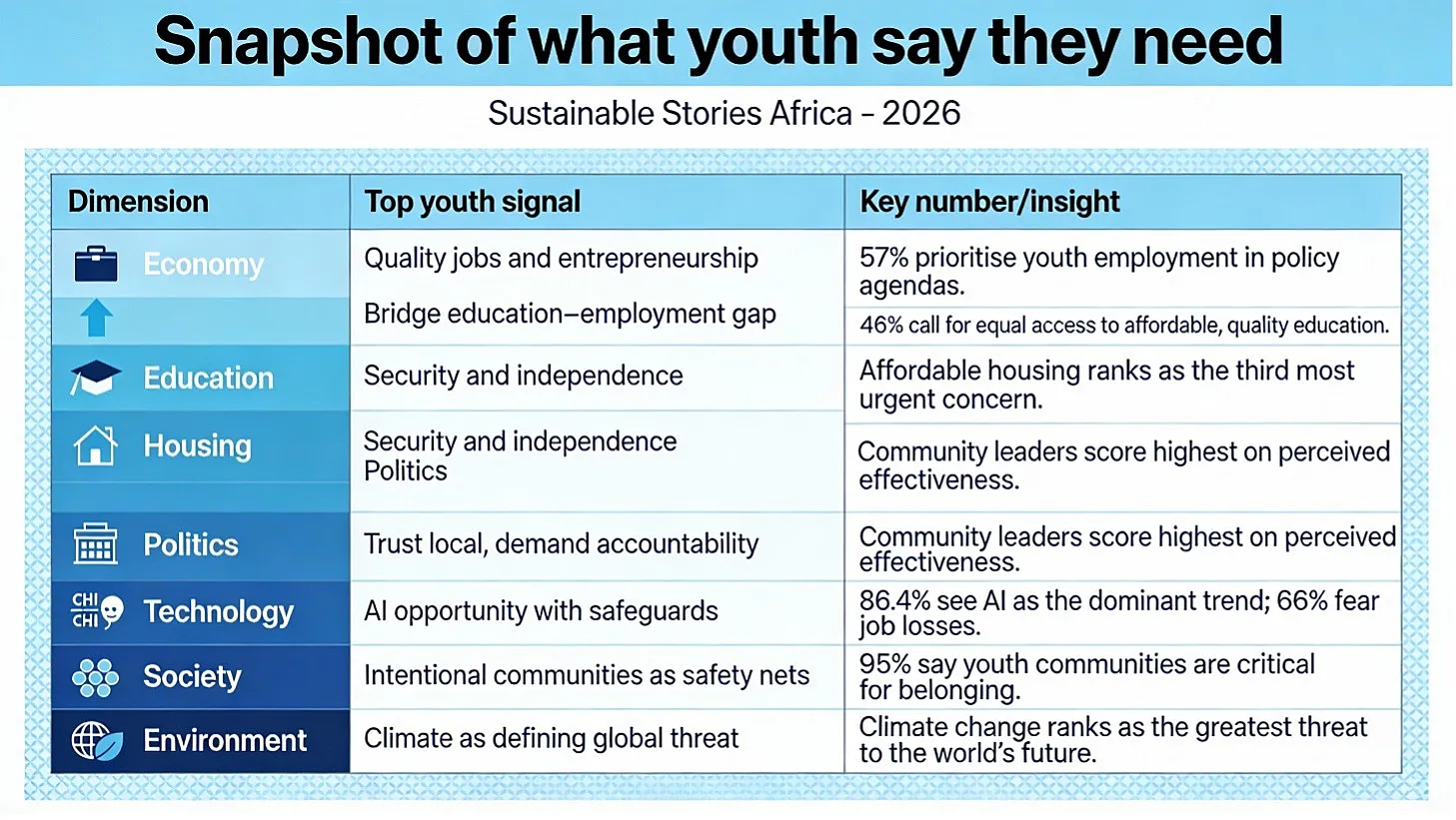
Snapshot of what youth say they need
| Dimension | Top youth signal | Key number/insight |
|---|---|---|
| Economy | Quality jobs and entrepreneurship | 57% prioritise youth employment in policy agendas. |
| Education | Bridge education–employment gap | 46% call for equal access to affordable, quality education. |
| Housing | Security and independence | Affordable housing ranks as the third most urgent concern. |
| Politics | Trust local, demand accountability | Community leaders score highest on perceived effectiveness. |
| Technology | AI opportunity with safeguards | 86.4% see AI as the dominant trend; 66% fear job losses. |
| Society | Intentional communities as safety nets | 95% say youth communities are critical for belonging. |
| Environment | Climate defining global threat | Climate change ranks as the greatest threat to the world's future. |
From Consultation Tokenism To Shared Stewardship
Through a Sustainable Stories Africa lens, Youth Pulse reads as a governance blueprint rather than a survey. Young people are demanding structural reform, embedded advisory roles, co-designed AI skills systems, and climate programmes that treat them as partners, not participants.
Their economic agenda is clear: meaningful work, opportunity-linked education, and access to capital and social protection. They want transparency enforced through open data and measurable impact.
Already active in the AI economy, they seek ethical guardrails and public-interest innovation.
Socially and environmentally, they frame community and climate as infrastructure pressing institutions to evolve from applause to partnership.
Match Youth Foresight With Real Power
For governments, businesses and development partners, Youth Pulse 2026 reads like an actionable briefing, not a sentimental portrait. The priorities are coherent across regions: enable quality jobs and entrepreneurial pathways, guarantee affordable and relevant education, unlock housing and capital, and embed youth leadership into governance, climate and technology systems.
What stakeholders should do next?
- Governments:
- Make youth employment targets, AI governance and climate adaptation explicitly youth‑inclusive, with formal advisory councils and co‑designed programmes at national and city levels.
- Institutionalise intergenerational foresight units in key ministries to ensure policies reflect long‑term, youth‑informed scenarios rather than short political cycles.
- Private sector:
- Replace "youth branding" with youth pathways, such as paid apprenticeships, skill‑based hiring, transparent wage practices and youth‑led innovation labs in AI and green sectors.
- Fund open‑access digital and climate‑skills platforms, particularly in regions where youth are early adopters but formal training is scarce.
- Civil society and multilaterals:
- Scale youth‑led models such as "My First Job", "Shaping Political Futures" and "Shaping Digital Futures" across countries, treating them as design templates for public programmes.
- Invest in purpose‑built youth communities as core infrastructure for social cohesion, mental health and civic participation.
At Sustainable Stories Africa, our editorial position is clear: youth perspectives are no longer a "nice to have" angle on bigger stories, they are the leading indicators of where economies, democracies and labour markets are actually headed. Any serious strategy for resilience, from Lagos to Lahore, Accra to Amsterdam, that does not start with this generation's data, demands, and designs is already behind.
Path Forward – From Pulse To Policy, With Youth
The path forward is not another cycle of youth consultations; it is shared authorship.
That means codifying youth foresight into laws, budgets, curricula and boardrooms, so that the priorities mapped in Youth Pulse 2026, such as dignified work, ethical technology, climate stewardship and social cohesion, move from survey dashboards into enforceable commitments, co-governed by the generation that will live longest with their consequences.