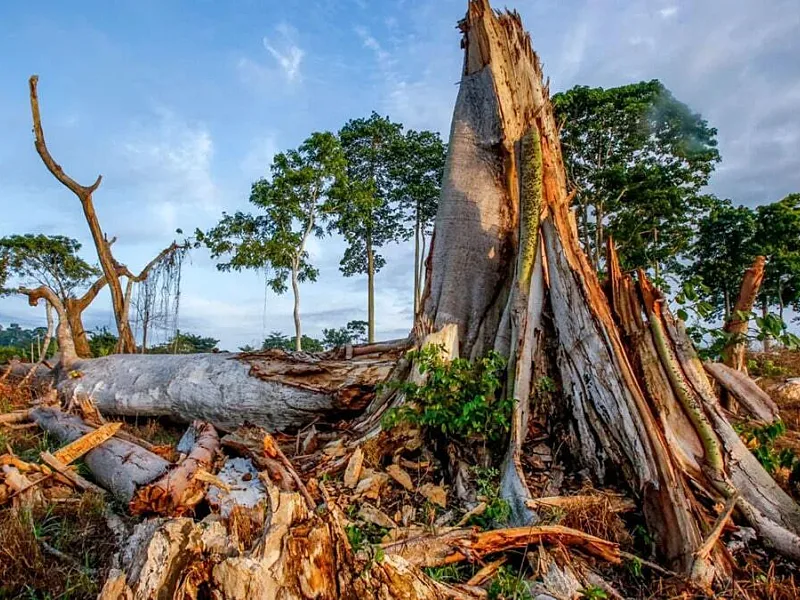
Artificial intelligence is rapidly becoming a powerful tool in fighting climate change and biodiversity loss.
From forecasting extreme weather to optimising renewable energy systems and monitoring forests, AI technologies are transforming how societies tackle environmental challenges.
But the technology also raises new questions: how can the world harness AI’s climate potential while managing its energy demands and ethical risks?
Artificial Intelligence Emerges As Climate Solution Engine
Artificial intelligence is quietly becoming one of the most powerful tools in the global climate fight.
Across sectors, from energy grids and agriculture to biodiversity monitoring, AI technologies are helping scientists, governments, and businesses make faster and more informed decisions about the planet’s future.
Organisations such as the United Nations Environment Programme and the World Economic Forum say AI could significantly accelerate climate mitigation and adaptation by unlocking new insights from vast environmental datasets.
At the same time, researchers caution that AI systems themselves consume increasing amounts of energy, raising questions about how the technology can scale sustainably.
The result is a new frontier of climate innovation, where digital intelligence meets planetary stewardship.
AI Applications Expanding Across Climate And Nature
AI’s climate potential lies in its ability to process enormous datasets, including satellite imagery and weather models, as well as financial and ecological data, far faster than traditional systems.
This capability is already transforming multiple sectors.
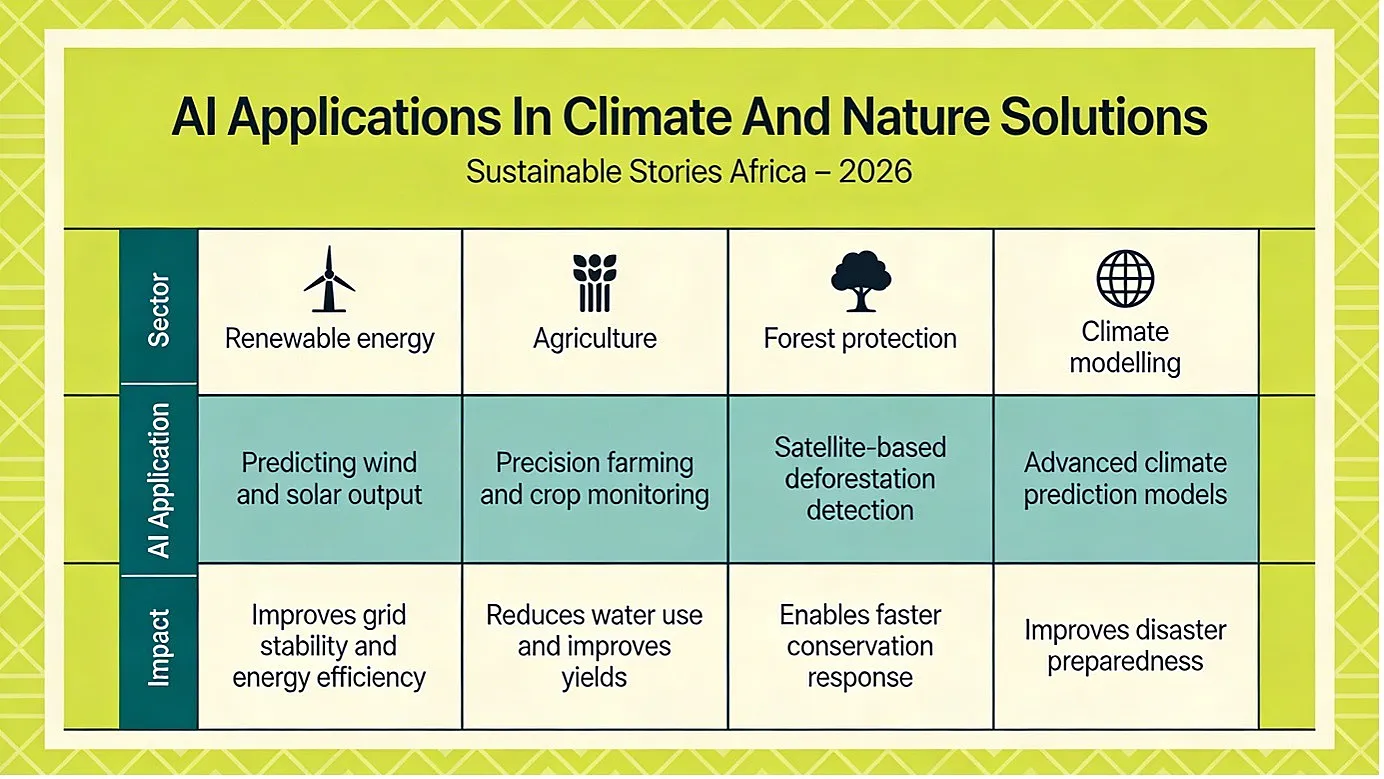
AI Applications In Climate And Nature Solutions
Sector | AI Application | Impact |
|---|---|---|
Renewable energy | Predicting wind and solar output | Improves grid stability and energy efficiency |
Agriculture | Precision farming and crop monitoring | Reduces water use and improves yields |
Forest protection | Satellite-based deforestation detection | Enables faster conservation response |
Climate modelling | Advanced climate prediction models | Improves disaster preparedness |
In Africa, where climate variability significantly affects agriculture and water systems, AI tools could help communities adapt more effectively to changing conditions.
Startups and research initiatives across the continent are experimenting with AI-powered weather forecasting, crop advisory services, and wildlife monitoring.
These technologies allow farmers and conservationists to make decisions based on real-time data rather than historical patterns that climate change has increasingly disrupted.
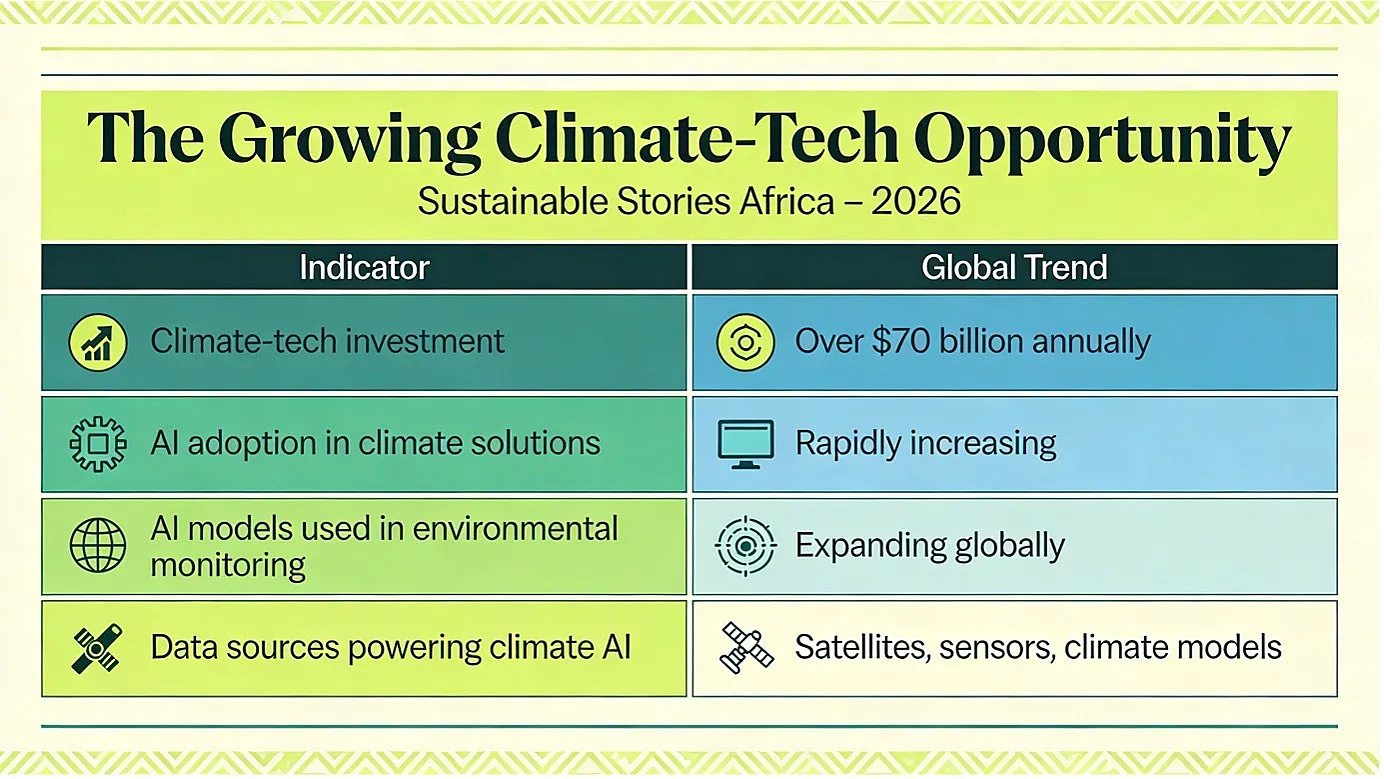
The Growing Climate-Tech Opportunity
Indicator | Global Trend |
|---|---|
Climate-tech investment | Over $70 billion annually |
AI adoption in climate solutions | Rapidly increasing |
AI models used in environmental monitoring | Expanding globally |
Data sources powering climate AI | Satellites, sensors, climate models |
According to industry estimates, AI could help reduce global greenhouse gas emissions by up to 10% by 2030 through improved efficiency and smarter infrastructure.
Yet the technology’s environmental footprint is also under scrutiny.
Training large AI models can consume significant electricity, raising concerns about the sustainability of expanding data infrastructure.
A New Digital Frontier For Planetary Stewardship
Despite these challenges, many experts believe AI could play a crucial role in accelerating progress and addressing climate change.
By enabling faster decision-making and better resource management, AI could help governments and businesses implement more effective sustainability strategies.
For example:
- Energy companies can optimise power grids with AI-driven forecasting
- Cities can use AI to manage traffic and reduce emissions
- Conservation organisations can monitor ecosystems in real time
- Financial institutions can assess climate risks more accurately
For Africa, the technology offers promise.
AI could help improve weather prediction for farmers, detect illegal mining and deforestation, and optimise renewable energy systems in regions with limited access to electricity.
In this sense, AI represents not just a technological breakthrough but a new layer of intelligence in humanity’s effort to manage planetary systems responsibly.
Harnessing AI Responsibly For Climate Progress
However, experts emphasise that technology alone will not solve the climate crisis.
Harnessing AI for environmental solutions requires strong governance, responsible innovation, and investment in sustainable digital infrastructure.
Key priorities include:
- Ensuring AI systems use energy-efficient computing
- Expanding open climate data platforms
- Encouraging collaboration between technology firms and environmental scientists
- Developing ethical frameworks for AI-driven environmental decision-making
Governments, universities, startups, and international institutions will need to work together to ensure that AI innovation supports, not undermines, global climate goals.
The challenge is not simply to build smarter machines, but to build smarter systems for managing the planet.
Path Forward – Responsible AI Can Accelerate Climate Action
Artificial intelligence is rapidly emerging as a powerful ally in fighting against climate change and biodiversity loss.
If developed responsibly, AI could help societies make faster, smarter decisions about energy systems, ecosystems, and environmental risks, turning digital innovation into a critical tool for sustainable development.
Culled From: AI and the Planet: How Artificial Intelligence Is Transforming Climate and Nature Solutions