An Ogoni conception of the Supreme Being as feminine unsettles inherited assumptions about God, authority and gender. Kawaa-Bari represents generativity, moral order and relational life - not a biological woman projected into heaven.
However, sacred femininity does not automatically deliver equality.
Its value now lies in testing whether theology, public institutions and Niger Delta restoration can convert symbolic reverence into real authority, justice and care.
Africa must hear its older theology
Africa's argument about gender is often presented as a contest between imported conservatism and imported liberalism. That frame is too small. Long before either vocabulary became dominant, African communities were developing their own accounts of power, personhood and the sacred.
Burabari Sunday Deezia's 2026 study of Ogoni religious philosophy brings one such account into view. It describes Kawaa-Bari, the Ogoni Supreme Being, as fundamentally feminine: the Mother of Creation, source of existence, sustenance, moral order and relational harmony. Femininity here does not mean biological sex.
It names the capacity to generate, nurture and hold life together.
That distinction matters. Kawaa-Bari should neither be reduced to a curious local goddess nor recruited as effortless proof that precolonial society was gender-equal.
Read critically, the concept offers something more demanding: an African vocabulary for judging authority by what it sustains, whose knowledge it honours and whether communities and ecosystems can flourish.
Divine language quietly organises earthly power
The words a society uses for God are never only about heaven. Father, king, lord and sovereign can communicate protection and responsibility, but they also make hierarchy feel natural when repeated without alternative images.
Deezia's central intervention is to show that Ogoni metaphysics begins elsewhere. Kawaa-Bari is not ultimate power as domination; she is ultimate power as generative presence.
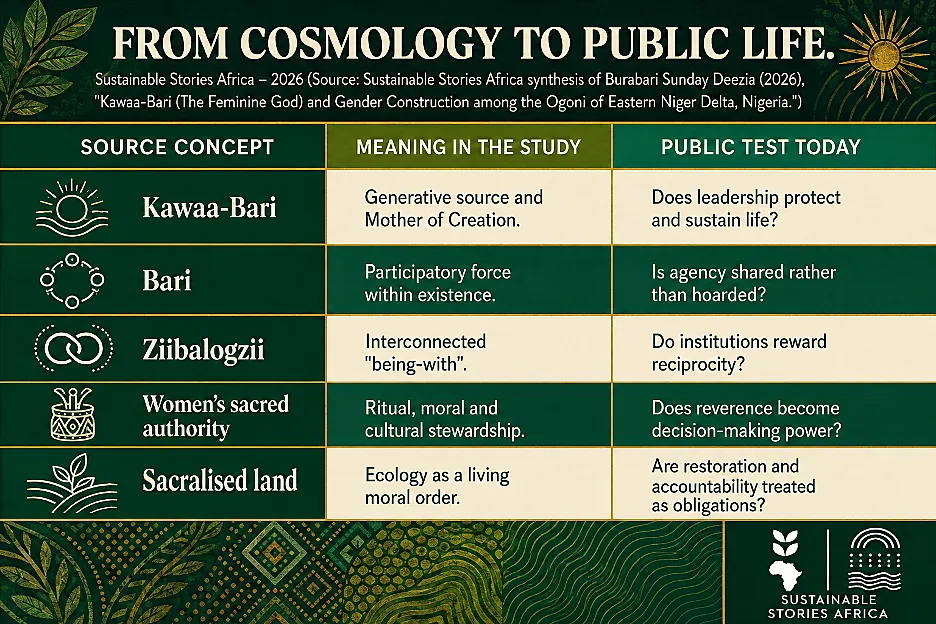
The paper parses Kawaa as Great Mother and Bari as the source or ground of being. From Kawaa-Bari proceeds bari, a participatory force present in beings, divinities, ancestors and individual destiny.
The result is not a remote creator standing outside creation, but a source whose transcendence lies in inexhaustible generativity and whose immanence is felt in the life she sustains.
This is more than a change of pronoun. Replacing "He" with "She" while leaving domination intact would achieve little.
- The deeper challenge is to replace a political imagination built around control with one that values relationship, continuity and care.
In an era of institutional distrust, gender violence and ecological breakdown, that is a public argument, not an antiquarian one.
Ogoni thought makes feminine power foundational
Deezia's qualitative ethnography treats oral narratives, ritual speech, proverbs and communal practice as philosophical evidence.
One proverb in the study says, "No one shows a child the Supreme Being."
The point is not hostility to reason. It is that knowledge can also be embodied, socially tested and transmitted through a form of life rather than proved only as a detached proposition.
The study connects this cosmology to women's roles as priestesses, ritual intermediaries, titleholders, healers, traditional birth attendants, traders, farmers, artists and custodians of moral formation.
It also identifies the Tor-Kabia, the women's arm of the chieftaincy council, and reports oral traditions about early female leaders.
These accounts position women in proximity to sacred, social, and ecological continuity.
However, proximity to the sacred is not the same as control of institutions.
- The paper notes a tension between matrilineal elements and predominantly male political authority.
- Practices that celebrate motherhood or feminine ideals may also confine women to reproductive and aesthetic expectations.
- "Complementarity" can describe reciprocity, but it can also disguise unequal access to land, leadership, income and voice.
Relational power can repair fractured systems
Taken seriously, Kawaa-Bari offers a richer test of progress than representation alone.
- A woman may enter a cabinet, boardroom or pulpit without changing how power works.
- A relational standard asks whether decisions improve safety, dignity, livelihoods and the capacity of future generations to thrive.
- It evaluates authority by its consequences, not merely the identity of its holder.
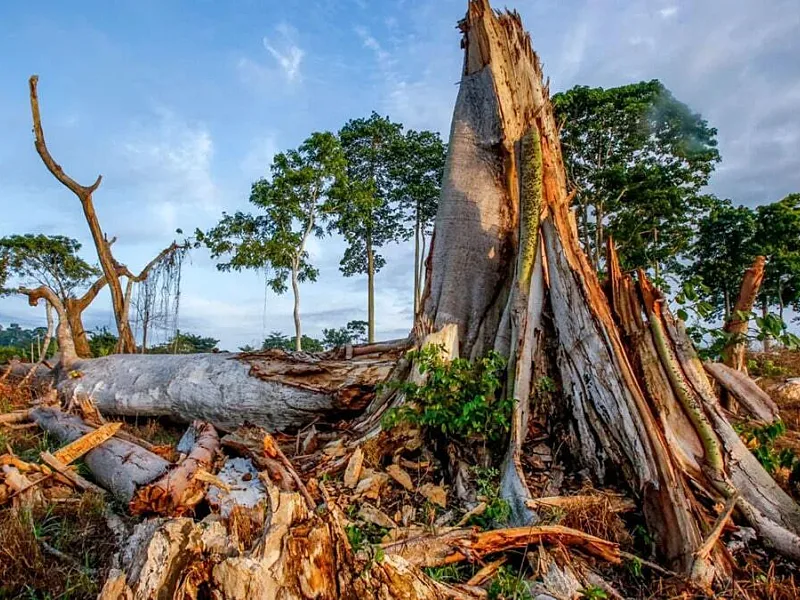
This matters acutely in Ogoniland. Decades of oil pollution have damaged land, water, health and livelihoods.
Within a worldview that treats the earth as living and sacred, environmental degradation is not simply an engineering failure or balance-sheet externality.
It is a breach of relationship. Cleanup, livelihood recovery and corporate accountability therefore become acts of material repair and cultural respect.
The same logic can strengthen gender policy.
- Instead of romanticising women as natural carers, institutions can value care as infrastructure and distribute it fairly.
- Health systems can respect community knowledge while maintaining clinical safeguards.
- Schools can teach indigenous philosophy alongside global traditions.
- Faith communities can recover maternal and non-hierarchical images of the divine without turning women into symbols while men retain authority.
The gain is not a return to an untouched past; no such past exists. It is a more confident intellectual future in which African concepts enter global debates as theories rather than folklore.
Kawaa-Bari can speak to feminist theology, public ethics and environmental governance precisely because the concept is culturally grounded and open to scrutiny.
Turn symbolic reverence into accountable practice
First, Ogoni scholars, elders, women leaders and young people should build a community-governed archive of names, proverbs, rituals and oral histories connected to Kawaa-Bari.
- Documentation must be consent-based, multilingual and protected from extraction.
- Universities should fund the work and credit knowledge holders as intellectual partners, not anonymous sources.
Second, churches and theological schools in Nigeria should examine how translation has masculinised indigenous understandings of God.
- This does not require abandoning Christian conviction.
- It requires intellectual honesty about the difference between doctrine and inherited cultural packaging, while making room for divine language that communicates nurture, interdependence and life-giving power.
Third, government and traditional institutions should audit the distance between symbolic honour and material authority.
- The relevant indicators are concrete: women's representation in councils; control over land and restoration funds; safety in public and domestic life; access to maternal healthcare; payment for cultural and care work; and participation in environmental monitoring.
Fourth, agencies and companies involved in Niger Delta restoration should treat cultural heritage as part of ecological recovery.
- Women-led organisations, local healers, farmers and fishers should help shape baselines, priorities and oversight.
- Scientific evidence must lead technical decisions, but community knowledge can identify damaged relationships, livelihood risks and culturally significant places that a laboratory report may miss.
Finally, advocates must preserve the source paper's own warning against romanticisation.
- A feminine Supreme Being does not automatically make just every inherited practice.
- Motherhood cannot be the price of women's dignity, and "tradition" cannot shield exclusion from challenge.
- Kawaa-Bari is most useful when the concept opens institutions to accountability rather than closes debate.
Path Forward – Let sacred language reshape public life
The next step is disciplined recovery: document Ogoni concepts on their own terms, test them against lived inequalities and give women knowledge-holders real authority in theology, governance and restoration.
Kawaa-Bari should not become a decorative emblem.
Her relevance will be measured by whether generative power becomes public practice - protecting life, repairing land, sharing authority and widening the circle of those whose knowledge counts.