Young entrepreneurs in Guinea and Benin are showing how agriculture can become a profitable, technology-enabled career.
An African Development Bank-funded programme combined digital recordkeeping, mentoring and unsecured finance to support thousands of enterprises.
The results, from higher turnover to new jobs, show why Africa’s food-system ambitions must include business capability as well as farm production.
Agriculture Becomes a Business Pathway
Young entrepreneurs across West Africa are converting farms and food products into growing businesses with support that combines digital tools, management training, mentorship and access to finance, challenging the view of agriculture as only the backbreaking work of previous generations.
In Kindia, Guinea, 29-year-old Bah Hassanatou started Jumelle Agri Business seven years ago to produce fresh pineapple juice.
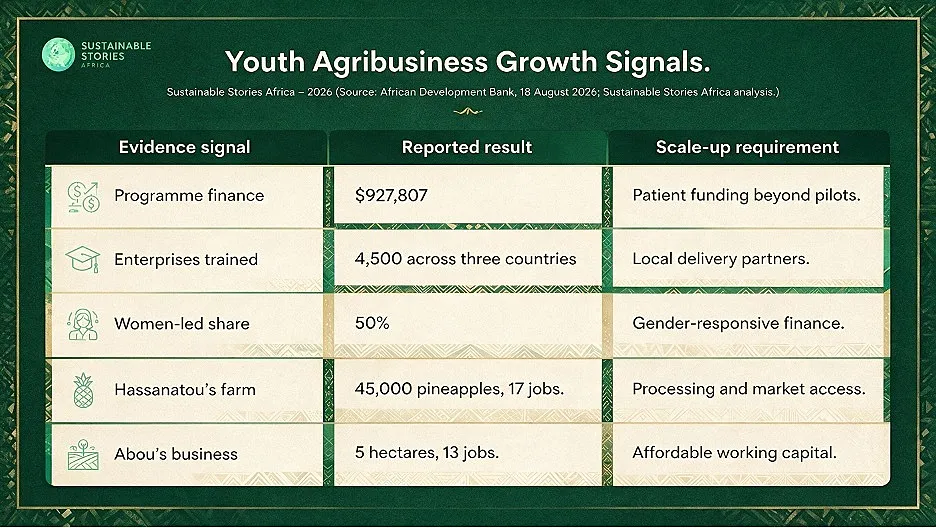
- Operational problems and limited management experience restricted growth until she joined a $927,807 African Development Bank-funded project supporting micro, small and medium-sized enterprises.
Hassanatou developed a growth strategy, structured operations and diversified sales through digital platforms.
Her company has nearly tripled annual turnover, cultivates 45,000 pineapples and employs 17 people, including five permanent staff.
Training Converts Records Into Credit
The project, financed through the Bank’s Youth Entrepreneurship and Innovation Multi-Donor Trust Fund, ran from October 2023 to March 2025 in Guinea, Benin and Ghana.
Oze Inc. provided a mobile platform for business records and performance insights, while Dare to Innovate delivered training and mentorship.
In Benin, 27-year-old Dramane Abou rebuilt after heavy rains destroyed his shed, crops and livestock.
- Training helped him secure a loan and restart with a stronger strategy.
He now grows cereals on five hectares, trades cattle, employs 13 people, nine of them women, and reports an average annual turnover of about $30,000.
Across the programme, Dare to Innovate trained and mentored 4,500 enterprises, half led by women, in cash-flow management, digital marketing and business operations.
Enterprise Support Strengthens Food Systems
The stories demonstrate why finance alone is insufficient.
- Reliable digital records help owners understand cash flow and allow lenders to evaluate businesses that may lack conventional collateral.
- Coaching helps entrepreneurs use loans productively and prepare for shocks.
The wider benefits extend beyond individual founders.
- Profitable local agribusinesses buy from farmers, preserve and process food, create rural jobs and retain value within communities.
- Women’s participation also increases when support is deliberately designed to reach them.
However, thousands of enterprises remain constrained by costly credit, weak logistics, climate exposure and fragmented markets.
A successful pilot must therefore connect to larger systems: extension services, insurance, storage, standards, procurement and regional trade.
Governments Must Finance Business Capability
African governments, development banks and commercial lenders should treat management capacity and digital records as investable infrastructure.
Credit products should reward verified performance while avoiding repayment schedules that ignore agricultural seasons.
Programmes should publish survival, job-quality and revenue outcomes after funding ends.
They should also connect youth-led enterprises to processors, retailers and public procurement so training leads to repeat demand rather than isolated success stories.
Path Forward – Scale Skills, Finance and Markets Together
Africa’s youth can turn agriculture into a source of jobs, food security and local wealth when finance is paired with skills, records and market access.
The next priority is to expand proven support through national institutions and commercial partnerships while tracking whether businesses remain profitable, climate-resilient and inclusive after grant-funded programmes close.
Culled from: Across the continent, young entrepreneurs reimagine African agriculture