Africa’s energy transition debate is shifting from ambition to accountability.
At a high-level industry dialogue, leaders argued that governance reform and ESG credibility must anchor sustainable energy expansion.
Speakers warned that without integrity frameworks tailored to African markets, capital flows and climate goals could stall.
Africa Redefines ESG Pathways for Energy Transition
Africa’s energy transition is entering a decisive phase, as policymakers, financiers and corporate leaders debate how global ESG standards intersect with local realities.
At a recent industry discussion highlighted by sustainability advocate Linda I. A. Obi, speakers emphasised that scaling renewable energy across African markets requires more than infrastructure investment. It demands regulatory coherence, corporate integrity and context-specific ESG compliance frameworks.
Participants warned that while global capital is increasingly tied to environmental and governance benchmarks, African markets must avoid adopting rigid templates that ignore domestic economic structures.
Energy Transition Meets Governance Imperative
Africa’s energy demand is projected to rise steadily, driven by urbanisation, industrialisation and population growth. Renewable energy shows a significant pathway to meet that demand sustainably.
However, speakers noted that ESG compliance is emerging as a gatekeeper to climate finance.
“Capital today follows credibility,” adding that governance gaps can deter investment even in high-potential markets.
The discussion underscored that energy transition strategies must align with both global reporting frameworks and domestic policy priorities.
Global Standards Require Local Calibration
Panellists argued that ESG frameworks developed in Europe or North America may not translate seamlessly into African regulatory ecosystems.
Local realities, informal economies, grid constraints, and evolving institutions require adaptive compliance models.
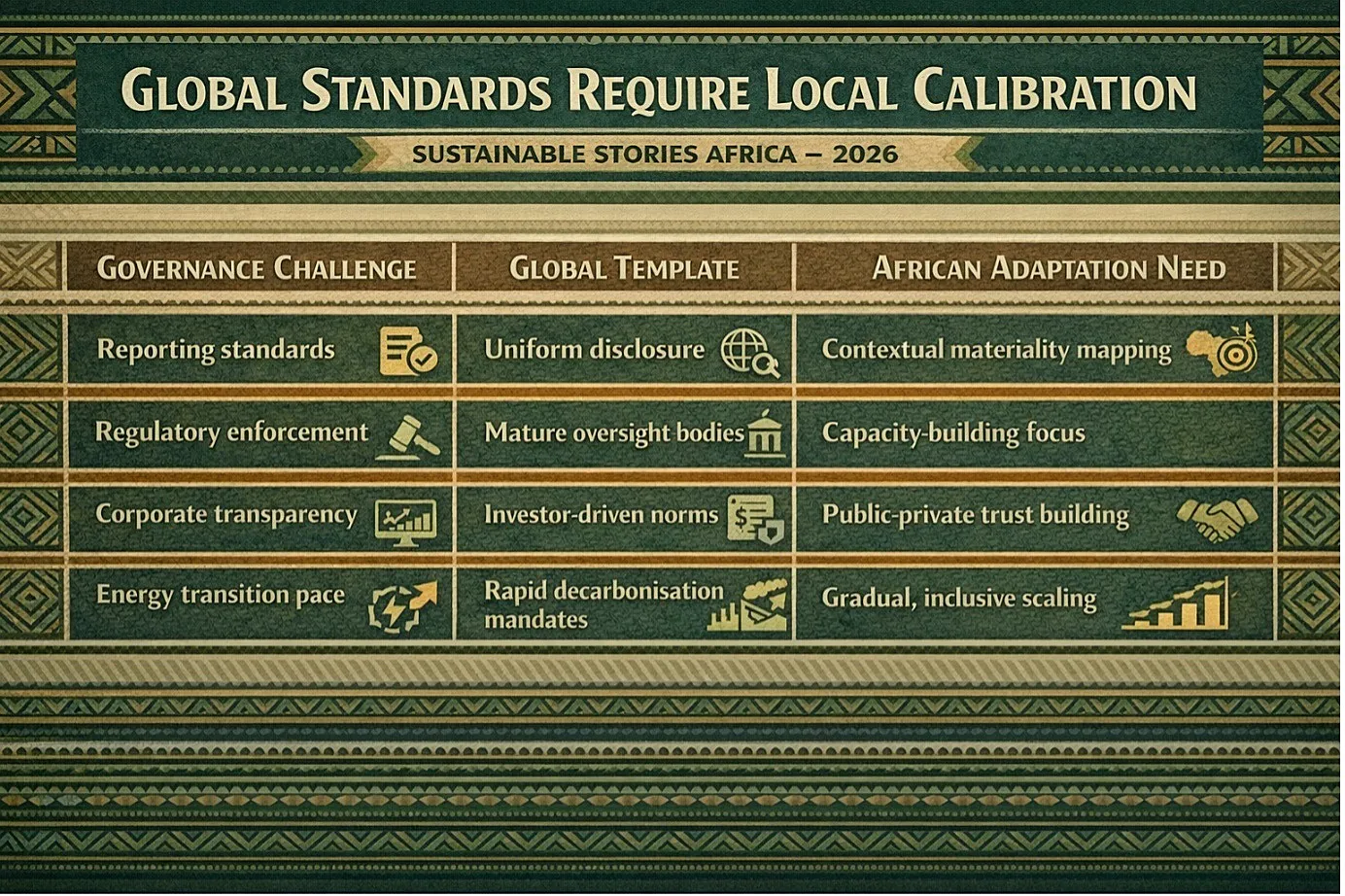
Governance Challenge | Global Template | African Adaptation Need |
|---|---|---|
Reporting standards | Uniform disclosure | Contextual materiality mapping |
Regulatory enforcement | Mature oversight bodies | Capacity-building focus |
Corporate transparency | Investor-driven norms | Public-private trust building |
Energy transition pace | Rapid decarbonisation mandates | Gradual, inclusive scaling |
Experts emphasised that ESG integrity should not become a compliance burden that is detached from developmental priorities.
Instead, it should serve as a framework for transparency, risk mitigation and long-term competitiveness.
Capital Flows Track Governance Signals
Climate finance inflows increasingly depend on measurable ESG performance.
Multilateral lenders and private investors alike are scrutinising governance structures before committing funds.
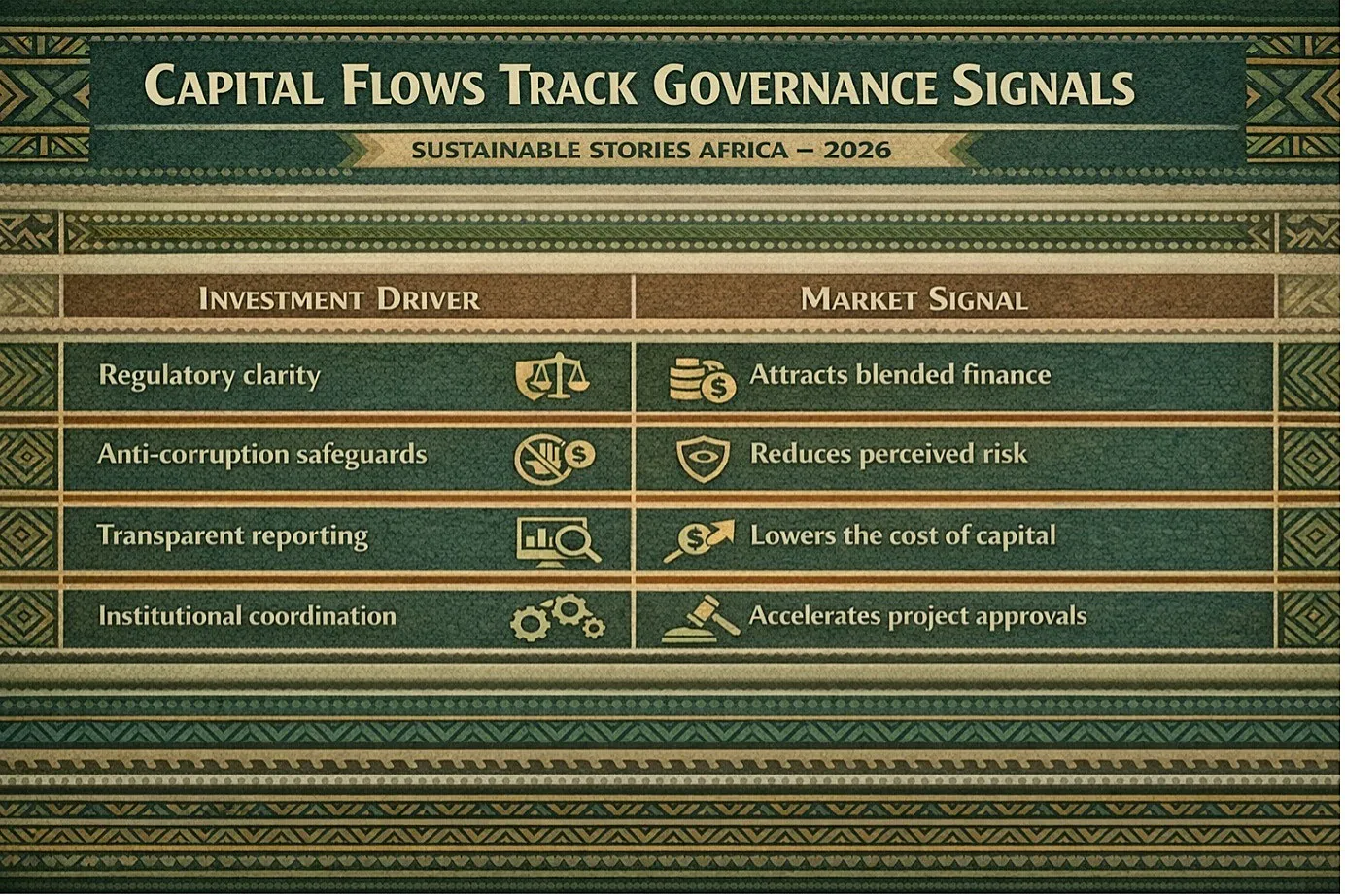
Investment Driver | Market Signal |
|---|---|
Regulatory clarity | Attracts blended finance |
Anti-corruption safeguards | Reduces perceived risk |
Transparent reporting | Lowers the cost of capital |
Institutional coordination | Accelerates project approvals |
Speakers noted that African energy markets competing for international capital must demonstrate both environmental ambition and governance robustness.
Failure to align could slow the deployment of renewable energy and undermine investor confidence.
Integrity Anchors Sustainable Energy Growth
The panel concluded that ESG compliance should be reframed as a strategic advantage rather than a regulatory obligation.
Corporate leaders were urged to embed governance principles into core operations, and not just in sustainability reports.
Governments, meanwhile, were encouraged to harmonise energy policy with anti-corruption frameworks and disclosure standards to reduce fragmentation.
“Africa’s transition must be credible to be bankable,” a speaker emphasised.
The conversation also highlighted the importance of cross-sector collaboration, bringing regulators, corporates and civil society into a unified accountability ecosystem.
Path Forward – Governance Alignment Secures Energy Credibility
Panellists advocated for adaptive ESG frameworks rooted in African economic contexts while aligned with global transparency expectations.
Capacity-building, regulatory harmonisation and institutional strengthening were identified as priorities.
By embedding integrity into energy transition strategies, stakeholders aim to unlock sustainable capital flows, accelerate renewable deployment and ensure Africa’s clean energy ambitions remain both credible and investable.