Africa’s democracy debate is no longer about whether citizens still value democratic rule.
It is about why support for democracy remains high while democratic outcomes, in many countries, remain fragile, uneven, or in retreat.
The strongest entry points are not universal templates. They are locally grounded, politically realistic reforms that target the real bottlenecks blocking accountability, legitimacy, and institutional trust across African markets and states.
Democracy Needs Better Entry Points
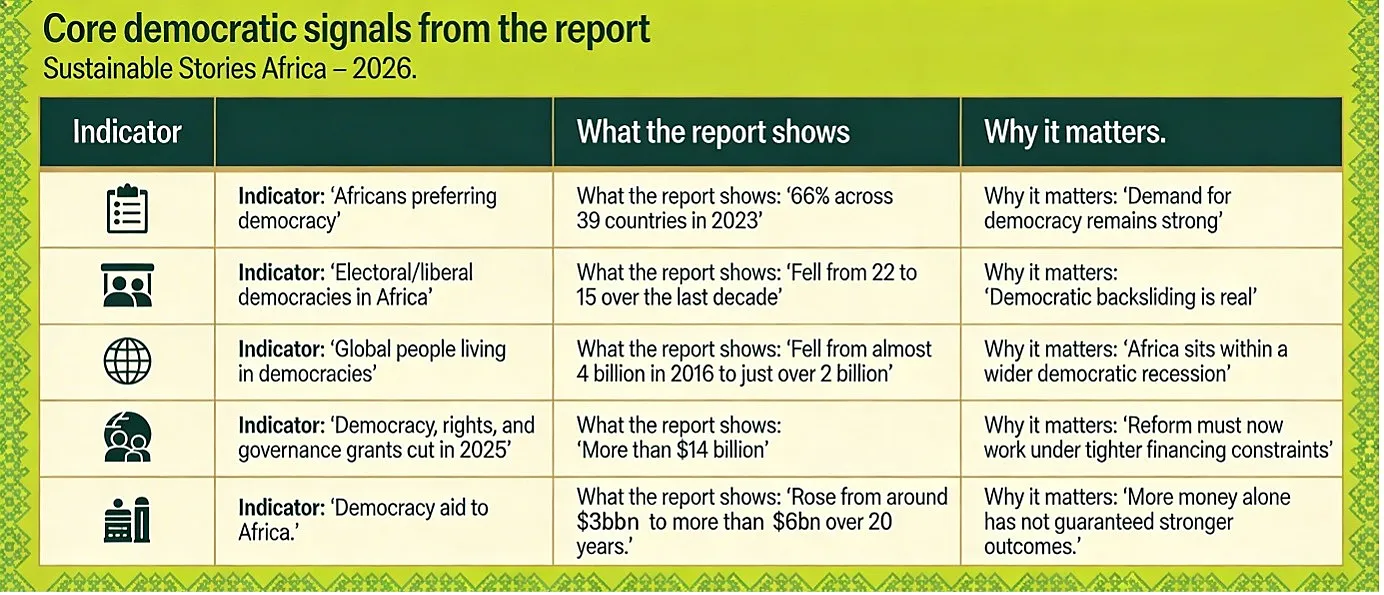
Africa’s democratic development is at a turning point. The broad picture is sobering: the number of electoral or liberal democracies on the continent fell from 22 to 15 over the last decade, even as public demand for democracy remained strong.
Afrobarometer data cited in the report shows that 66% of respondents across 39 African countries in 2023 agreed that democracy is preferable to any other form of government.
That contrast matters. It suggests Africa does not primarily face a crisis of democratic aspiration.
It faces a crisis of democratic delivery, democratic credibility, and democratic design.
Too many systems have failed to convert elections into accountability, institutions into trust, or reform rhetoric into lived legitimacy.
The Brookings report, Entry Points for Strengthening Democratic Development in Africa, gets closest to the real issue by shifting the discussion away from generic democracy promotion and toward practical entry points shaped by context.
Its central lesson is persuasive: Africa’s democratic strengthening will depend less on abstract commitments and more on whether reformers identify the right institutional pressure points in each country.
The democratic problem is now a design problem
The report’s most important conclusion is that Africa’s democratic challenge is not only about regime type, but about institutional fit. Democratic support has often been too broad, externally scripted, fragmented, or disconnected from how power works in practice.
That helps explain why rising democracy aid, from about $3 billion to more than $6 billion over two decades, has not consistently produced deeper democratic outcomes.
The report also shows that support has flowed more heavily into public finance management, civil society, decentralisation and public-sector policy.
It also shows that elections, legislatures, political parties, media freedom and anti-corruption have often received less attention.
That imbalance is political as much as technical. Democratic resilience depends less on funding a standard list of governance than on strengthening the institutions that matter most in each national context.
For African policymakers, reformers, civic actors and investors, the report’s framing is especially useful.
Different democratic trajectories require different responses. Backsliding systems, fragile states and more stable democracies each need tailored support grounded in legitimacy, accountability and institutional credibility.
What the five-country cases actually show
The report’s five case studies, the DRC, Ghana, Kenya, Mali and Zimbabwe, make its core argument more tangible: democratic development in Africa is not moving along a single path.
- Ghana reflects relative democratic steadiness.
- Kenya shows resilience with structural vulnerability.
- DRC remains stuck in an electoral oligarchy.
- Mali has slipped into junta rule.
- Zimbabwe remains locked in hardened electoral authoritarianism.
That diversity helps explain why a one-size-fits-all democracy has repeatedly underperformed.
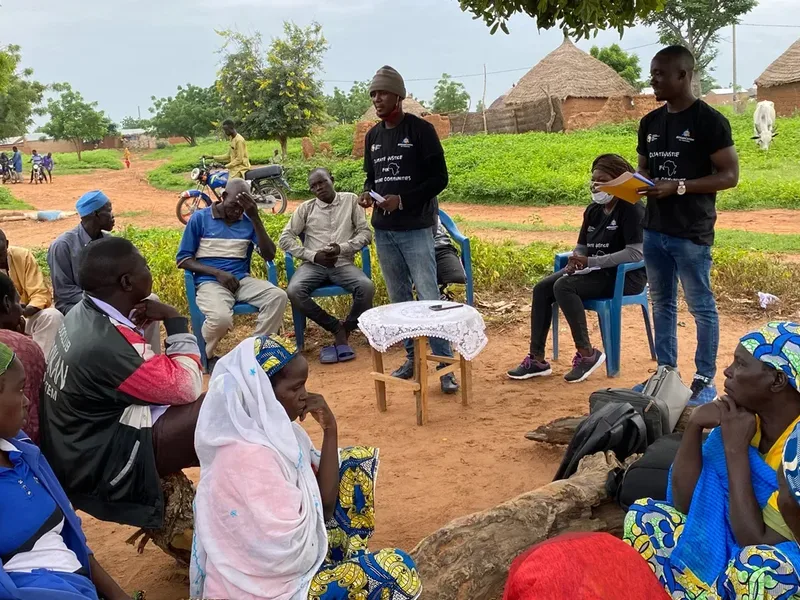
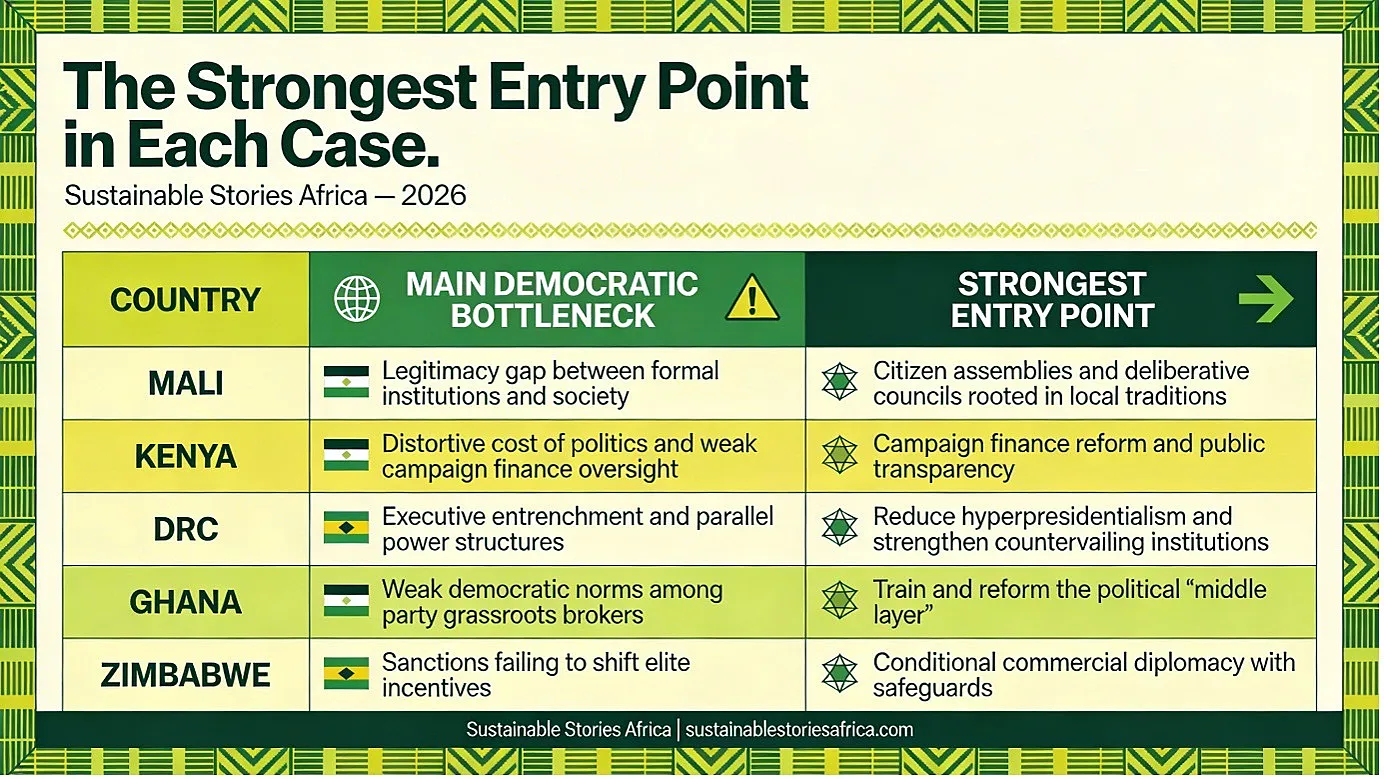
- In Mali, the report makes one of its strongest contributions by arguing that democratic rebuilding should be rooted in local traditions of consultation and deliberation.
It points to chiefs’ consultative meetings in rural areas, urban green social clubs, and earlier citizen forums used during political crises.
Its case for citizen assemblies and deliberative councils is persuasive because it builds from forms of engagement Malians already regard as legitimate.
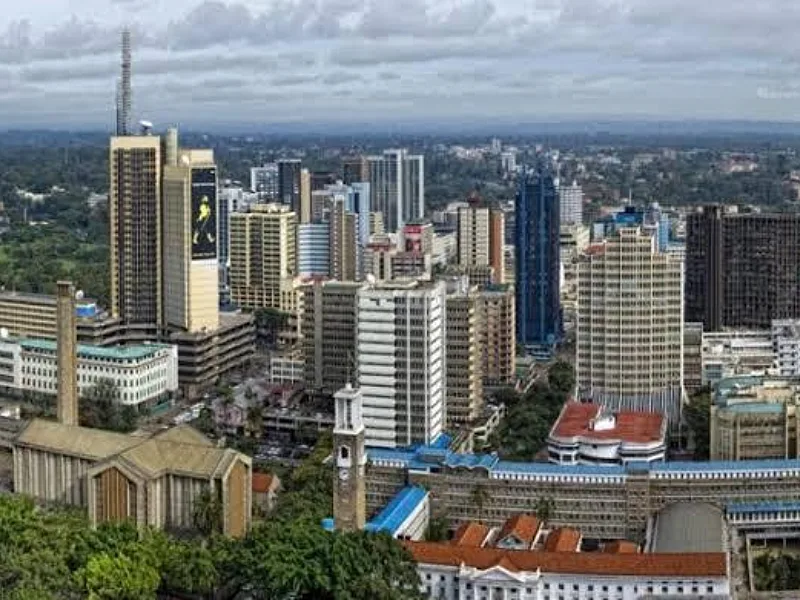
- In Kenya, the report identifies campaign finance as a binding democratic constraint.
When presidential races can cost about $39 million and gubernatorial contests up to $4.7 million, politics becomes structurally exclusionary.
The report’s recommendations, tighter regulation, digitised disclosure, stronger IEBC capacity, sanctions for violations, and firmer civic and media oversight, focus on the institutional plumbing that democratic competition depends on.
- In the DRC, the report identifies hyperpresidentialism as the central obstacle. When executive power weakens oversight bodies, bends electoral institutions, sidelines parliament, and relies on parallel structures, every other reform becomes fragile.
Its recommendations, protecting accountability institutions, improving transparency, exposing parliamentary records, and strengthening opposition parties and civil society, address the concentration of power directly.
Ghana and Zimbabwe highlight two different warnings.
- In Ghana, the report argues that democracy support has overlooked the “middle layer” of party foot soldiers and brokers who can normalise intolerance, vote buying and hostility to media freedom.
- In Zimbabwe, it is blunt that sanctions have not significantly changed elite incentives, and it instead proposes conditional commercial diplomacy tied to labour, environmental, anti-corruption and human-rights safeguards.
What Africa could gain from smarter democratic reform
The real prize is not only cleaner elections, but stronger state legitimacy, lower political volatility, better policy continuity, and more credible markets.
For citizens, that matters directly. When democratic institutions function, service delivery improves, elite impunity becomes harder to sustain, and political grievances are less likely to spill into apathy, unrest, or violence.
The report’s discussion of Mali, Kenya, and the DRC shows that legitimacy gaps and accountability failures are not abstract governance concerns.
They shape security, public trust, and the state of everyday performance. That also matters for business and investors, who struggle in systems marked by opaque campaign finance, executive dominance, and weak regulatory integrity.
The report’s broader point is that Africa needs democratic reform that strengthens fair competition, sharper oversight, more legitimate civic voice, and harder-to-game political incentives.
What should be done now?
The priority is diagnostic discipline.
- First, Governments, donors, civic groups and regional institutions should stop treating democracy support as a standard package.
Each reform effort should begin with a political-economy diagnosis of the main binding constraint, whether that is money in politics, executive overreach, institutional illegitimacy, party weakness, civic repression or elite insulation.
The report is right that scarce resources should not be spread too thinly.
- Second, reform must be more locally authored. Democratic durability depends on institutions people recognise as their own, not on externally designed templates.
The report also argues that the “middle layer” deserves far more attention, because local party actors, grassroots civic networks and community accountability spaces often shape political outcomes most directly.
- Finally, external partners need smarter incentive design. Failed sanctions should not become doctrine, and commercial leverage should be tied to credible safeguards and monitoring.
Path Forward – Reform Must Meet Reality
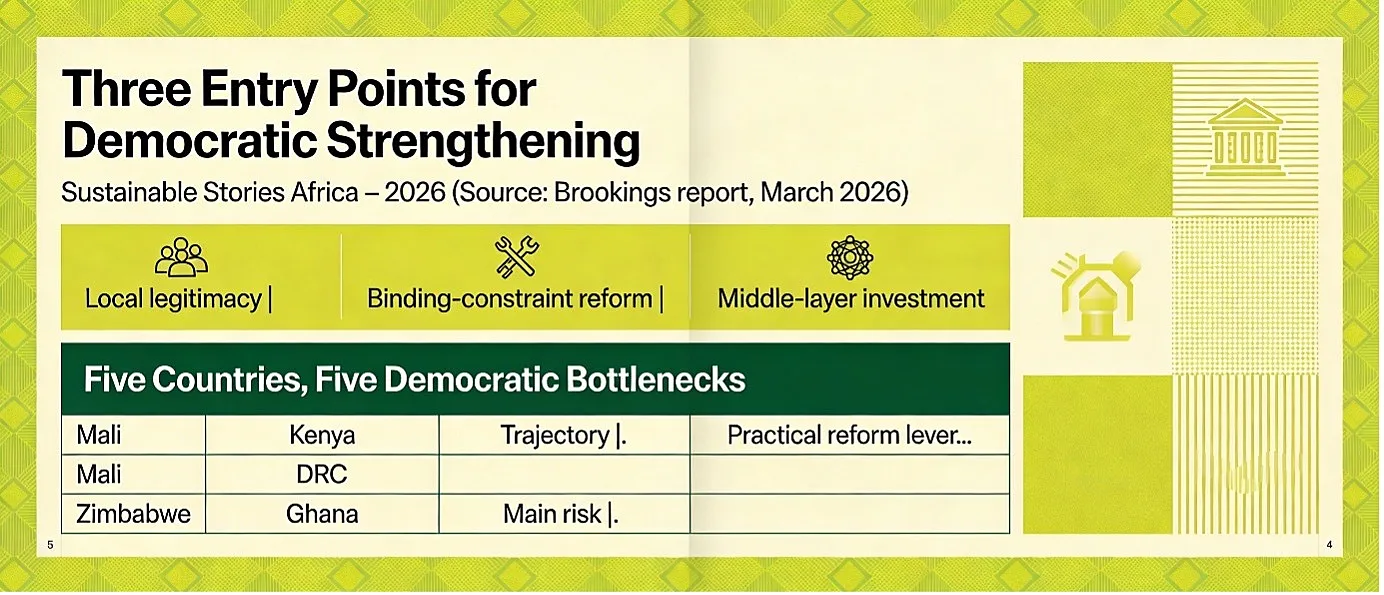
Africa’s democratic development will be strengthened not by louder commitments, but by sharper choices: root reforms in local legitimacy, target the true institutional bottleneck, and invest in the actors who connect citizens to power.
The practical agenda is clear. Backsliding states need smarter incentive structures; resilient democracies need focused institutional repair.
The goal is not democracy as branding, but democracy as a credible public infrastructure.