Africa stands at the centre of the global renewable energy transformation; however, it remains far behind in deployment relative to its potential.
Meeting the UAE Consensus to triple global renewable capacity by 2030 will require unprecedented acceleration in investment, infrastructure and policy alignment.
For Africa, the stakes extend beyond climate goals. Renewable expansion represents the foundation of energy security, industrial growth and economic sovereignty, determining whether the continent emerges as a leader in the global clean energy economy or remains constrained by structural energy deficits.
Renewable acceleration defines Africa’s economic future
Africa’s renewable energy future is no longer optional; it is existential. The UAE Consensus reached at COP28 commits the world to tripling renewable energy capacity and doubling energy efficiency by 2030, marking one of the most ambitious global energy transitions in history.
However, Africa’s current trajectory remains insufficient. Despite possessing some of the world’s richest renewable energy resources, the continent accounts for only a small fraction of global renewable deployment and investment.
The gap presents both risk and opportunity. Accelerating renewable deployment could transform Africa’s economic trajectory, strengthening energy security, unlocking industrial growth and positioning the continent as a decisive force in the global energy transition.
UAE Consensus reshapes global renewable expectations
The UAE Consensus represents a historic turning point in global energy policy. The agreement commits countries worldwide to triple renewable energy capacity by 2030, requiring annual additions of over 1,000 gigawatts globally, more than three times the current rate of deployment.
Renewable energy already represents the fastest-growing energy source globally, but current growth remains insufficient to meet climate targets.
Africa’s role is critical. Despite contributing 60% of the world’s best solar resources, Africa accounts for only 2% of global renewable capacity, highlighting a profound gap in deployment.
This gap represents one of the most significant structural constraints on Africa’s economic development.
Without accelerated renewable expansion, energy shortages will continue to limit industrial growth, job creation and economic transformation.
Renewable investment gaps constrain Africa’s energy transformation
Africa’s renewable deployment gap reflects structural financing, infrastructure and policy challenges.
Africa’s Renewable Energy Deployment Gap
Indicator | Africa | Global |
|---|---|---|
Share of global renewable capacity | 2% | 100% |
Solar resource potential | 60% of the global best resources | Distributed globally |
Annual renewable investment share | Less than 3% globally | Majority concentrated elsewhere |
Electricity access gap | Largest globally | Limited elsewhere |
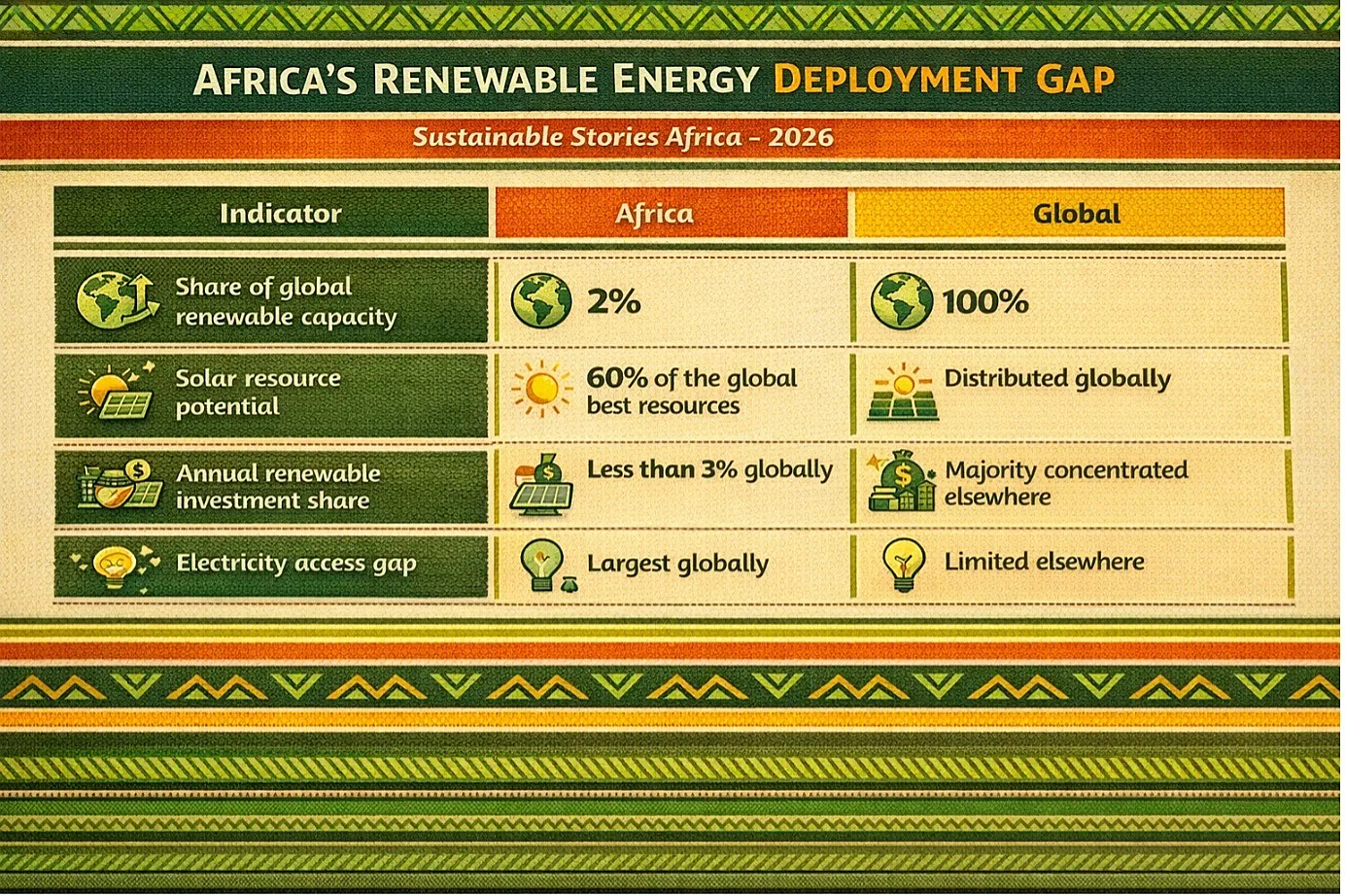
Investment remains heavily concentrated in advanced economies and major emerging markets, leaving Africa underfunded relative to its potential.
Grid infrastructure limitations, regulatory barriers and financing constraints further slow deployment.
Without addressing these structural barriers, Africa risks falling further behind in the global energy transition.
Renewable acceleration unlocks Africa’s economic transformation opportunity
Renewable expansion offers transformative economic benefits.
Renewable energy enables reliable industrial growth by providing affordable electricity, which is essential for manufacturing and economic diversification.
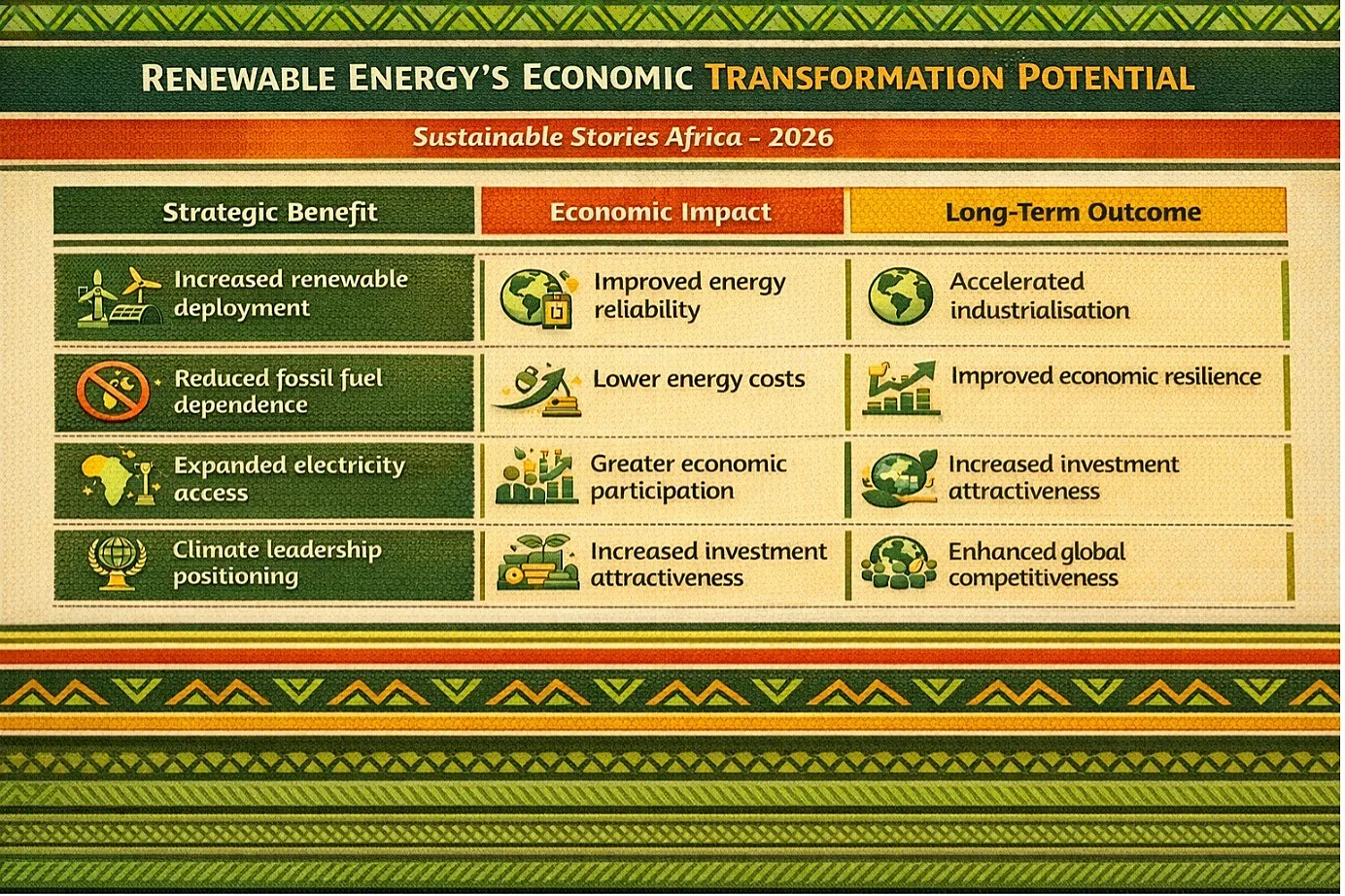
Renewable Energy’s Economic Transformation Potential
Strategic Benefit | Economic Impact | Long-Term Outcome |
|---|---|---|
Increased renewable deployment | Improved energy reliability | Accelerated industrialisation |
Reduced fossil fuel dependence | Lower energy costs | Improved economic resilience |
Expanded electricity access | Greater economic participation | Inclusive economic growth |
Climate leadership positioning | Increased investment attractiveness | Enhanced global competitiveness |
Renewable energy also strengthens energy security by reducing reliance on imported fossil fuels.
This improves fiscal stability and reduces vulnerability to global energy price volatility.
Renewable expansion is therefore not simply an environmental priority; it is an economic strategy.
Policy and investment reforms accelerate renewable deployment
Achieving renewable expansion at scale requires coordinated policy and investment reforms.
Key priorities include:
- Scaling renewable investment – Investment must increase dramatically to meet global renewable deployment targets.
- Strengthening grid infrastructure – Modernising transmission networks is essential to integrate renewable energy at scale.
- Improving regulatory frameworks – Clear, stable policies attract private sector investment and reduce project risk.
- Expanding international partnerships – Global cooperation can mobilise financing and technical support.
- Strengthening institutional capacity – Effective governance ensures efficient deployment and investment utilisation.
Policy alignment between national governments, regional institutions and international partners is essential.
PATH FORWARD – Africa must accelerate renewable deployment urgently
Africa’s renewable future depends on rapidly scaling its investments, strengthening infrastructure development, and aligning policy frameworks with global renewable targets.
Accelerating deployment will require coordinated action across governments, private sector investors and international partners.
By aligning with the UAE Consensus and leveraging its vast renewable resources, Africa can secure energy sovereignty, accelerate industrial growth and position itself as a global leader in the clean energy economy.
Strategic Editorial Analysis (SSA Perspective) - Renewable expansion defines Africa’s global economic position
Africa’s renewable energy transformation represents one of the defining economic opportunities of the century. The UAE Consensus provides a global framework, but Africa must act decisively to translate ambition into reality.
Accelerating renewable deployment will determine whether Africa achieves energy security, economic resilience and sustainable prosperity.
Renewable energy is no longer simply a climate solution. It is Africa’s economic future.