Africa’s economic future will be shaped less by natural resources and more by how effectively it builds, measures and deploys its human capital.
Leaders, policymakers and development experts increasingly agree that skills, education and health outcomes are now the most decisive drivers of sustainable growth.
However, the continent faces a measurement gap. Without reliable human capital data, governments risk underinvesting in the very systems that determine long-term productivity, resilience and competitiveness.
Human Capital Defines Africa’s Growth Frontier
Africa’s economic trajectory is entering a decisive phase, where human capital, rather than commodities, infrastructure or extractive industries, will determine whether countries achieve sustained prosperity.
Policymakers and development leaders are shifting focus towards measuring education quality, workforce readiness and health outcomes as core economic indicators.
Speakers at the “Building Human Capital and Measuring Progress” event emphasised that traditional growth metrics such as GDP fail to capture the structural drivers of long-term productivity.
Instead, human capital indicators increasingly enable clearer insight into economic resilience and future competitiveness.
With Africa projected to account for the world’s largest workforce growth over the coming decades, the ability to invest in, track and improve human capital outcomes will define whether the continent realises its demographic dividend or misses it entirely.
Africa’s Workforce Boom Demands Measurement Urgency
Africa stands at the threshold of the largest workforce expansion in modern history. Over the next two decades, hundreds of millions of young people will enter labour markets across the continent, creating unprecedented economic opportunity, but also significant risk if human capital systems fail to keep pace.
Experts emphasised that economic growth is no longer determined solely by capital investment or infrastructure development. Instead, workforce quality, measured through education attainment, skill levels, and health outcomes, has become the defining factor for productivity and competitiveness.
Without reliable systems to measure human capital progress, governments risk misallocating resources, underinvesting in education quality, and failing to align workforce development with economic transformation strategies.
This shift represents a fundamental redefinition of development priorities.
Measurement Gaps Obscure Africa’s True Progress
One of the central challenges identified was the lack of comprehensive human capital measurement systems across many African countries.
While enrolment rates have improved significantly, education quality, learning outcomes and workforce readiness often remain uneven.
Traditional metrics such as school attendance fail to capture whether students acquire meaningful, economically relevant skills.
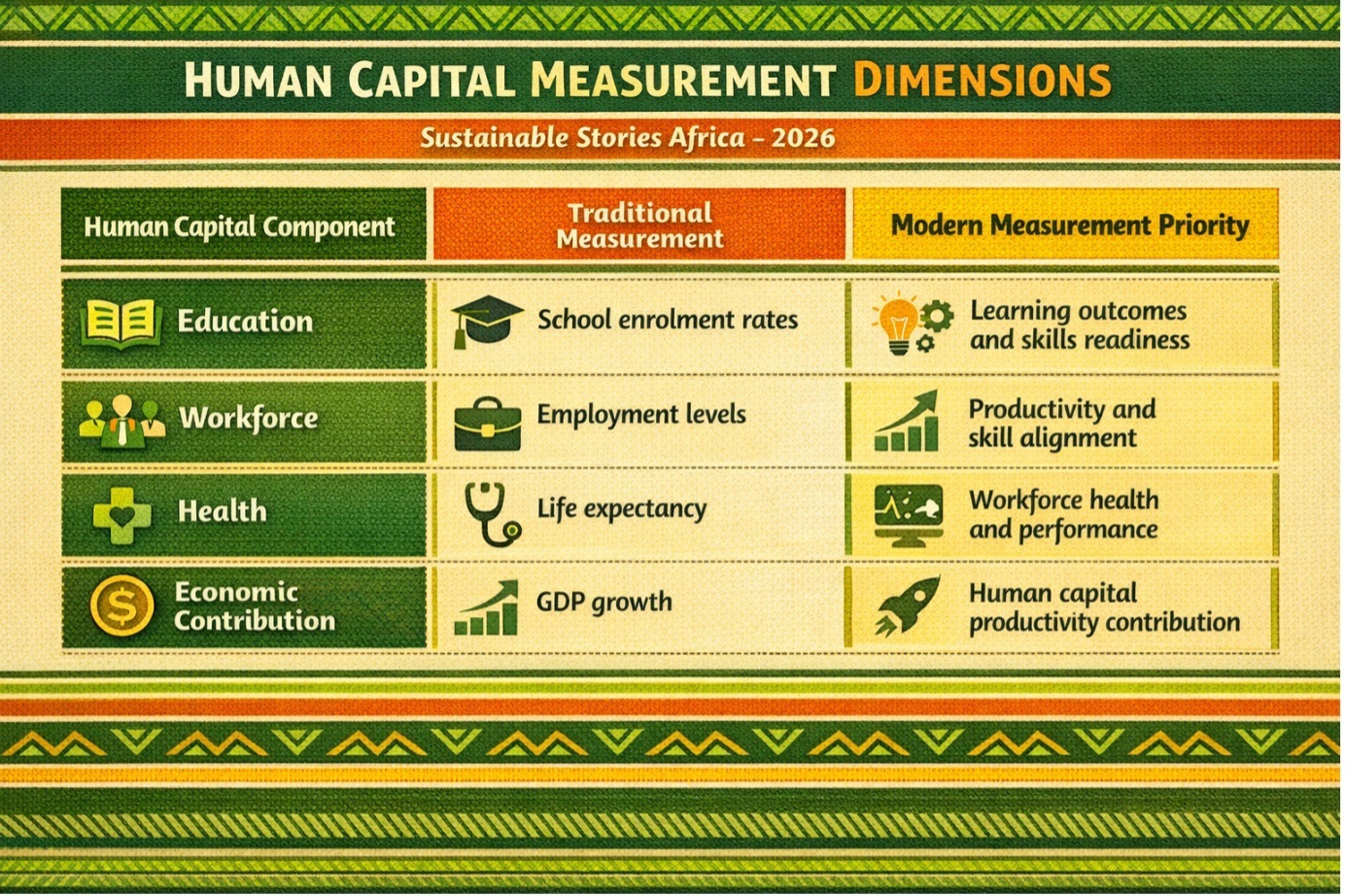
Human Capital Measurement Dimensions
Human Capital Component | Traditional Measurement | Modern Measurement Priority |
|---|---|---|
Education | School enrolment rates | Learning outcomes and skills readiness |
Workforce | Employment levels | Productivity and skill alignment |
Health | Life expectancy | Workforce health and performance |
Economic Contribution | GDP growth | Human capital productivity contribution |
Experts highlighted that improving measurement systems allows policymakers to identify gaps, target interventions effectively, and allocate resources more efficiently.
Countries with stronger human capital measurement systems consistently achieve faster productivity growth and economic diversification.
Investing In People Unlocks Sustainable Growth
The economic case for human capital investment is clear. Countries that improve education quality, workforce skills and health outcomes experience stronger economic growth, greater innovation capacity and increased resilience to global shocks.
Human capital drives productivity across all sectors, from agriculture and manufacturing to technology and the service sectors.
More importantly, human capital investment creates multiplier effects across the entire economy:
- Higher productivity increases national income
- Improved skills attract foreign investment
- Better education systems foster innovation ecosystems
- Healthier populations sustain workforce participation longer
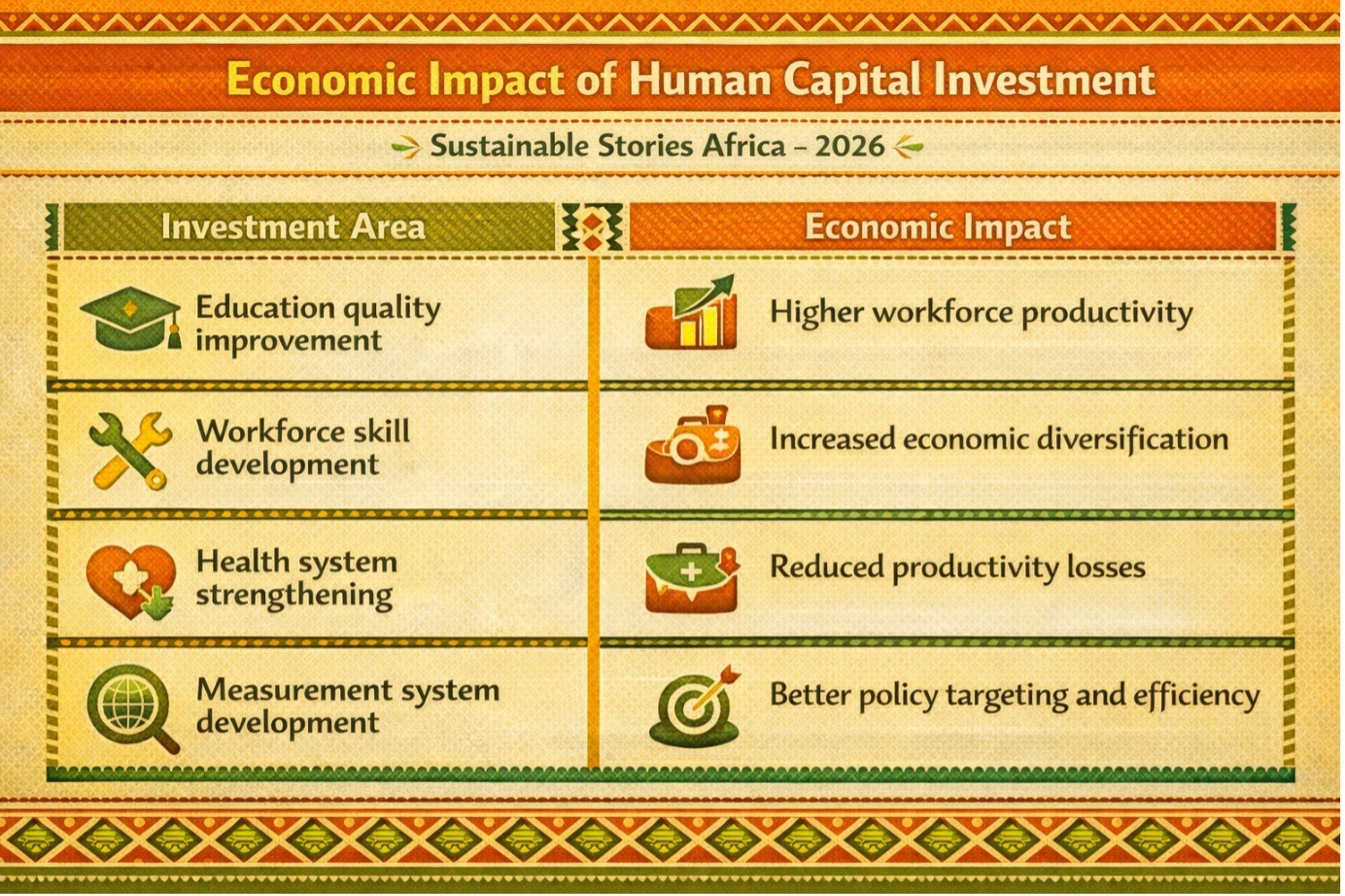
Economic Impact of Human Capital Investment
Investment Area | Economic Impact |
|---|---|
Education quality improvement | Higher workforce productivity |
Workforce skill development | Increased economic diversification |
Health system strengthening | Reduced productivity losses |
Measurement system development | Better policy targeting and efficiency |
Experts emphasised that countries that prioritise human capital measurement and investment position themselves for long-term economic competitiveness.
Governments Must Prioritise Measurement Infrastructure Now
A key recommendation emerging from the discussions is the urgent need for governments to strengthen human capital measurement frameworks.
This includes:
- Developing national human capital indices
- Integrating skills measurement into education systems
- Linking workforce data to economic planning
- Tracking productivity impacts of education and training
Accurate measurement enables evidence-based policymaking, ensuring resources are directed towards interventions with the highest impact.
It also strengthens accountability, allowing governments, investors and citizens to track progress transparently.
For Africa, this represents not just a policy adjustment, but a strategic transformation.
Countries that invest early in measurement systems will gain significant economic advantages.
Path Forward – Measurement Systems Will Define Africa’s Future
Human capital measurement is emerging as a core pillar of Africa’s economic strategy. Governments, institutions and development partners are prioritising systems that track education quality, workforce skills and productivity outcomes.
Strengthening measurement frameworks will enable smarter investment decisions, improve workforce readiness, and position African economies for sustained productivity growth and global competitiveness in the decades ahead.
Strategic Editorial Analysis (SSA Perspective)
The central insight emerging from this discussion is structural: human capital measurement is transitioning from a social policy tool into a core economic management instrument.
Africa’s next phase of economic growth will not be constrained by capital availability, but by how effectively countries develop and measure workforce capability.
Countries that treat human capital as measurable economic infrastructure will achieve faster growth, greater resilience and stronger global competitiveness.
This represents one of the most important economic transitions currently underway across African markets.