Global progress toward the Sustainable Development Goals (SDGs) is entering a decisive phase. With only five years remaining to 2030, deepening debt distress, climate shocks and widening inequality are slowing momentum.
However, multilateral cooperation, science-driven policymaking and renewed financial reform commitments are creating pathways to accelerate progress.
The United Nations Department of Economic and Social Affairs (UN DESA) is emerging as a central institutional force driving global coordination to close implementation gaps and restore development momentum.
Multilateral action shapes sustainable development trajectory
The global sustainable development agenda is entering its most critical phase, with only five years remaining to achieve the Sustainable Development Goals (SDGs).
Escalating geopolitical tensions, climate shocks, debt distress and widening inequality are placing unprecedented strain on progress toward the 2030 targets.
While nearly one in five SDG targets have been achieved or are on track, an equal number have regressed, underscoring the fragile and uneven nature of global development gains.
In response, the United Nations Department of Economic and Social Affairs (UN DESA) is mobilising multilateral cooperation, financing reform, data innovation and institutional capacity-building to accelerate implementation and prevent long-term structural setbacks.
Global crises threaten sustainable development progress
The path to sustainable development has become increasingly complex amid the convergence of a global crisis.
Conflict, economic instability, climate disruption and rising debt burdens are reversing gains and weakening development resilience, particularly across developing economies.
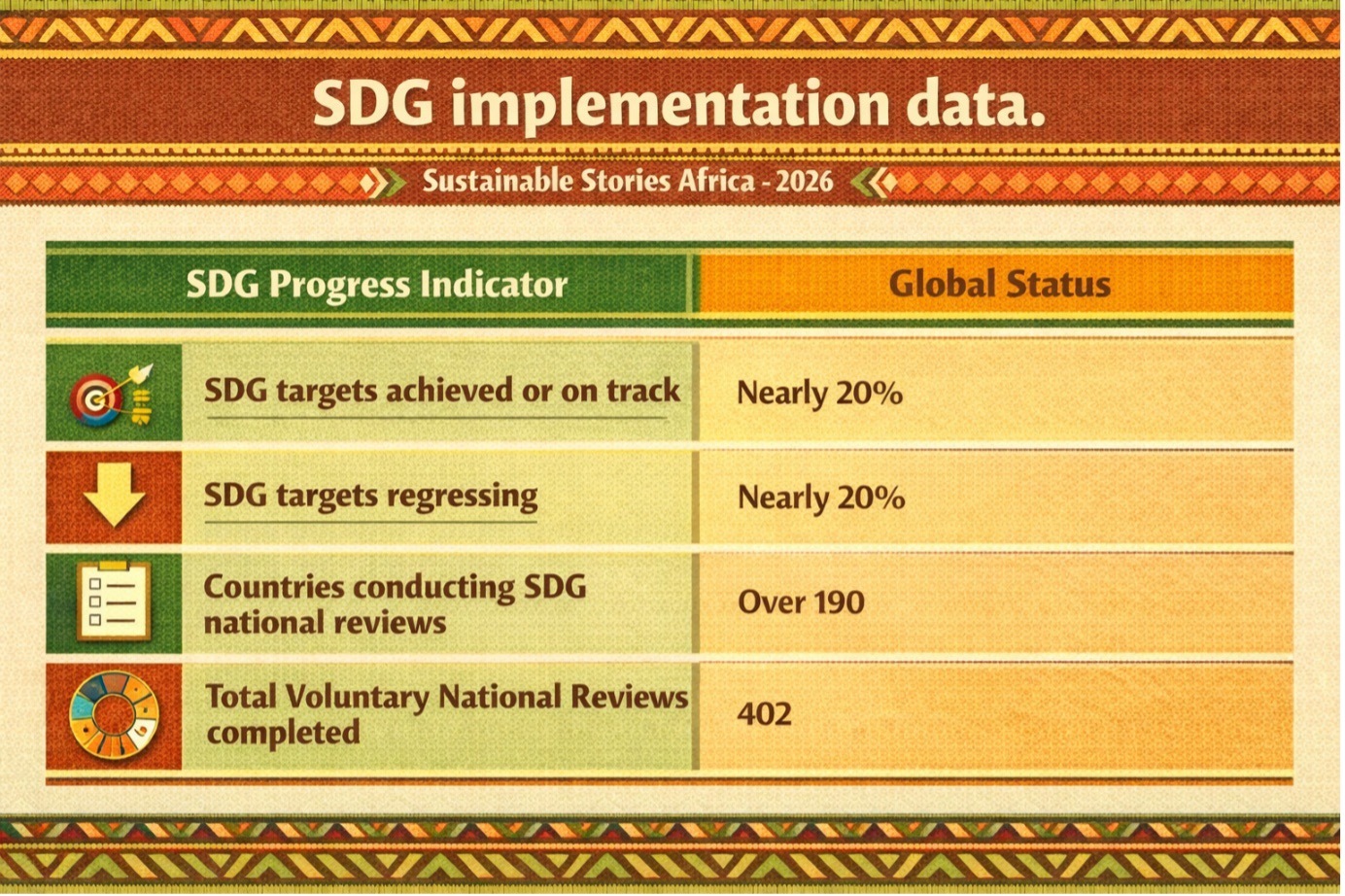
The scale of the challenge is reflected in SDG implementation data:
SDG Progress Indicator | Global Status |
|---|---|
SDG targets achieved or on track | Nearly 20% |
SDG targets regressing | Nearly 20% |
Countries conducting SDG national reviews | Over 190 |
Total Voluntary National Reviews completed | 402 |
This mixed progress highlights a structural inflexion point.
Without accelerated investment, stronger governance and coordinated policy action, global development progress risks stagnation or reversal.
Multilateral cooperation accelerates development implementation globally
UN DESA is emerging as a central institutional engine coordinating global development action.
The Department supports governments across three strategic pillars:
- Policy coordination and intergovernmental negotiations
- Evidence-based economic and social analysis
- Capacity-building and technical implementation support
These functions enable countries to translate global commitments into national development strategies.
The scale of engagement is unprecedented. The 2025 High-Level Political Forum on Sustainable Development attracted approximately 6,000 participants, including heads of state, ministers, private sector leaders and civil society representatives.
Multilateral engagement is also expanding rapidly. UN DESA supported over 123 capacity-building projects across more than 100 countries, while receiving over 105 formal requests for technical assistance in 2024 alone.
This demand reflects the growing reliance on multilateral coordination to navigate increasingly complex development challenges.
Financing reform unlocks sustainable development acceleration
A central priority is reforming the global development financing architecture.
The landmark Sevilla Commitment, adopted at the Fourth International Conference on Financing for Development, mobilised over 15,000 participants, including nearly 50 heads of state, to strengthen sustainable development financing frameworks.
Climate and energy investment commitments are also expanding rapidly.
Global Energy Compact initiatives alone mobilised over $1.4 trillion in commitments, highlighting the scale of capital required to support sustainable transition.
Technology and innovation are becoming critical enablers.
The UN Technology Facilitation Mechanism and AI governance initiatives are helping countries bridge digital divides, strengthen innovation ecosystems and accelerate sustainable economic transformation.
Multistakeholder partnerships are playing a pivotal role.
The SDG Acceleration Actions Platform has already secured over 40 national commitments to accelerate the implementation of the SDGs.
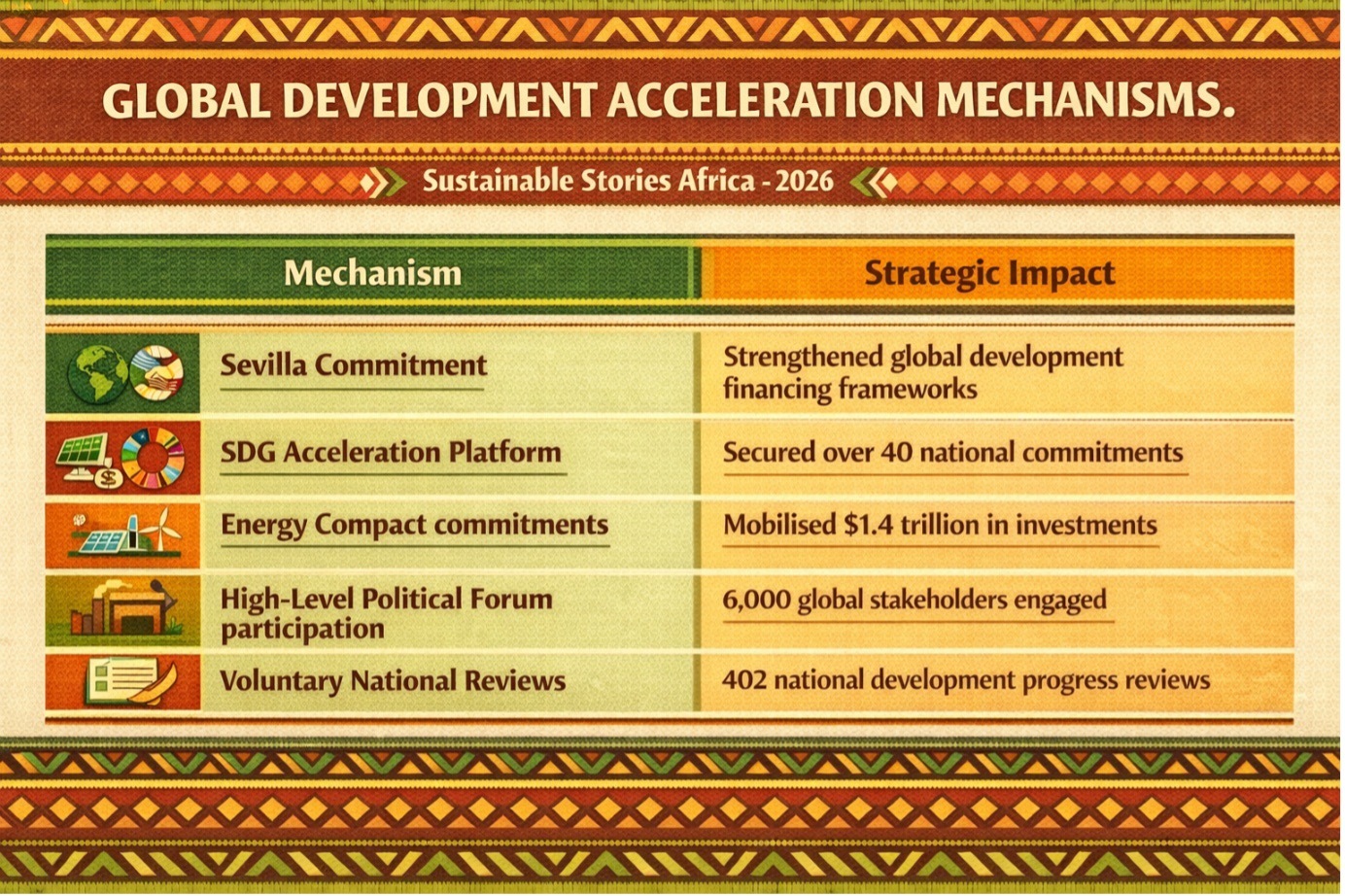
GLOBAL DEVELOPMENT ACCELERATION MECHANISMS
Mechanism | Strategic Impact |
|---|---|
Sevilla Commitment | Strengthened global development financing frameworks |
SDG Acceleration Platform | Secured over 40 national commitments |
Energy Compact commitments | Mobilised $1.4 trillion in investments |
High-Level Political Forum participation | 6,000 global stakeholders engaged |
Voluntary National Reviews | 402 national development progress reviews |
Strategic coordination drives future development success
The next five years represent a decisive window for global development.
UN DESA is prioritising strategic reforms across four core areas:
- Financing reform – Strengthening sustainable investment frameworks and international tax cooperation
- Institutional capacity – Supporting governments to implement SDG-aligned policies
- Data systems – Improving statistical infrastructure for evidence-based decision-making
- Technology adoption – Leveraging AI and innovation to accelerate implementation
These reforms aim to align global capital, policy and technology with sustainable development objectives.
Equally important is strengthening inclusive participation.
Civil society engagement increased significantly, with over 1,100 NGO applications received for UN consultative status in 2025, representing a 34% increase year-on-year.
This surge reflects growing recognition that sustainable development requires whole-of-society engagement.
Multilateral cooperation is no longer optional; it is essential.
PATH FORWARD – Multilateral cooperation defines sustainable development outcomes
Global sustainable development progress will depend on accelerating financing reform, strengthening institutional capacity and scaling multistakeholder partnerships.
Coordinated international action is critical to preventing any regression and restoring implementation momentum.
The next five years represent a decisive opportunity. With sustained investment, technology adoption and inclusive cooperation, global institutions and governments can still achieve transformative progress toward the 2030 Sustainable Development Goals.