The electricity access crisis across Africa is not driven by limitations in technology, but by access to critical capital. Nearly 600 million people remain without power, despite growing investment momentum and proven decentralised energy solutions.
Reaching universal access by 2035 will require annual investments of $15 billion, six times current levels, forcing governments, private investors and development partners to redesign financing models.
Without urgent financial innovation and coordinated capital mobilisation, Africa risks prolonging its energy poverty and limiting economic transformation.
Capital gap defines Africa’s electrification future
Electricity access remains one of Africa’s most consequential development challenges, with nearly 600 million people, almost two out of five Africans, still living without reliable power.
This persistent energy deficit continues to constrain economic productivity, limit social mobility and weaken climate resilience across the continent, according to the Financing Electricity Access in Africa report.
Despite technological improvements in solar home systems, mini-grids and grid expansion, the progress of electrification has declined.
Annual connections averaged fewer than 19 million people in recent years, insufficient to keep pace with Africa’s rapid population growth.
The constraint is no longer technological feasibility; it is financing. Without a structural shift in capital mobilisation, Africa risks extending energy poverty well beyond its universal access targets.
Electricity access crisis reflects financing realities
Africa’s electricity access challenge is fundamentally a financing crisis. Less than $2.5 billion was committed to electricity access projects across sub-Saharan Africa in 2023, significantly below the requirements to close the electrification gap.
At current electrification rates, the continent risks leaving over 520 million people without electricity by 2035, even as population growth accelerates demand for energy services.
This persistent deficit highlights a structural mismatch between investment flows and the need for electrification.
Electricity access is not merely a social objective; it is a prerequisite for economic transformation, industrialisation, healthcare delivery, digital connectivity and climate resilience.
Without electricity, economic opportunity remains constrained.
Financing flows remain insufficient and uneven
Electricity access financing remains heavily dependent on public capital and international development finance, highlighting structural weaknesses in Africa’s energy investment ecosystem.
Private finance accounted for less than 30% of total electricity access funding in 2023, with only $640 million committed compared with $1.8 billion from international public finance providers.
Investment flows are also geographically concentrated. Six countries, Angola, Kenya, Mozambique, Nigeria, Senegal and South Africa, accounted for half of the total electricity access financing, leaving many high-need countries underserved.
This concentration reflects investor preference for lower-risk environments and stronger regulatory frameworks.
Meanwhile, decentralised energy solutions are emerging as critical drivers of electrification.
Mini-grid financing more than doubled between 2019 and 2023, while stand-alone solar home systems attracted $560 million in investment in 2023 alone.
These technologies are faster and provide lower electrification costs, especially in rural areas where grid expansion remains expensive and slow.
However, capital constraints continue to limit the scale of deployment.
Investment expansion unlocks Africa’s electrification potential
Achieving universal electricity access across Africa by 2035 will require approximately $150 billion in cumulative investment, equivalent to $15 billion annually, six times current investment levels.
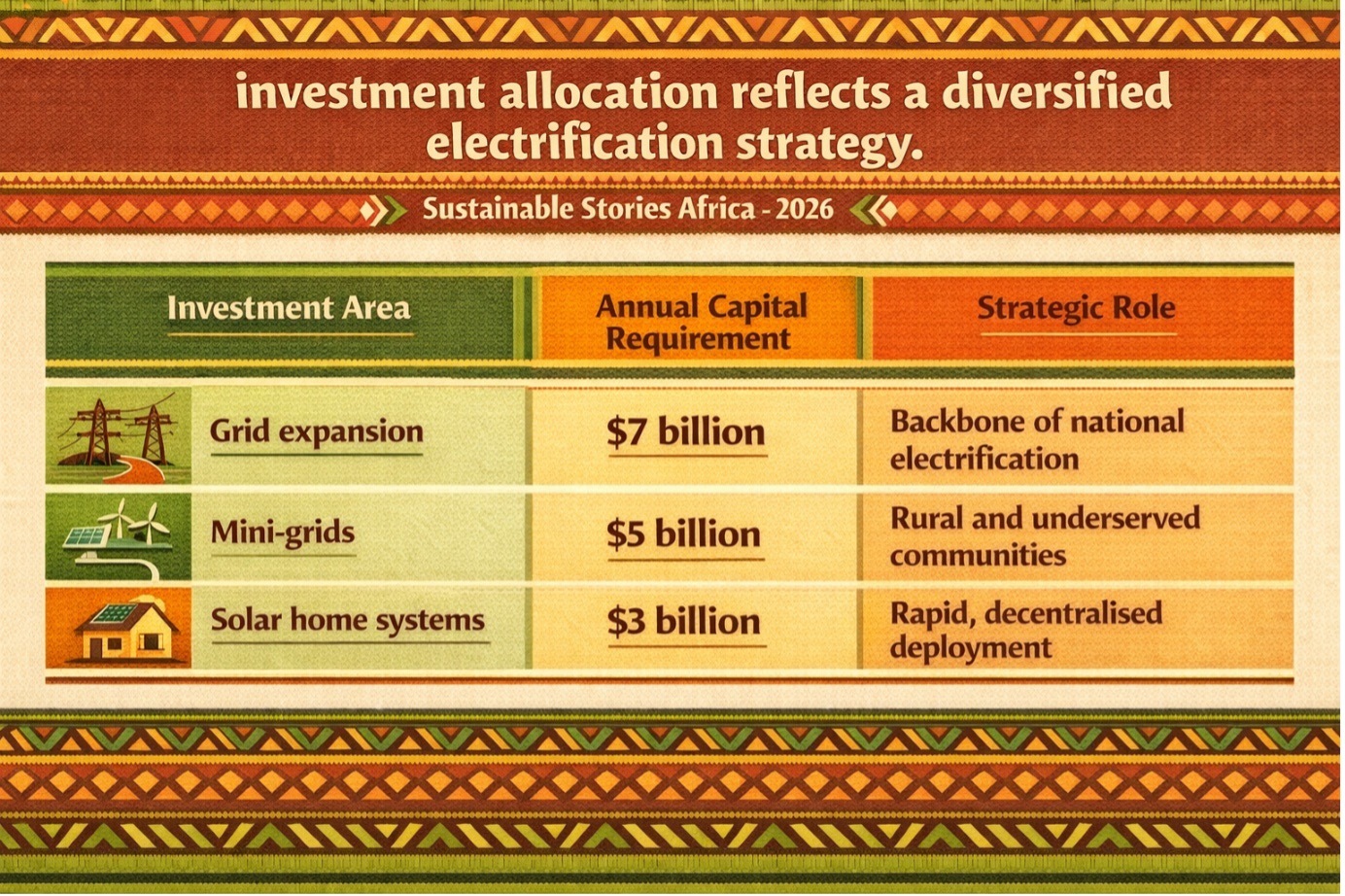
The investment allocation reflects a diversified electrification strategy:
Investment Area | Annual Capital Requirement | Strategic Role |
|---|---|---|
Grid expansion | $7 billion | Backbone of national electrification |
Mini-grids | $5 billion | Rural and underserved communities |
Solar home systems | $3 billion | Rapid, decentralised deployment |
Private capital is expected to play a growing role, accounting for approximately 45% of total investment under the universal access scenario.
Innovative financing tools, including blended finance, concessional loans, green bonds and securitisation, are already expanding capital availability.
These instruments reduce investor risk, unlock institutional capital and accelerate deployment.
Critically, electrification also strengthens economic productivity.
Businesses consume three times as much electricity as households. Public institutions such as schools and healthcare facilities consume up to six times more, making electrification a catalyst for broader economic transformation.
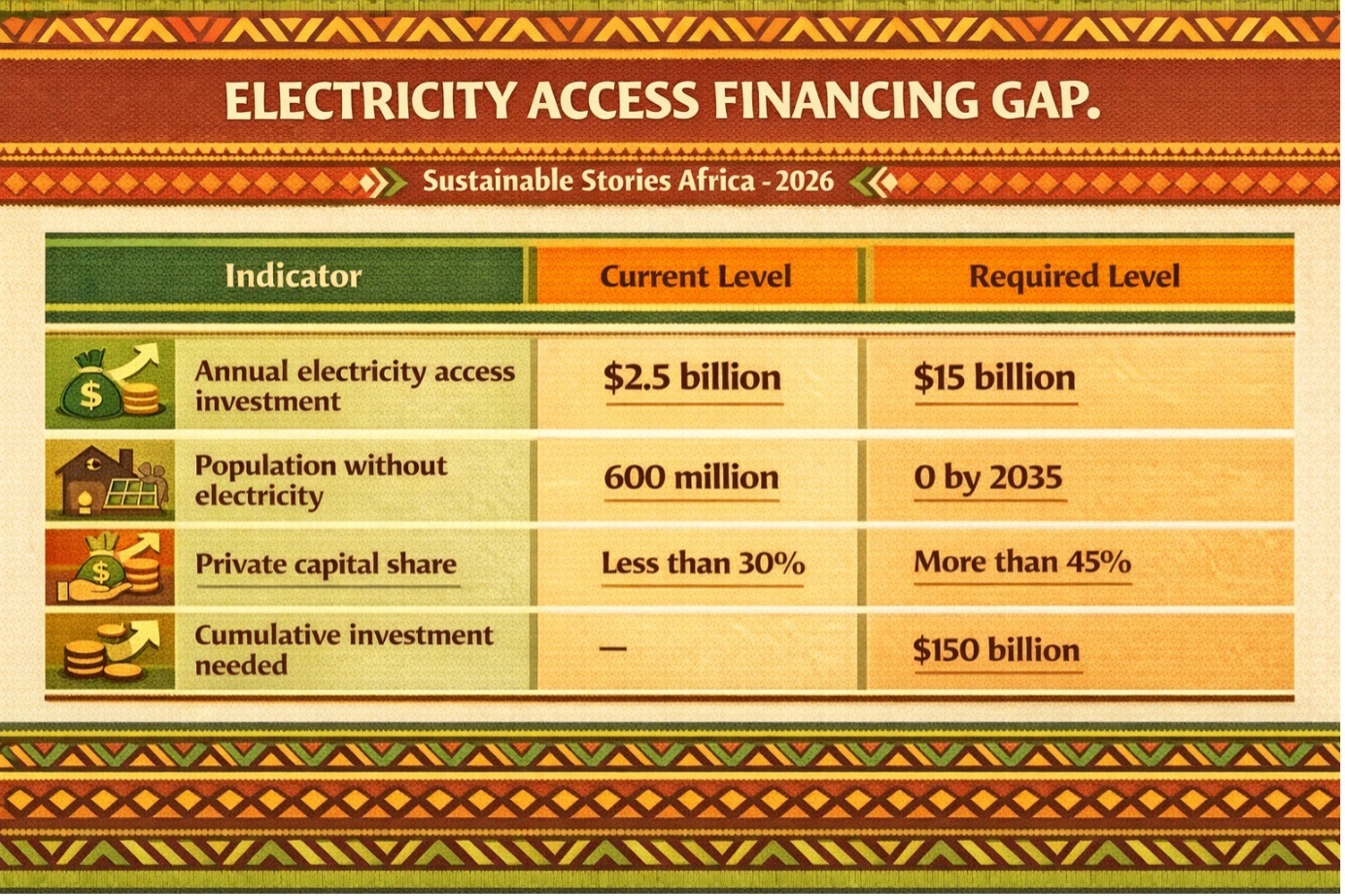
ELECTRICITY ACCESS FINANCING GAP
Indicator | Current Level | Required Level |
|---|---|---|
Annual electricity access investment | $2.5 billion | $15 billion |
Population without electricity | 600 million | 0 by 2035 |
Private capital share | Less than 30% | More than 45% |
Cumulative investment needed | — | $150 billion |
Financial innovation becomes electrification’s defining catalyst
Closing Africa’s electricity access gap will require systemic transformation in capital mobilisation. Public finance will remain essential, particularly concessional funding, grants and risk mitigation tools, to support projects in high-risk or low-income environments.
However, long-term success depends on scaling private capital participation.
Reducing regulatory risk, strengthening local capital markets and deploying blended finance structures can unlock billions of dollars in private sector investment.
Local banks, pension funds and institutional investors must play a larger role in financing the future of electricity across Africa.
Equally important is improving affordability.
Approximately 220 million Africans remain unable to afford basic electricity services without financial support, highlighting the need for targeted subsidies and concessional capital.
Electricity access is not only about infrastructure; it is about inclusion.
The next decade will determine whether Africa closes its energy gap or remains constrained by it.
PATH FORWARD – Strategic financing unlocks Africa’s electrification future
Achieving universal electricity access requires coordinated capital mobilisation across public, private and development finance institutions.
Scaling innovative financing tools, including blended finance, concessional equity and risk mitigation instruments, will be critical to unlocking investment at scale.
Africa’s electrification future depends on strengthening regulatory frameworks, expanding private investment participation and ensuring affordability.
With sustained investment and coordinated action, universal electricity access can become the foundation for economic transformation and inclusive growth across the continent.