The global economy is undergoing a quiet but profound shift. Long-term growth, the engine of jobs, prosperity, and development, is slowing across regions, threatening the ability of emerging economies, especially in Africa, to close income gaps and finance climate and infrastructure transitions.
However, the same forces hindering growth, investment weakness, demographic change, and trade fragmentation, can also be reversed.
With bold policy reforms, climate-aligned investment, and expansion of digital-driven services, Africa and other emerging economies can redefine the trajectory of global growth.
Slowing Growth Redefines Global Economic Future
The world’s economic engine is losing momentum. Long-term global growth, the sustainable pace at which economies expand without triggering inflation, is projected to fall to its slowest rate in decades, reshaping prospects for prosperity, investment, and development.
The World Bank’s Potential Growth Prospects Long-Term Report, Pages 389-523, highlights that the loss of momentum reflects structural forces rather than temporary shocks.
Productivity gains have weakened, investment growth has slowed, and labour force expansion is decelerating globally.
For emerging markets and developing economies, including much of Africa, the implications are profound: slower growth reduces opportunities to close income gaps and finance development priorities.
However, this moment also presents an inflexion point. Strategic investment, policy reform, and digital transformation could reverse declining growth trajectories, unlocking new engines of productivity and resilience.
Silent Structural Forces Undermining Future Prosperity
The global growth slowdown is not a cyclical downturn; it is structural. According to the World Bank, potential global GDP growth is expected to decline to approximately 2.2% annually between now and 2030, down sharply from 3.5% in the early 2000s, reflecting weakening investment, productivity, and labour force expansion.
For emerging markets and developing economies (EMDEs), potential growth is projected to decline even more sharply, from 6% annually in the 2000s to around 4% over the remainder of this decade, reducing their ability to achieve convergence with advanced economies.
This shift has profound consequences. Potential growth determines wage growth, investment returns, fiscal sustainability, and the ability to finance climate transition. Slower growth weakens each of these pillars simultaneously.
For Africa, where demographic expansion and infrastructure investment needs remain high, slower growth risks widening inequality and delaying structural transformation.
Structural Drivers Weakening Global Growth Momentum
The slowdown is driven by simultaneous deterioration across the fundamental pillars of growth: productivity, investment, labour, and trade.
Structural Drivers of Global Growth Slowdown
Growth Driver | Past Performance | Current Trend | Impact on Growth |
|---|---|---|---|
Investment Growth | Strong expansion pre-2010 | Growth halved in the recent decade | Reduced capital formation |
Productivity Growth | Rapid technology-driven gains | Significant slowdown | Lower output efficiency |
Labour Force Growth | Expanding working-age population | Ageing populations globally | Reduced labour supply |
Trade Integration | Trade growth exceeded GDP growth | Trade now grows roughly in line with GDP | Reduced efficiency gains |
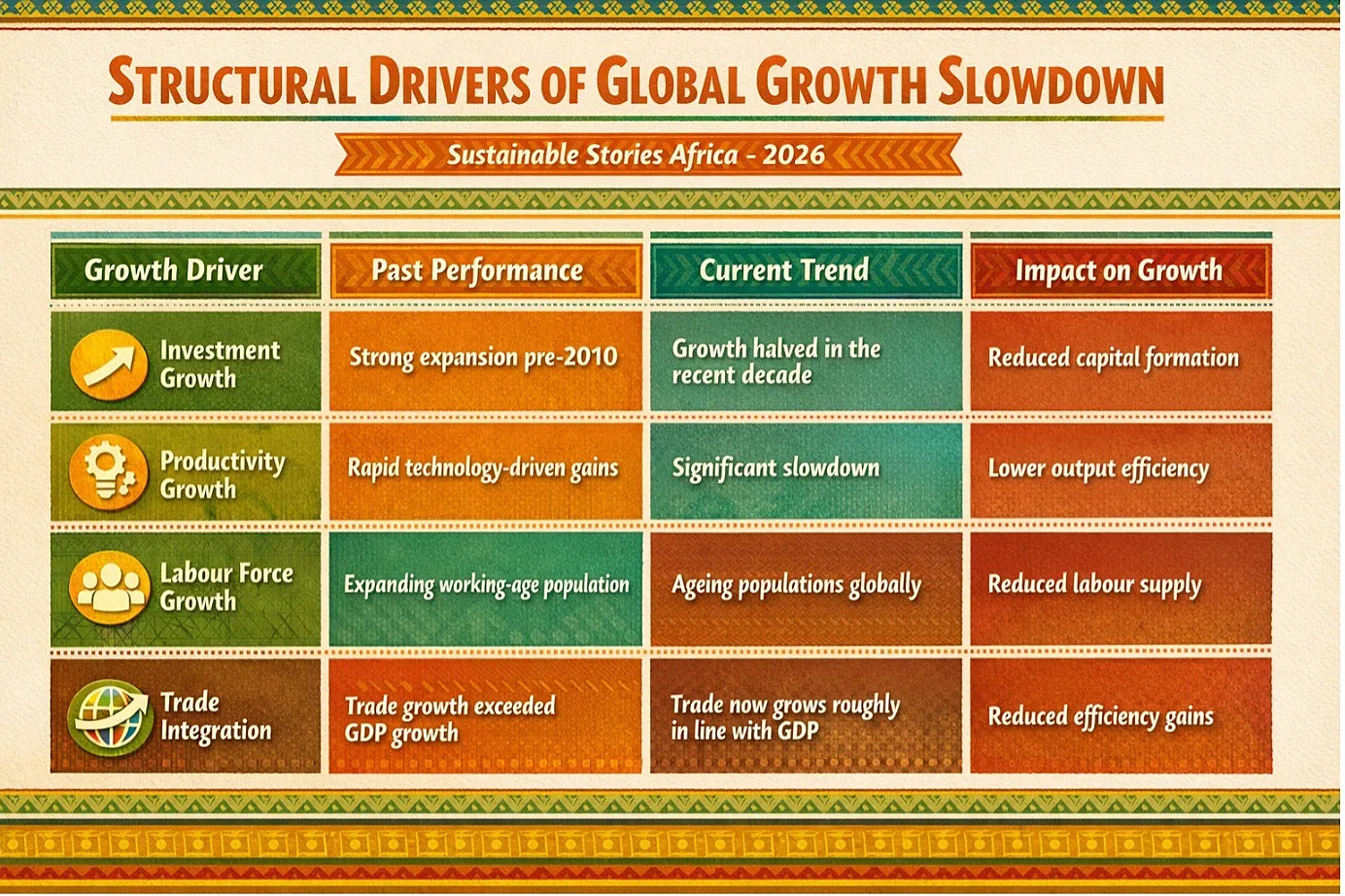
These forces reinforce each other. Weak investment reduces productivity growth. Lower productivity reduces income growth. Slower income growth reduces investment incentives.
The services sector, however, represents a counterbalancing force. Digitally delivered services exports have expanded rapidly, particularly in ICT-enabled sectors, creating new pathways for growth.
Digital transformation has reshaped the growth equation. Services exports, technology adoption, and digital productivity improvements offer emerging economies new opportunities to leapfrog traditional industrialisation pathways.
For Africa, this presents a strategic opportunity. Digital infrastructure investments can unlock services-led growth, accelerating productivity and global competitiveness.
Strategic Reforms Can Reverse Growth Decline
Despite the structural slowdown, the future remains open, not predetermined. The World Bank estimates that coordinated global reforms could increase potential global growth by 0.7 percentage points, reversing much of the expected slowdown.
Policy Actions and Potential Growth Impact
Policy Action | Growth Impact | Strategic Benefit |
|---|---|---|
Increased infrastructure investment | Significant | Boost productivity and jobs |
Digital and services sector expansion | High | Accelerate productivity gains |
Trade facilitation reforms | Moderate-High | Reduce costs, improve competitiveness |
Female labour force participation expansion | Moderate | Increase workforce size |
Climate-aligned investment | High | Improve resilience and growth sustainability |
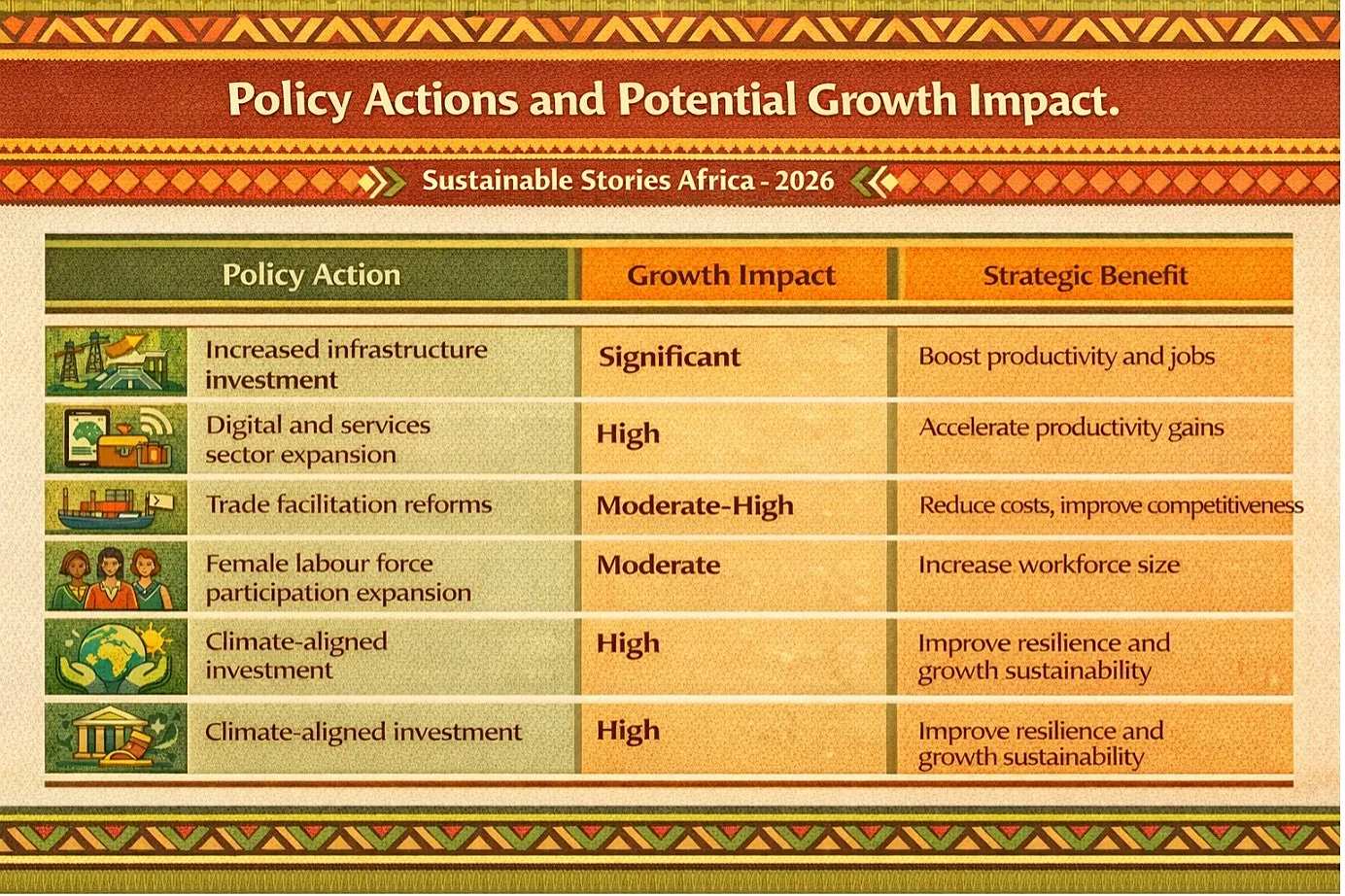
Climate-aligned investment represents one of the most transformative levers. Investments in renewable energy, resilient infrastructure, and sustainable agriculture can simultaneously boost productivity and strengthen resilience.
Similarly, institutional reforms, including stronger governance, regulatory clarity, and macroeconomic stability, can unlock private sector investment and innovation.
Services-led growth, driven by digital transformation, represents perhaps the most scalable pathway.
Digital services exports require less physical infrastructure and offer higher potential for productivity growth.
For Africa, this creates a unique strategic advantage. With the world’s youngest population and rapidly expanding digital adoption, the continent can bypass legacy industrial constraints.
Africa Must Lead Global Growth Reinvention
Africa’s growth trajectory will not be determined only by global forces, but by domestic policy choices and strategic investment decisions.
Three priorities stand out.
- First, accelerating infrastructure investment is essential. Energy, transport, and digital infrastructure underpin productivity and private sector development.
- Second, expanding digital capacity and services exports can unlock productivity gains. Digital connectivity transforms labour productivity, expands markets, and reduces structural constraints.
- Third, strengthening institutional governance can unlock private investment. Investor confidence depends on regulatory predictability, macroeconomic stability, and transparent governance.
The stakes are high. Slower growth limits fiscal capacity, increases debt vulnerability, and constrains development progress.
However, decisive action can reverse the trend. Growth is not simply inherited; it is engineered.
Africa’s future prosperity depends on policy choices made today.
Path Forward – Strategic Policy Action Will Shape Growth
Reversing the global growth slowdown requires sustained investment in infrastructure, digital transformation, and climate-aligned development.
Governments must strengthen institutional frameworks, attract private capital, and expand labour force participation, particularly among women and youth.
For Africa, the opportunity is clear. By prioritising digital services expansion, strengthening governance, and accelerating climate-aligned infrastructure investment, the continent can transform structural headwinds into engines of long-term prosperity and resilience.