Artificial intelligence will not wait for Africa to be ready. It is already reshaping governance, growth, and power across regions.
The question is not whether Africa adopts AI, but whether it does so on its own terms — or inherits another architecture of dependence.
AI Neutrality Is a Dangerous Myth
The most dangerous myth about artificial intelligence is that it is neutral.
The UNDP’s “The Next Great Divergence” warns that AI is accelerating faster than any prior general-purpose technology, concentrating early gains in countries with high-level infrastructure, data, and governance capacity. Part 3 of the report, found on pages 82–114, lays out something more sobering: inclusive AI does not happen by default. It must be designed, sequenced, governed, and measured.
From an African vantage point, this is not an abstract policy debate. It is a familiar historical pattern. Every major technological revolution, such as the steam engine, electricity, and computing, widened global divides before narrowing them. Africa cannot afford to assume convergence will come later.
If AI becomes foundational infrastructure like power or roads, then governance decisions made in Beijing, Washington, Brussels, or Seoul will shape opportunity in Nairobi, Lagos, and Accra. The stakes are generational.
AI Will Reorder Global Power
AI is not simply another productivity tool. It is infrastructure.
The UNDP frames AI as a general-purpose technology whose diffusion depends on both hard infrastructure (computers, connectivity, data centres) and soft capacity (skills, institutions, governance, regulation). Countries that align these levers early accumulate compounding advantages.
Africa enters this race with uneven starting points:
- Lower broadband penetration in many regions
- Limited domestic compute infrastructure
- High dependency on imported cloud platforms
- Fragmented regulatory frameworks
The result is predictable: AI dividends accrue first to countries already AI-prepared.
In UNDP’s policy sequencing framework (Immediate, Medium, Long-Term horizons), early movers institutionalise advantages within 0–24 months. For late adopters, catching up becomes structurally harder.
We have seen this story before in industrialisation, manufacturing value chains, and digital platforms.
The difference now is speed.
Governance Is the Real Battleground
Pages 82–114 shift the debate from hype to implementation. They emphasise three pillars:
- Put people first
- Govern innovation responsibly
- Build future-ready systems
This triad is not philosophical. It is strategic.
Consider governance capacity. Countries with existing data registries, procurement reform, AI literacy programs, and independent oversight bodies can operationalise AI responsibly.
Others risk vendor lock-in, opaque decision systems, and algorithmic dependency.
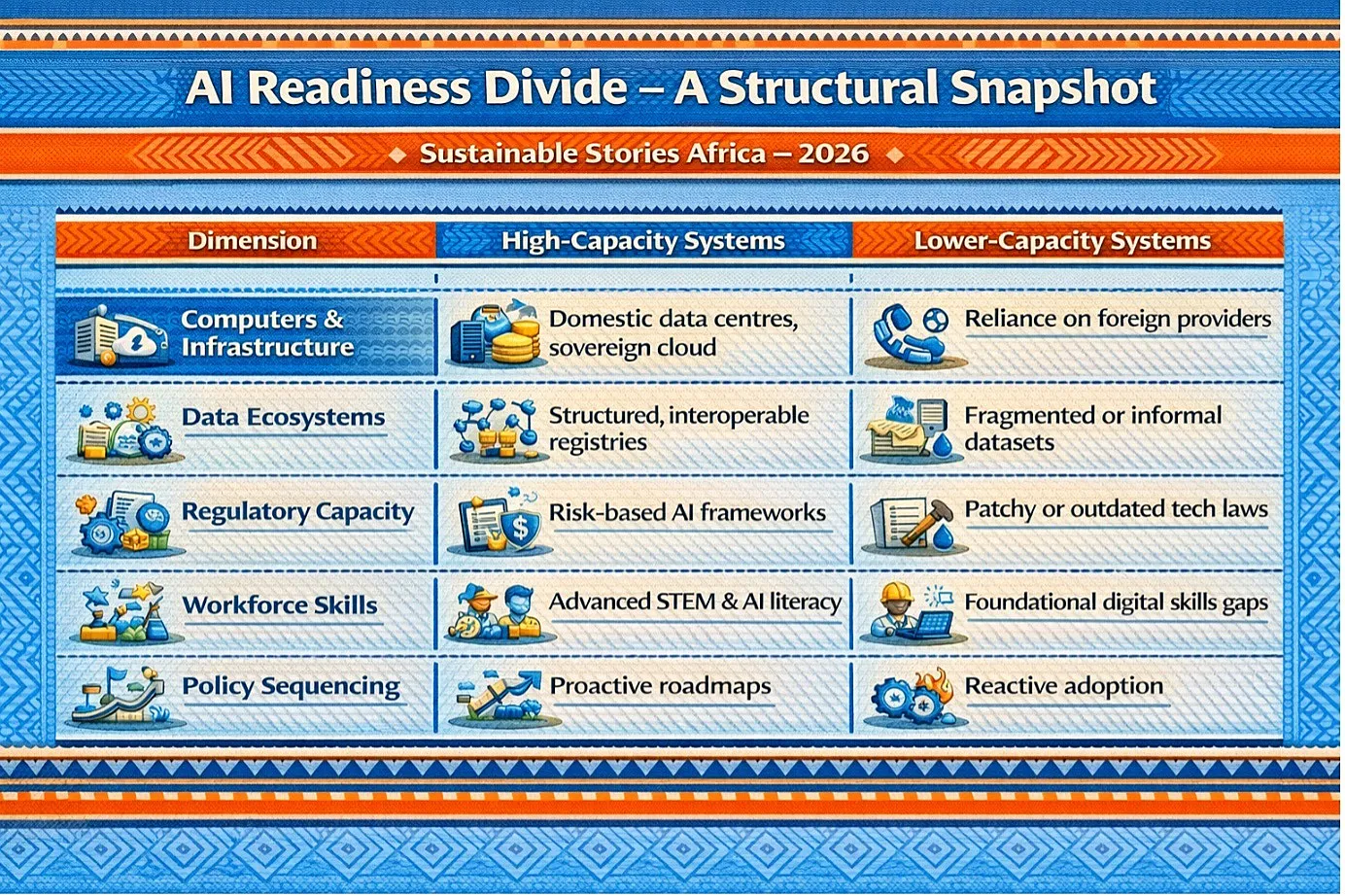
AI Readiness Divide – A Structural Snapshot
Dimension | High-Capacity Systems | Lower-Capacity Systems |
|---|---|---|
Compute & Infrastructure | Domestic data centres, sovereign cloud | Reliance on foreign providers |
Data Ecosystems | Structured, interoperable registries | Fragmented or informal datasets |
Regulatory Capacity | Risk-based AI frameworks | Patchy or outdated tech laws |
Workforce Skills | Advanced STEM & AI literacy | Foundational digital skills gaps |
Policy Sequencing | Proactive roadmaps | Reactive adoption |
Africa sits across this spectrum, Rwanda experimenting with digital public infrastructure, Nigeria scaling fintech ecosystems, Kenya deploying AI in agriculture; however, continent-wide coherence remains fragile.
A senior African policymaker recently told me: “We are consuming AI, not shaping it.” That is the core risk.
Africa’s Leapfrogging Moment
The UNDP framework does not assume divergence is inevitable. It explicitly argues that policy choices determine diffusion outcomes.
Africa has leapfrogged before:
- Mobile banking bypassed traditional banking infrastructure.
- Renewable micro-grids bypassed centralised fossil systems.
- Digital ID systems accelerated inclusion in select markets.
AI could unlock:
- Precision agriculture for climate-stressed regions
- Early disease diagnostics in rural health systems
- AI-enabled education in local languages
- Smart urban management in rapidly expanding cities
But only if designed intentionally.
Voices from the Ground
A Kenyan agritech founder put it plainly: “If AI models are trained on Iowa corn and not Turkana maize, they won’t work here.” Data sovereignty is not ideology; it is functionality.
An Ethiopian policy analyst added, “We don’t just need AI tools. We need AI institutions.”
That distinction matters. Tools can be imported. Institutions must be built.
Five Strategic Imperatives for Africa
Drawing from UNDP’s policy sequencing (Immediate 0–12 months; Medium 1–2 years; Long-term 3–5 years), Africa’s agenda should prioritise:
- Build Digital Public Infrastructure First – Connectivity, interoperable ID systems, secure data frameworks.
- Develop Regional AI Governance Frameworks – African Union–aligned standards to prevent regulatory fragmentation.
- Invest in Local Data Ecosystems – Representative datasets in African languages and contexts.
- Sequence Skills Development – From foundational digital literacy to advanced AI engineering.
- Guard Against Vendor Dependency – Negotiate technology partnerships that prioritise transfer, not extraction.
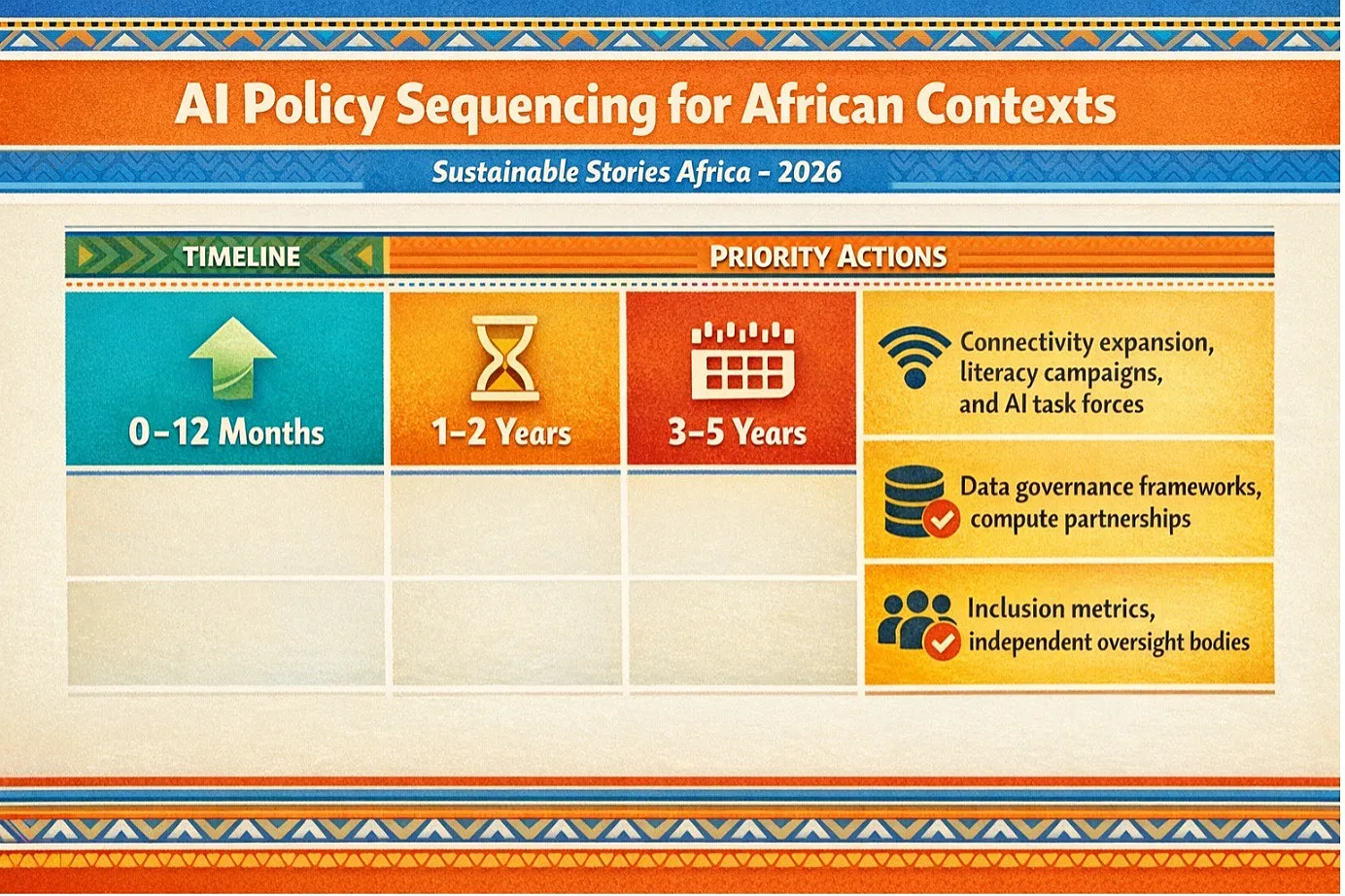
AI Policy Sequencing for African Contexts
Timeline | Priority Actions |
|---|---|
0–12 Months | Connectivity expansion, literacy campaigns, and AI task forces |
1–2 Years | Data governance frameworks, compute partnerships |
3–5 Years | Inclusion metrics, independent oversight bodies |
Africa must move in parallel on hard infrastructure and soft capacity.
Ethics without infrastructure invites irrelevance.
Path Forward – Build Sovereign, Inclusive AI
Africa’s AI moment is not about catching up. It is about refusing to repeat history.
If the continent invests in people-first governance, regional cooperation, and institutional capacity, AI can narrow capability gaps rather than widen them.
The Next Great Divergence is not predetermined. However, it is accelerating.