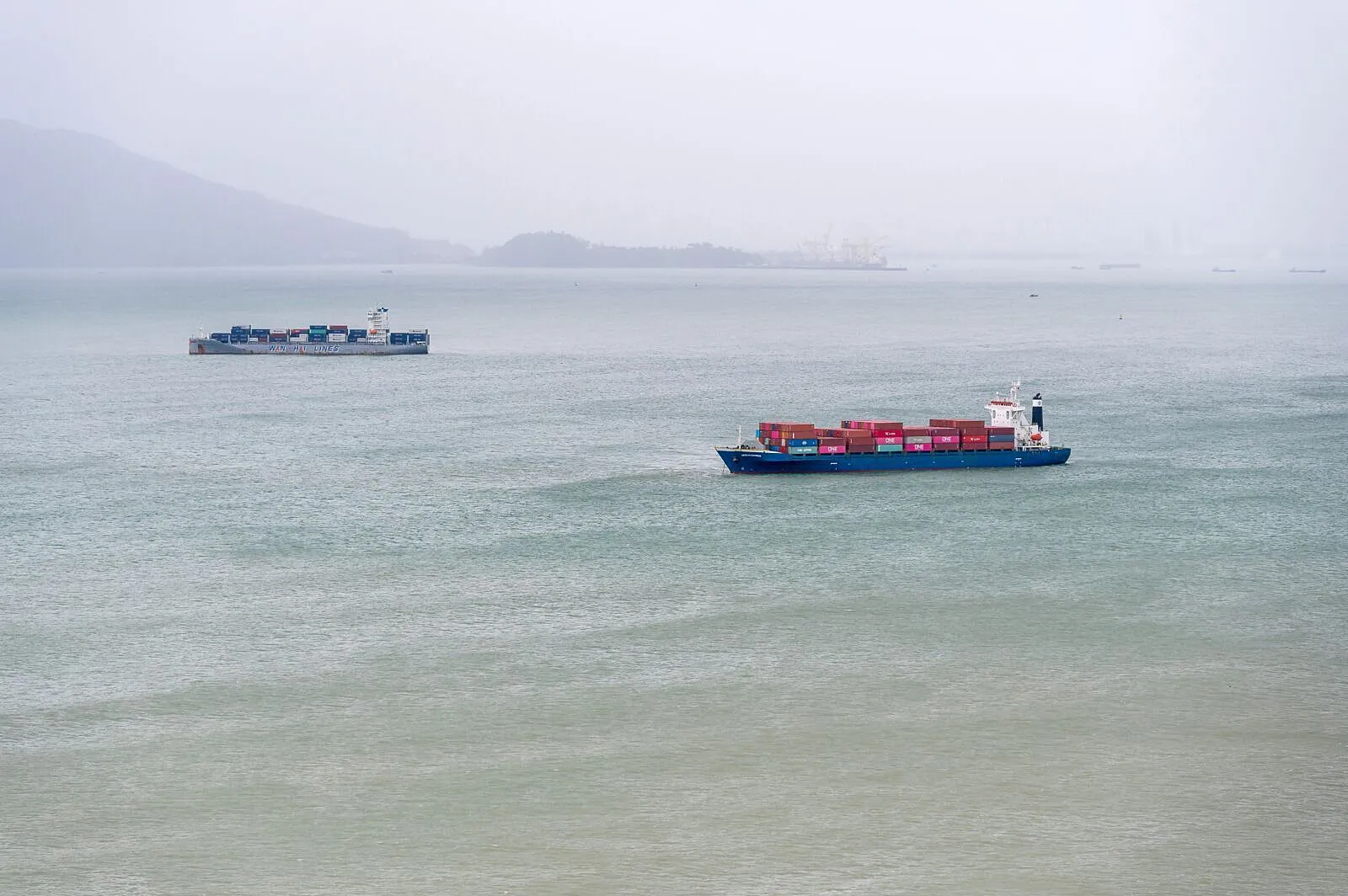
Cleaner air was meant to be an unequivocal win for public health and climate policy. However, new modelling suggests that the 2020 global shipping sulphur cap may have unintentionally intensified heat stress on the Great Barrier Reef.
When Cleaner Air Warms Fragile Seas
The global shipping industry's 2020 sulphur cap was hailed as a landmark environmental victory.
By reducing the allowable fuel sulphur content from 3.5% to 0.5%, regulators dramatically reduced harmful air pollution over oceans and coastal cities. The public health dividend was immediate and undeniable.
However, climate systems rarely operate in a linear pattern.
New research published in Communications Earth & Environment finds that this well-intentioned reform may have reduced the cooling effect previously provided by ship-generated sulphate aerosols, allowing additional solar radiation to reach the Great Barrier Reef (GBR) during periods of critical heat stress.
In the delicate balance between air quality and radiative forcing, the atmosphere has responded in ways that policymakers did not fully anticipate.
The Clean-Air Paradox Emerges
In February 2022, during the lead-up to a La Niña-linked mass bleaching event, researchers found that 11 W/m² of additional daytime solar radiation reached the Great Barrier Reef compared to pre-regulation scenarios.
That additional radiative energy translated into:
- Sea surface temperature increases of 0.05–0.15°C
- Approximately 5–10% additional coral thermal stress
- An estimated 1.8 Degree Heating Weeks (DHW) contribution during extreme conditions
For context, widespread severe bleaching typically occurs at 8 DHW.
A regulation designed to clean the air may have subtly intensified marine heat stress.
That is not a policy failure. It is a systems lesson.
How Sulphur Cuts Changed Ocean Radiation
The study used the WRF-Chem atmospheric model and the STEAM emissions inventory to compare three scenarios:
- Pre-FSC05 (before sulphur cap)
- Post-FSC05 (after 2020 regulation)
- NoShips (no ship emissions)
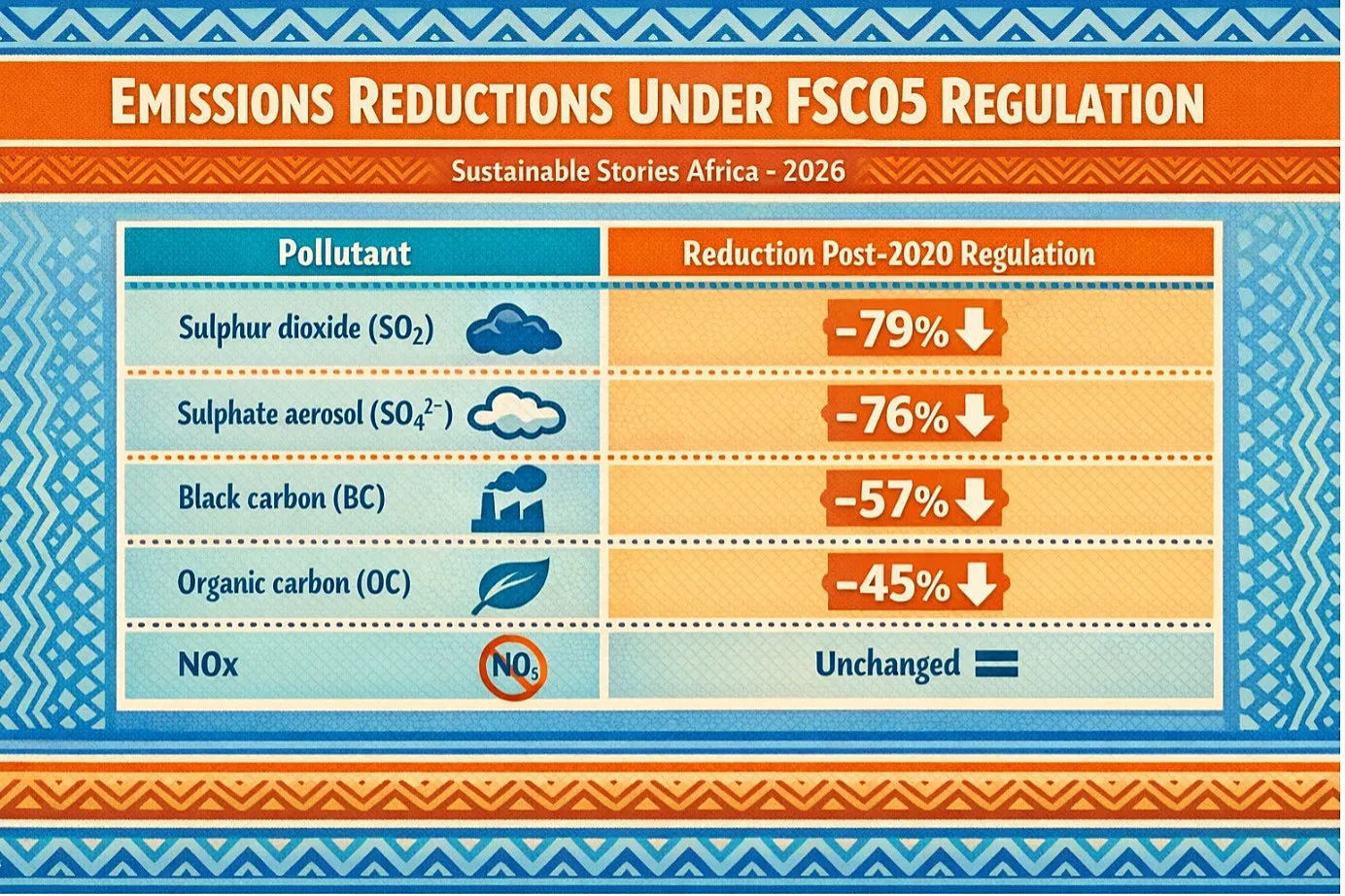
Emissions Reductions Under FSC05 Regulation
| Pollutant | Reduction Post-2020 Regulation |
|---|---|
| Sulphur dioxide (SO₂) | −79% |
| Sulphate aerosol (SO₄²⁻) | −76% |
| Black carbon (BC) | −57% |
| Organic carbon (OC) | −45% |
| NOx | Unchanged |
Sulphate aerosols previously acted as cloud condensation nuclei (CCN), brightening clouds and increasing ocean albedo — effectively reflecting sunlight into space.
With sulphate concentrations reduced, this "aerosol masking" effect weakened.
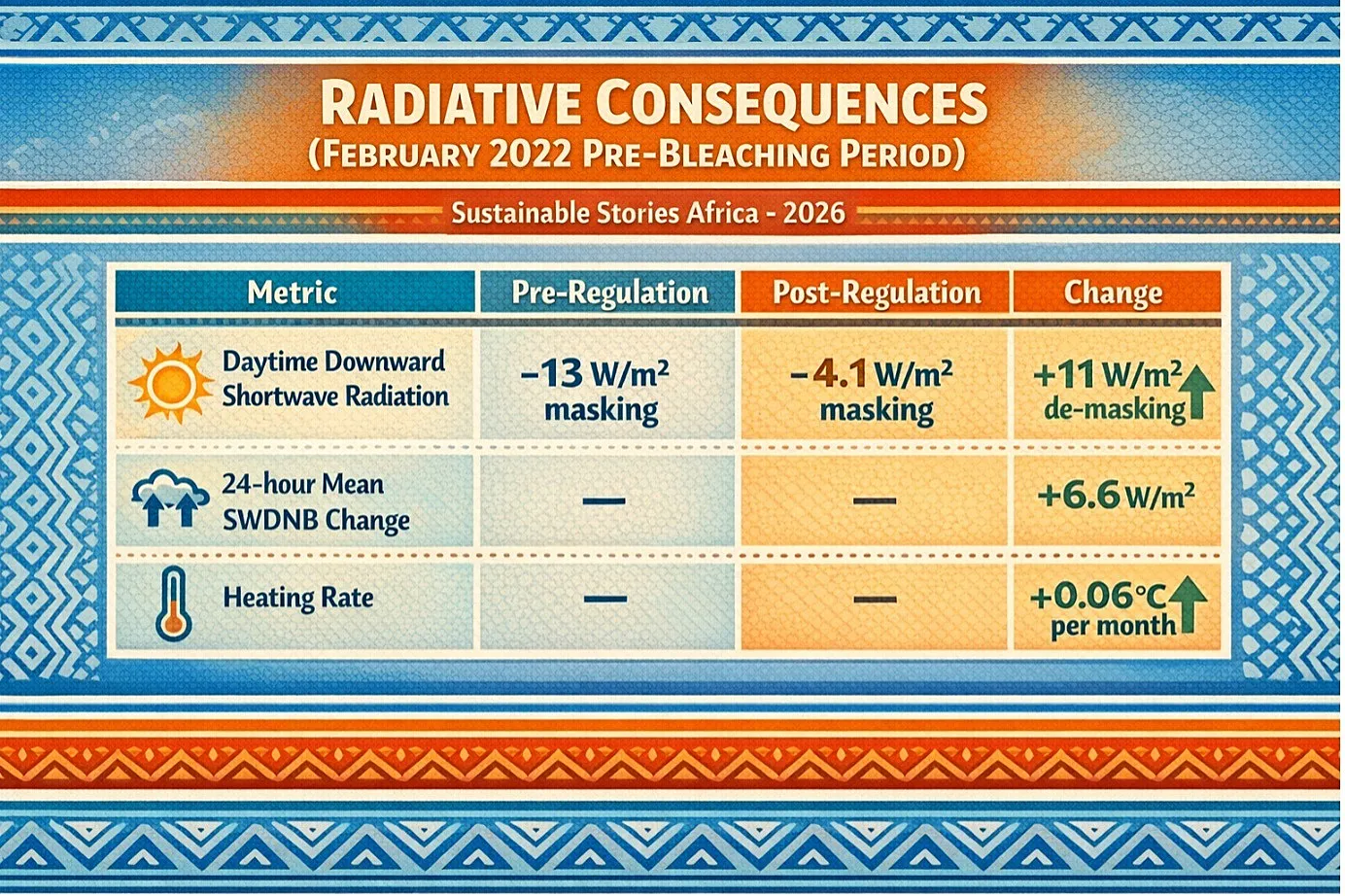
Radiative Consequences (February 2022 Pre-Bleaching Period)
| Metric | Pre-Regulation | Post-Regulation | Change |
|---|---|---|---|
| Daytime Downward Shortwave Radiation | −13 W/m² masking | −4.1 W/m² masking | +11 W/m² de-masking |
| 24-hour Mean SWDNB Change | — | — | +6.6 W/m² |
| Heating Rate | — | — | +0.06°C per month |
The radiative effect was strongest under clear-sky, low-wind conditions, when aerosol accumulation would otherwise have been highest.
Notably, during persistent trade wind periods in 2023, the radiative impact dropped to just 2.2 W/m², underscoring the meteorological sensitivity of the phenomenon.
Why This Matters Beyond Australia
The Great Barrier Reef is not merely an Australian ecological treasure. It is a global climate sentinel.
The research suggests that sulphur reductions may have removed up to 15% of the shortwave radiation anomaly observed during the 2022 bleaching event.
While the global radiative forcing increase from shipping sulphur cuts is estimated at 120–200 mW/m² globally, the localised impacts during extreme heat events may be more consequential for coral ecosystems.
The study does not argue against sulphur regulation. The public health benefits remain overwhelming.
Rather, it highlights three realities:
- Climate systems respond to total forcing, not isolated policy objectives.
- Aerosol "demasking" may temporarily accelerate warming trends.
- Geoengineering conversations, such as marine cloud brightening, must account for real-world aerosol dynamics.
The findings also suggest that artificial marine cloud brightening efforts might be most effective during hot, sunny, low-wind periods, rather than during persistent trade wind conditions.
In other words: timing, meteorology and atmospheric chemistry matter as much as intent.
Align Air Quality and Climate Strategy
For regulators, the implication is not reversal but integration.
Shipping decarbonisation must now consider:
- Rapid greenhouse gas reductions alongside sulphur regulation
- Regional climate feedback analysis in sensitive ecosystems
- Coordinated maritime, climate and ocean policy frameworks
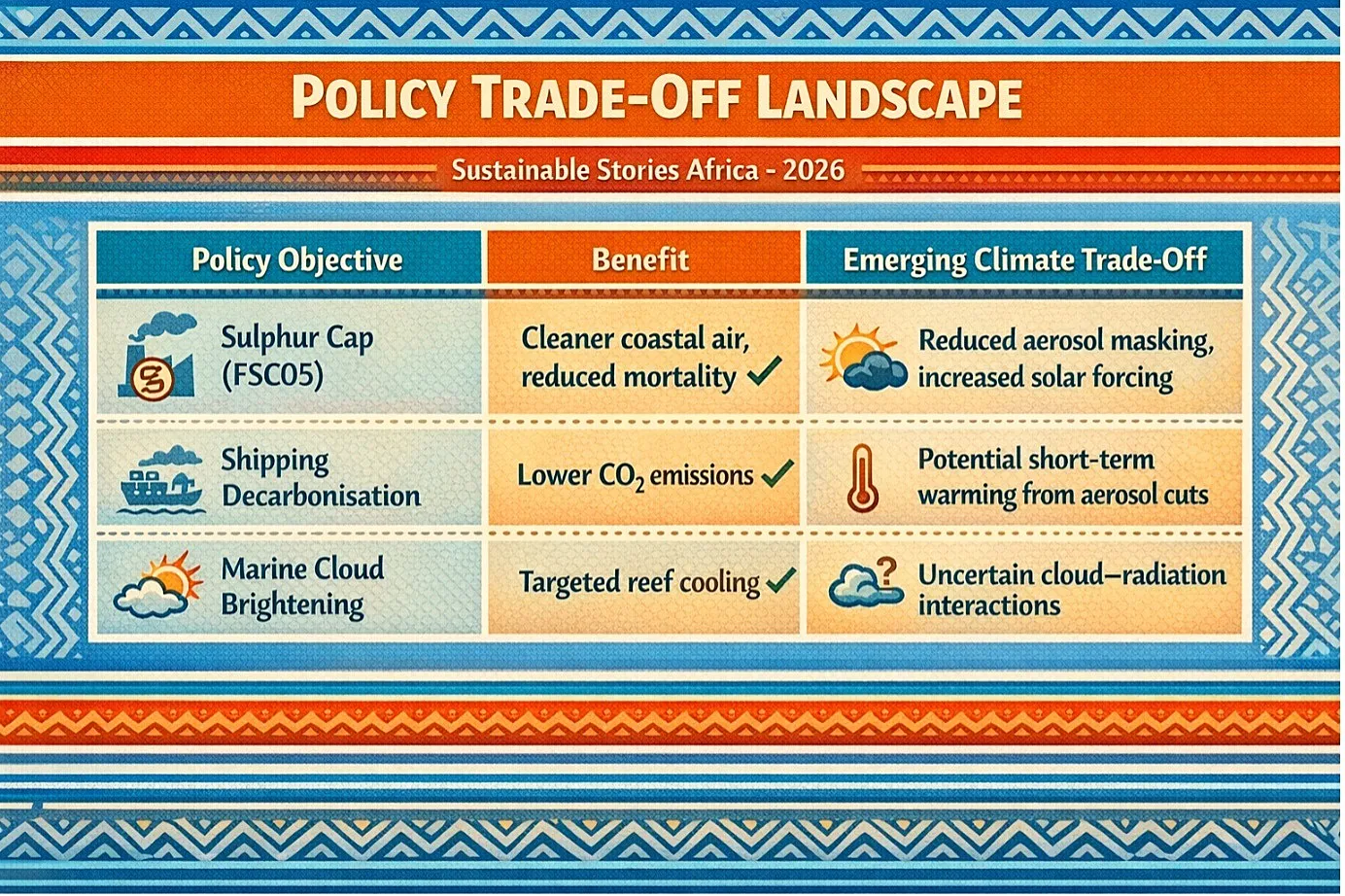
Policy Trade-Off Landscape
| Policy Objective | Benefit | Emerging Climate Trade-Off |
|---|---|---|
| Sulphur Cap (FSC05) | Cleaner coastal air, reduced mortality | Reduced aerosol masking, increased solar forcing |
| Shipping Decarbonisation | Lower CO₂ emissions | Potential short-term warming from aerosol cuts |
| Marine Cloud Brightening | Targeted reef cooling | Uncertain cloud–radiation interactions |
The Sustainable Stories Africa Editorial Board's view is clear:
Policy silos are no longer viable in the Anthropocene. Every environmental intervention is in tandem with a complete web of atmospheric feedback loops.
Air quality gains must be paired with accelerated carbon mitigation; otherwise, temporary warming effects may compound.
Path Forward – Integrate, Accelerate, Safeguard
Climate governance must evolve toward an integrated atmospheric strategy. Shipping reforms should proceed, but in tandem with clarity on greenhouse gas emissions and enhanced regional climate modelling to anticipate secondary effects.
For coral reef resilience, adaptive tools from marine cloud research and ecosystem restoration must be scaled together with mitigation. Cleaner air remains essential. However, safeguarding ocean heat balance now requires a systems-level response.
SSA Editorial Board Perspective
From the vantage point of Sustainable Stories Africa, this research is a cautionary signal, not an indictment of environmental progress.
Africa's coastal economies, shipping corridors, and coral systems from the Red Sea to the Western Indian Ocean operate within the same atmospheric physics.
The lesson is universal:
Climate action cannot be compartmentalised. Every emission cut reshapes the radiative balance. Every policy has atmospheric consequences. The solution is not retreat but precision.