Sustainability risks, from climate regulation to supply-chain disruptions, are widely discussed in corporate reports. However, many organisations still fail to translate these risks into financial terms that shape real investment decisions.
As climate policy tightens and ESG scrutiny intensifies, investors and companies are confronting a crucial question: how should sustainability risks be priced into capital allocation, strategy and long-term competitiveness?
When Sustainability Risk Enters Financial Models
Introduction
For many companies, sustainability risks are well documented but poorly integrated into financial decision-making.
Corporate sustainability reports increasingly describe exposures to climate regulation, labour issues or reputational pressures, yet these risks rarely influence how organisations allocate capital.
This disconnect is becoming harder to ignore. As regulatory frameworks tighten, carbon markets expand, and supply-chain scrutiny intensifies, sustainability risks are increasingly translating into measurable economic consequences.
The shift is forcing companies, investors and policymakers to rethink a fundamental question: what happens when sustainability risks are finally priced into business decisions?
For African economies navigating the climate transition, energy transformation and evolving ESG standards, this question carries significant implications for infrastructure investment, industrial competitiveness and capital markets development.
If The Risk Is Not Priced
“If it is not in the model, it is not in the decision.”
That observation captures a central challenge in corporate sustainability discussions: capital allocation is quantitative, while sustainability risks are often treated qualitatively.
According to an analysis by sustainability strategist Johan F., many organisations describe sustainability risks in narrative terms but rarely convert them into financial impacts that influence strategy and investment decisions.
The result is a structural blind spot.
When sustainability risk is implicitly priced at zero, investment decisions become distorted.
Assets may appear more profitable than they truly are, supply chains may appear more resilient than they are, and technologies that will become economically necessary may appear unjustified.
In practice, this gap often means companies react to sustainability disruptions only after they materialise.
From Description To Financial Impact
Many organisations now maintain detailed sustainability risk registers.
These often include risks such as:
- climate transition policy
- labour rights violations in supply chains
- environmental controversies affecting brand reputation
However, the difference between describing a risk and pricing a risk is significant.
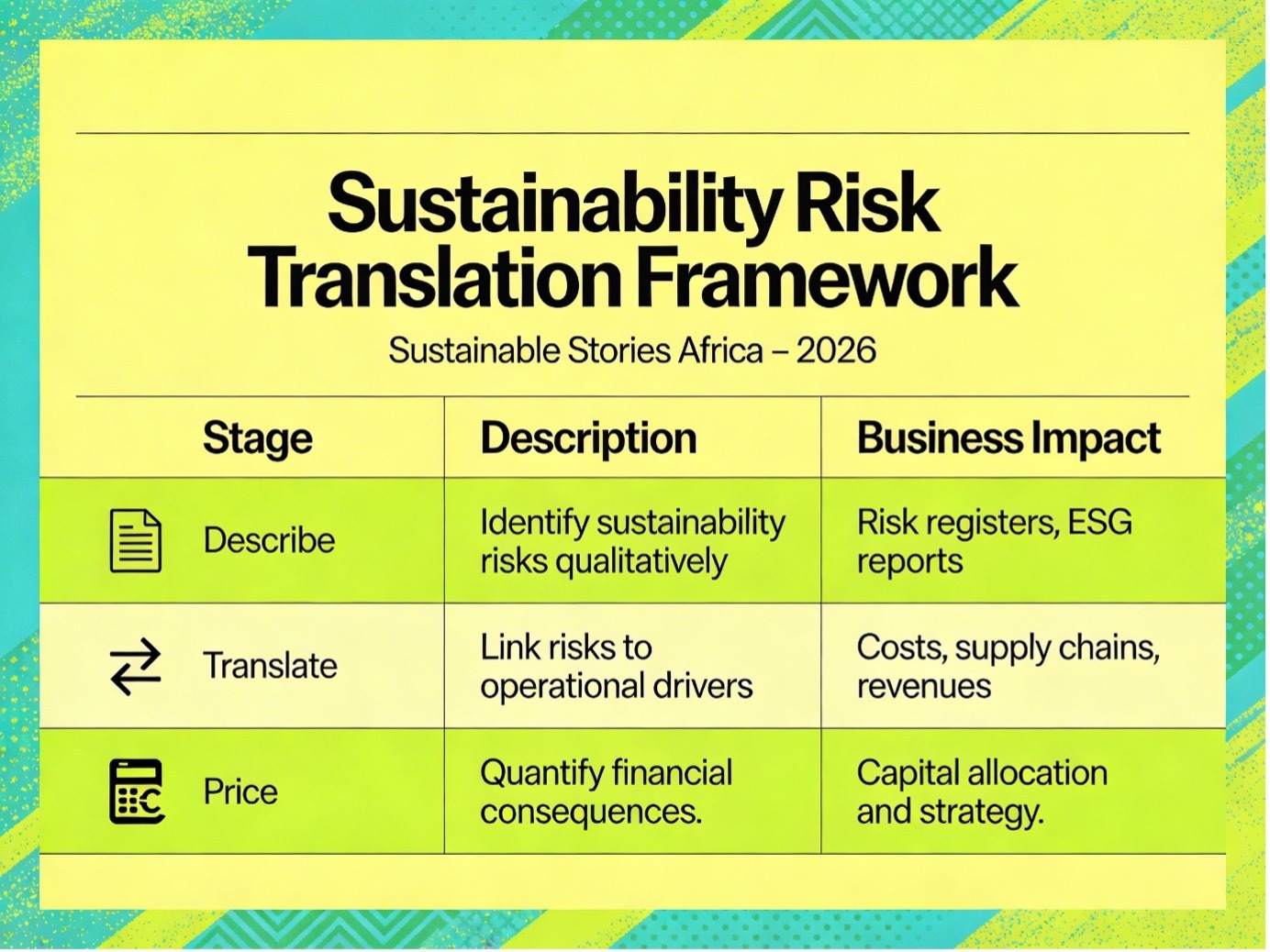
The transformation typically follows three stages:
Describe → Translate → Price
This framework highlights how sustainability risks must evolve from narrative concerns into quantifiable economic variables that influence corporate strategy.
Climate Risk: From Policy Debate To Cost Structure
Climate transition risk is commonly described in sustainability reports as exposure to future carbon pricing.
However, when quantified, the implications become far clearer.
Consider a manufacturing facility emitting 200,000 tonnes of CO₂ annually. If carbon prices increase from €90 to €150 per tonne, annual operating costs would rise by €12 million.
Over a decade, this could represent €120 million in additional cost exposure, excluding indirect effects such as higher electricity prices.
What initially appears as a regulatory discussion becomes a fundamental business question:
- Should the company invest in cleaner technology?
- Should production shift to lower-carbon facilities?
- Will the asset remain competitive?
When climate risks are disclosed within financial models, they reshape investment decisions.
Social Risk: Supply Chains And Labour Standards
Social risks are another example in which narrative framing often obscures economic impact.
Companies frequently identify labour rights risks within global supply chains but rarely quantify the operational consequences.
However, if a supplier employing thousands of workers is found to violate labour standards, the results can include:
- termination of supplier contracts
- temporary production disruptions
- regulatory investigations
- higher procurement costs
If replacing a supplier increases sourcing costs by 8% and causes several months of disruption, the financial consequences for a large manufacturer can reach tens of millions of euros.
What appears initially as a compliance issue becomes a supply-chain resilience challenge.
Reputational Risk And Revenue Stability
Reputational sustainability risks often remain even more abstract.
Companies frequently reference the risk of negative media coverage related to environmental or social issues.
However, the economic consequences can be measurable.
During major sustainability controversies, organisations often experience:
- declining consumer demand
- retailer pressure
- regulatory scrutiny
- increased marketing costs
Even a 2% or 3% decline in annual sales can amount to tens or hundreds of millions of euros for large consumer-facing businesses.
In financial terms, reputational risk becomes revenue volatility rather than merely a communications challenge.
Sustainability Risk Translation Framework
Stage | Description | Business Impact |
|---|---|---|
Describe | Identify sustainability risks qualitatively | Risk registers, ESG reports |
Translate | Link risks to operational drivers | Costs, supply chains, revenues |
Price | Quantify financial consequences | Capital allocation and strategy |
Why Pricing Sustainability Risk Matters
Integrating sustainability risk into economic decision-making can significantly improve corporate resilience.
Companies that systematically price sustainability risk can:
- anticipate regulatory changes earlier
- allocate capital more efficiently
- identify technology investment needs sooner
- strengthen supply-chain resilience
For investors, the benefits are equally significant.
Understanding sustainability risk pricing helps reveal which assets may become stranded, which industries may face regulatory disruption, and which companies are positioned to benefit from the low-carbon transition.
For African economies, the implications extend further.
As climate policies expand globally and carbon markets develop, sustainability risk pricing will increasingly shape:
- infrastructure financing
- energy investment decisions
- export competitiveness
- capital flows into emerging markets
In this context, sustainability risk becomes a central variable in economic development strategy.
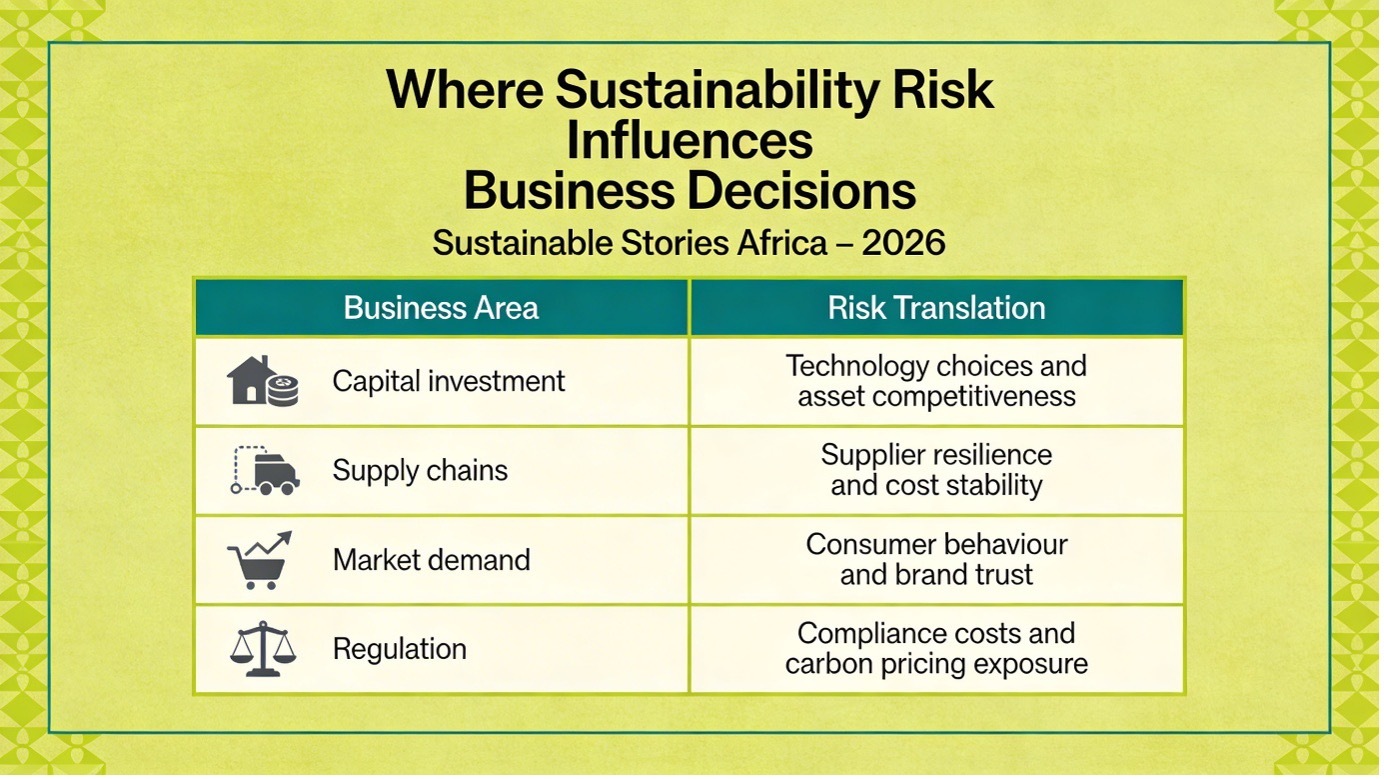
Where Sustainability Risk Influences Business Decisions
Business Area | Risk Translation |
|---|---|
Capital investment | Technology choices and asset competitiveness |
Supply chains | Supplier resilience and cost stability |
Market demand | Consumer behaviour and brand trust |
Regulation | Compliance costs and carbon pricing exposure |
Integrating Sustainability Into Capital Allocation
Bridging the gap between sustainability reporting and financial decision-making requires several organisational shifts.
- Integrate ESG Into Financial Modelling – Sustainability risks must be incorporated directly into financial forecasts, scenario analysis and investment appraisals.
- Break Down Organisational Silos – In many companies, sustainability teams operate separately from finance or strategy departments.
Integrating these functions ensures sustainability insights influence investment decisions.
- Strengthen Scenario Analysis – Companies should model future climate policies, carbon-pricing trajectories, and supply-chain disruptions.
These scenarios allow decision-makers to evaluate long-term strategic risks.
- Link Sustainability To Corporate Strategy – When sustainability risks are priced properly, they influence core strategic decisions such as:
- technology adoption
- facility location
- supplier diversification
- product innovation
In this way, sustainability issues are not a reporting exercise and become part of competitive strategy.
Path Forward – Pricing Risk To Shape Sustainable Markets
The shift from describing sustainability risk to pricing it marks a critical evolution in corporate strategy.
When sustainability risks appear in financial models, they begin to shape real decisions about investment, technology and competitiveness.
For companies and economies navigating climate transition, integrating sustainability risk into capital allocation will increasingly determine which businesses remain resilient in a rapidly changing global economy.
Culled From: Pricing Sustainability Risk By Johan-F’s LinkedIn Page