
Generative AI is moving from boardroom theory to economic infrastructure, reshaping productivity, hiring, skills and competitiveness across major markets.
For Africa, the question is no longer whether AI will change work. It is whether governments, businesses and educators can turn disruption into inclusive growth before the skills gap widens.
AI Growth Needs Human Skills First
Generative artificial intelligence could unlock trillions of dollars in productive capacity; however, the countries and companies that benefit most will be those that invest early in people, skills and inclusive adoption, according to LinkedIn’s report, AI and the Global Economy: Unlocking Growth and Reshaping Work.
The report, drawing on LinkedIn Economic Graph data and Access Partnership analysis, argues that AI is not only a technology story.
It is now a labour market, competitiveness and development story.
For African economies, where small businesses anchor employment and young workers are entering fast-changing labour markets, the signal is direct: AI readiness must become part of industrial strategy, education reform, digital inclusion and enterprise support.
AI Is Redrawing Global Growth Maps
The next global productivity race may be decided less by who has access to artificial intelligence and more by who has the skills, data systems and confidence to use it well.
LinkedIn's analysis estimates that generative AI could unlock up to $6.6 trillion in productive capacity across five major economies if deployed effectively across work tasks.
The evidence is already compelling: three-quarters of companies using generative AI report significant time savings, while half report revenue increases of 10% or more within 24 months of adoption.
For African businesses, this is a practical question about competitiveness. A logistics company forecasting demand, a clinic reducing administrative delays or a small manufacturer accelerating product design does not need to become a technology giant. Each will need affordable tools, trained workers and a policy environment that rewards experimentation.
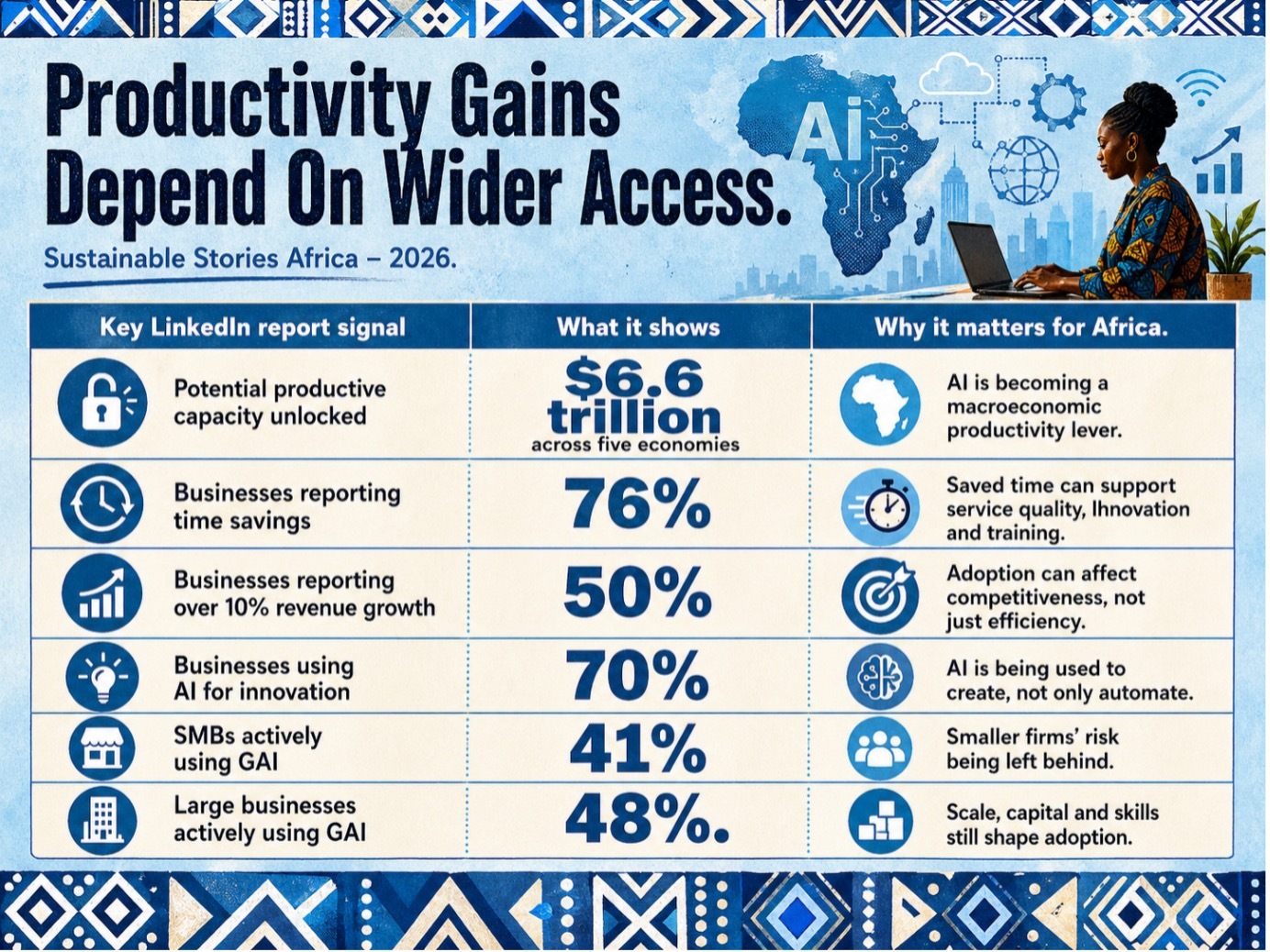
The most valuable AI use cases are emerging not in automation of routine tasks, but in expanding what teams can imagine, test and deliver.
That distinction matters enormously for Africa's development debate. Treated as an automation threat, AI narrows the conversation.
Treated as a productivity and creativity tool, it can strengthen agriculture value chains, improve public services and help entrepreneurs reach markets faster.
The adoption gap, however, is real. Small and medium-sized businesses, which represent over 90% of businesses and 50% of workers worldwide, are being outpaced by larger companies. That gap is not just a private-sector concern; it is a development risk.
Skills Gap Becomes The Central Risk
The report identifies skills as one of the biggest barriers to AI adoption. More than half of the surveyed businesses cited a lack of relevant technical skills and AI literacy skills as major constraints.
LinkedIn also projects that by 2030, 70% of the skills used in most jobs will change, with AI emerging as a catalyst.
This is where the story becomes human. For a young graduate in Lagos, Nairobi, Accra or Johannesburg, employability may increasingly depend not only on formal qualifications, but also on the ability to use AI tools, ask better questions, verify outputs, communicate clearly and apply judgment in context.
The report separates three skill needs.
- First are AI technical skills: the ability to design, develop and maintain AI systems.
- Second are AI literacy skills: the ability to understand, evaluate and use AI tools such as ChatGPT, Microsoft Copilot and prompting systems.
- Third are people skills: communication, leadership, critical thinking and stakeholder management.
This mix is important. The future worker is not simply a coder. The future worker is adaptive, digitally literate and able to use technology responsibly with human judgment.
Human Skills Can Protect Opportunity
LinkedIn’s data challenges the simplistic view that AI automatically means mass job loss.
Among businesses considering AI in workforce planning, 63% plan to increase headcount through hiring or retention. Many want workers to develop and deploy AI applications, meet rising customer demand and support new business opportunities.
At the same time, the risks are real. Workers will need targeted reskilling, especially in roles where many tasks can be replicated. The report identifies groups that may be more exposed, including women, younger workers and workers with undergraduate degrees in some markets.
Exposure, however, does not lead to displacement if workers receive timely training and pathways into less exposed roles.
- For African markets, this creates a policy opening.The continent’s youth population can become a competitive asset if AI literacy is embedded into schools, vocational training, universities and workplace learning.
- Women entrepreneurs can gain new market access if digital tools are affordable and training is inclusive.
- Small businesses can compete more effectively if the adoption of AI is supported through grants, shared infrastructure and practical advisory services.
The opportunity is not only to prepare workers for AI. It is to use AI to prepare economies for better work.
Governments and firms must move together
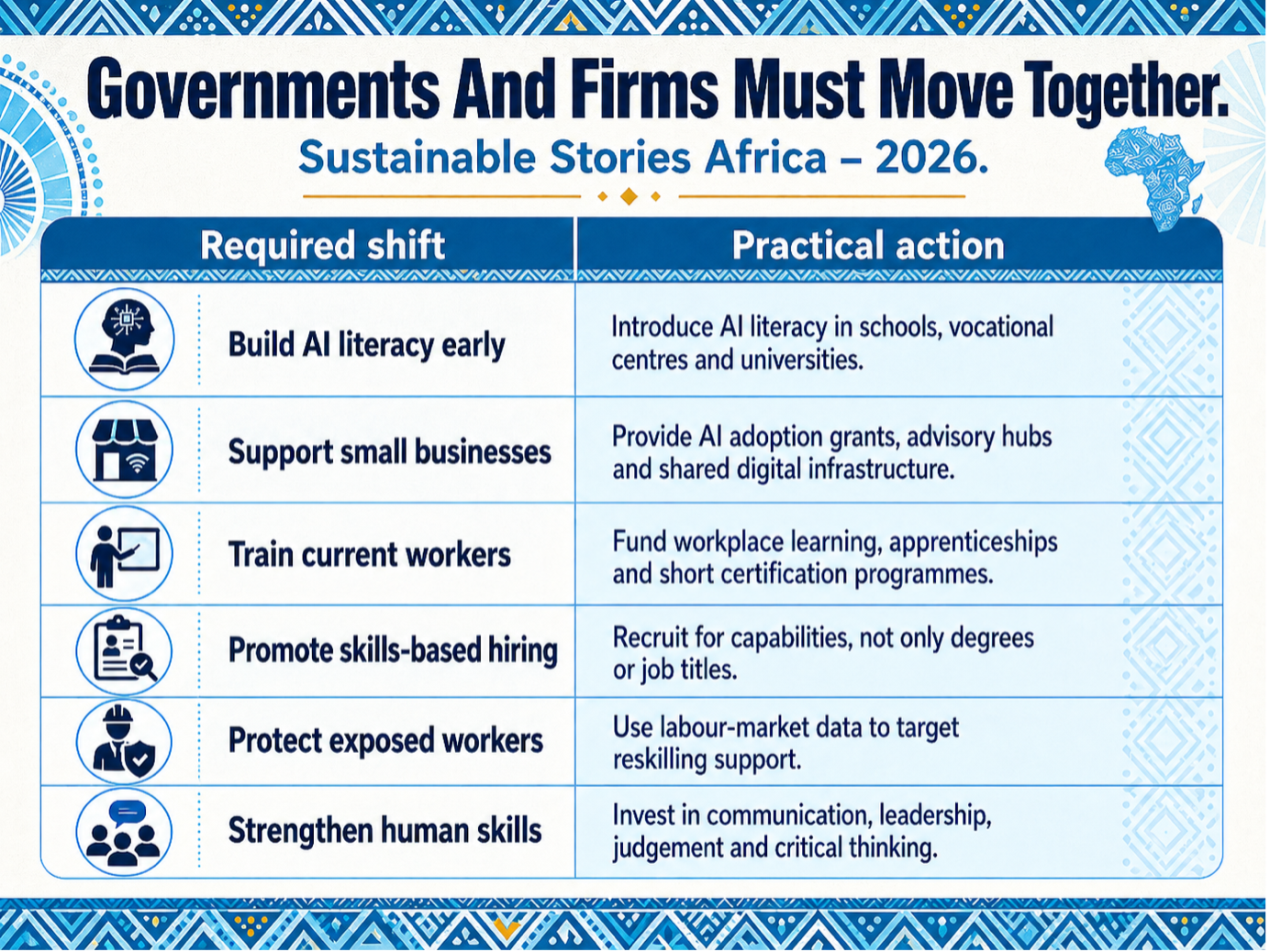
LinkedIn’s recommendations are direct: governments should expand AI education, support teacher development, fund AI research, create certification pathways, promote skills-based hiring and improve access to digital infrastructure.
Businesses, meanwhile, must move beyond pilot projects and make workforce preparation part of their core strategy.
For African policymakers, the lesson is practical.
- An AI strategy cannot sit only inside technology ministries.
- It belongs in education, labour, trade, industrial policy, public-sector reform and SME development.
The countries that transition early can turn AI into a productivity tool for inclusive development. Those who delay may import the technology without building the workforce power to shape it.
Path Forward – For Inclusive AI
Africa’s AI priority should be skills-first adoption: affordable tools, practical training, stronger digital infrastructure and targeted support for small businesses and exposed workers.
The objective is not to chase technology for its own sake. It is to enable AI to serve decent work, enterprise growth, public service delivery and sustainable competitiveness.
The next advantage will belong to economies that train people fast enough to use the tools well.