Sustainable, green and climate finance are often used interchangeably, as if they mean the same thing. They do not.
For African markets seeking credible capital, better reporting and real development impact, the distinction is no longer semantic.
It shapes where money goes, what gets measured and who is held accountable.
Finance Labels Now Shape Real Outcomes
In sustainable finance, language can move money. That is why the difference between sustainable finance, green finance and climate finance matters for governments, investors, companies and communities trying to turn ESG commitments into measurable development outcomes.
A Sustainable Finance Series explainer argues that the three terms carry different mandates, metrics and stakeholder expectations.
Used interchangeably, they do more than confuse communication; they can misdirect capital.
For African economies, the issue is practical. A solar mini-grid, a clean water project, a women-led enterprise fund, a mangrove restoration programme and a flood-resilience investment may all sit inside sustainability conversations.
However, they do not always belong within the same financing category, and they should not be assessed with the same metrics.
Imprecise Language Misdirects Capital
The core warning is simple: “green” does not automatically mean “climate,” and “sustainable” does not automatically mean either.
Each term describes a different layer of finance, with sustainable finance as the broadest system, green finance as the environmental focus, and climate finance as the most targeted priority within both.
This matters now because African markets are competing for capital in a world of tighter climate disclosure, rising transition-risk scrutiny and growing demand for credible ESG claims.
- A project labelled “sustainable” may advance social equity or economic resilience.
- A “green” project may improve water quality or reduce pollution.
- A “climate” project must directly address emissions reduction or climate resilience.
This means a lot towards assessing finance and funding project types and structures.
- For policymakers, this distinction affects national taxonomies.
- For investors, it affects portfolio classification.
- For companies, it affects reporting.
- For communities, it affects whether capital reaches the projects that genuinely respond to their risks.
Three Finance Terms, Three Purposes
The explainer presents the relationship as a nested system.
- Sustainable finance is the outer ring.
- Green finance lies within it.
- Climate finance lies at the core as the most urgent, targeted allocation.
Sustainable finance is the broadest lens.
- It considers how capital supports long-term environmental, social and economic outcomes.
- It can cover climate, biodiversity, social impact, governance and economic resilience.
- Its defining feature is that it explicitly incorporates social and governance outcomes alongside environmental ones.
Green finance is narrower.
- It funds activities that directly benefit the environment, such as renewable energy, resource efficiency, clean water, ecosystem restoration and pollution control. Social and governance goals may still matter to project quality; however, they are not the central lens.
Climate finance is the most targeted.
- It is specifically directed at addressing climate change through two pillars:
- Mitigation, which reduces emissions across sectors
- Adaptation, which builds resilience to physical climate risks.
- If capital is directly linked to climate risk or climate transition, it belongs here.
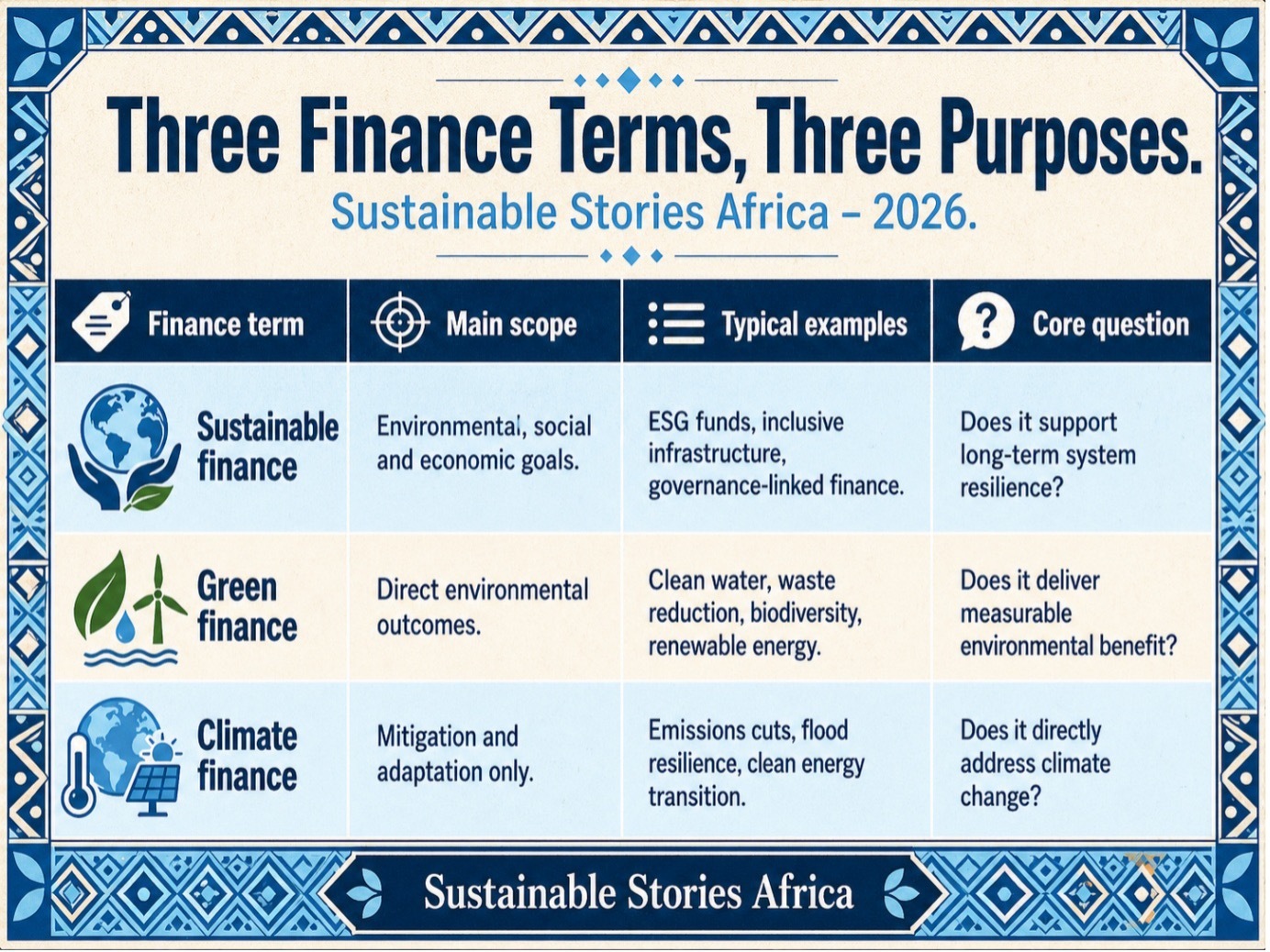
The practical implication is powerful: all climate finance can be green finance, but not all green finance is climate finance.
- Water management, waste reduction and ecosystem finance may be green without being climate-specific.
Green finance lies within sustainable finance; however, sustainable finance extends beyond environmental outcomes, to include equity, governance and economic resilience.
Clarity Builds Trust And Performance
Precise language in finance is not a technicality; it shapes how capital is allocated, reported and ultimately deployed.
- A wastewater treatment facility may qualify as green finance through its environmental benefit, but not as climate finance unless it directly reduces emissions or builds climate resilience.
- A social housing bond may be sustainable finance without being green. These distinctions matter because they determine what gets funded, what gets measured and what gets counted.
For African markets, the precision unlocks practical gains.
- National development banks can separate climate-adaptation projects from broader environmental programmes.
- Pension funds can distinguish sustainable infrastructure from climate-aligned assets.
- Listed companies can avoid overstating climate impact when their programmes reflect wider ESG management rather than climate specificity.
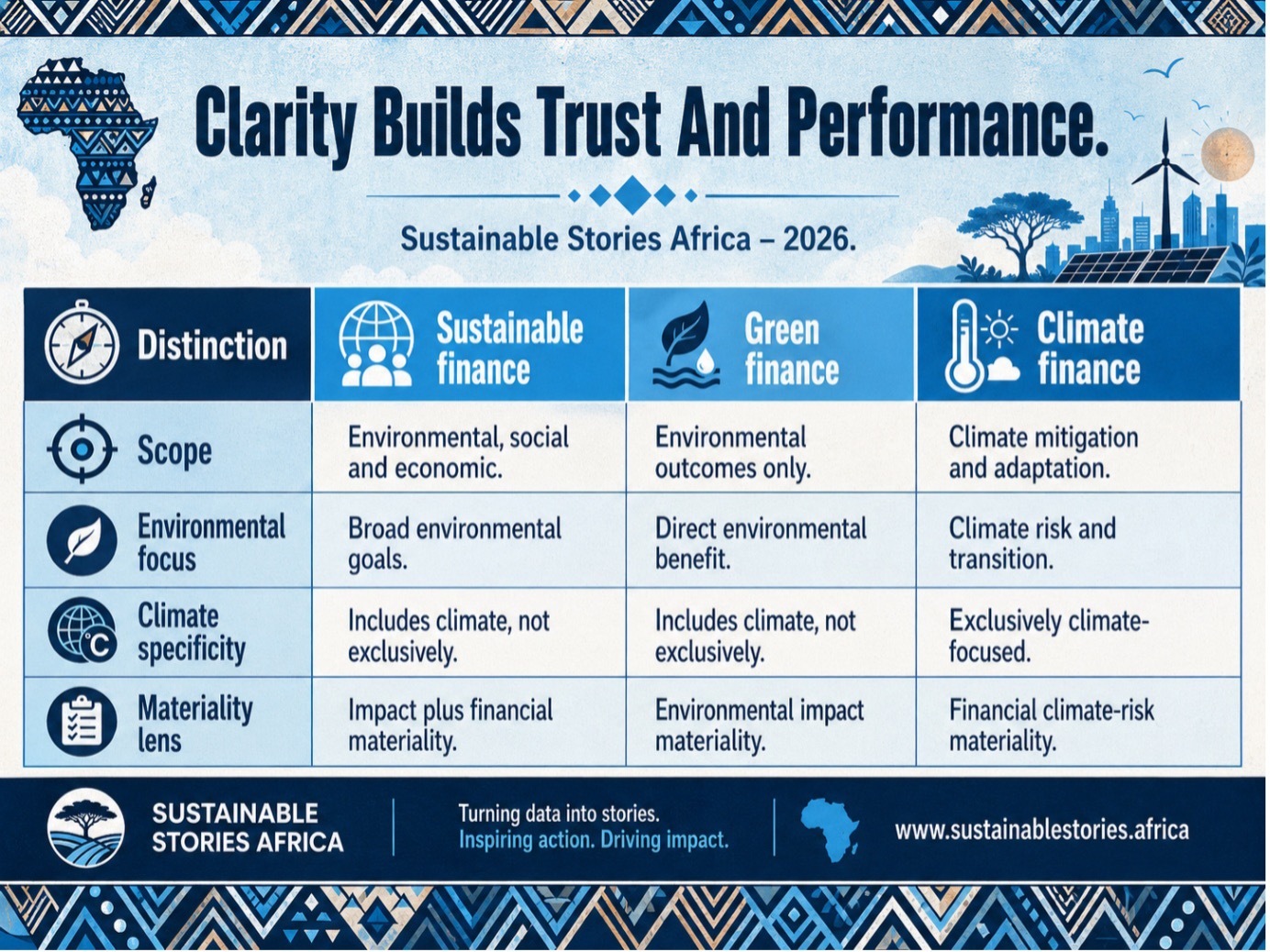
The four areas where these terms diverge, including scope, environmental focus, climate specificity and primary materiality, form the basis of stronger disclosure.
When the label is precise, the metric follows. When the metric is clear, accountability improves, and performance becomes easier to track.
Markets Need Stronger Classification Discipline
African regulators, exchanges, banks and companies should treat finance labels as governance infrastructure.
That begins with taxonomies that define which activities qualify as sustainable, green or climate-aligned, and which metrics should be used for each.
- Governments can use the distinctions to improve public investment planning.
- Climate ministries and agencies can prioritise adaptation and mitigation finance.
- Environment ministries can identify broader green finance needs around water, waste, forests and biodiversity.
- Finance ministries can place both within wider sustainable development strategies that include jobs, inclusion and institutional resilience.
Banks and asset managers should also tighten product labelling.
- A fund marketed as climate finance should show its mitigation or adaptation logic.
- A green loan should show the environmental benefit.
- A sustainability-linked instrument should explain the wider social, governance or economic performance targets behind the label.
Companies need the same discipline.
- A cement producer reducing emissions should report the transition-finance case.
- A beverage company investing in watershed protection may report green finance outcomes.
- A telecoms company expanding digital access in low-income communities may report sustainable finance outcomes.
Each can be valuable, but each tells a different story.
For citizens and communities, the benefit is fairness.
- Clear finance labels make it easier to ask whether capital is reducing flood exposure, cutting pollution, restoring ecosystems, creating decent work, or improving local resilience.
- Precision gives people a better way to judge whether sustainability claims match lived impact.
Path Forward – Precision Must Guide Capital
Sustainable finance is the system, green finance is the environmental focus, and climate finance is the urgent priority within both.
African markets should build strategies, disclosures and investment pipelines around these distinctions.
Better language will not solve every financing gap, but it can help ensure capital reaches the right instruments, projects and communities, with metrics that prove the impact.