The World Economic Forum’s 2026 Global Lighthouse Network report says leading manufacturers are moving beyond pilot projects to build resilient, AI-enabled operations at scale.
For African and emerging-market industries, the message is practical: competitiveness will depend on digital infrastructure, skilled workers, cleaner production and supply chains that can adapt under pressure.
Factories Rewire For A Volatile Era
The World Economic Forum says the world’s most advanced manufacturing and supply-chain sites are no longer using digital tools only to improve efficiency. They are rewiring operations to withstand volatility, scale artificial intelligence and deliver measurable gains for people, planet and performance.
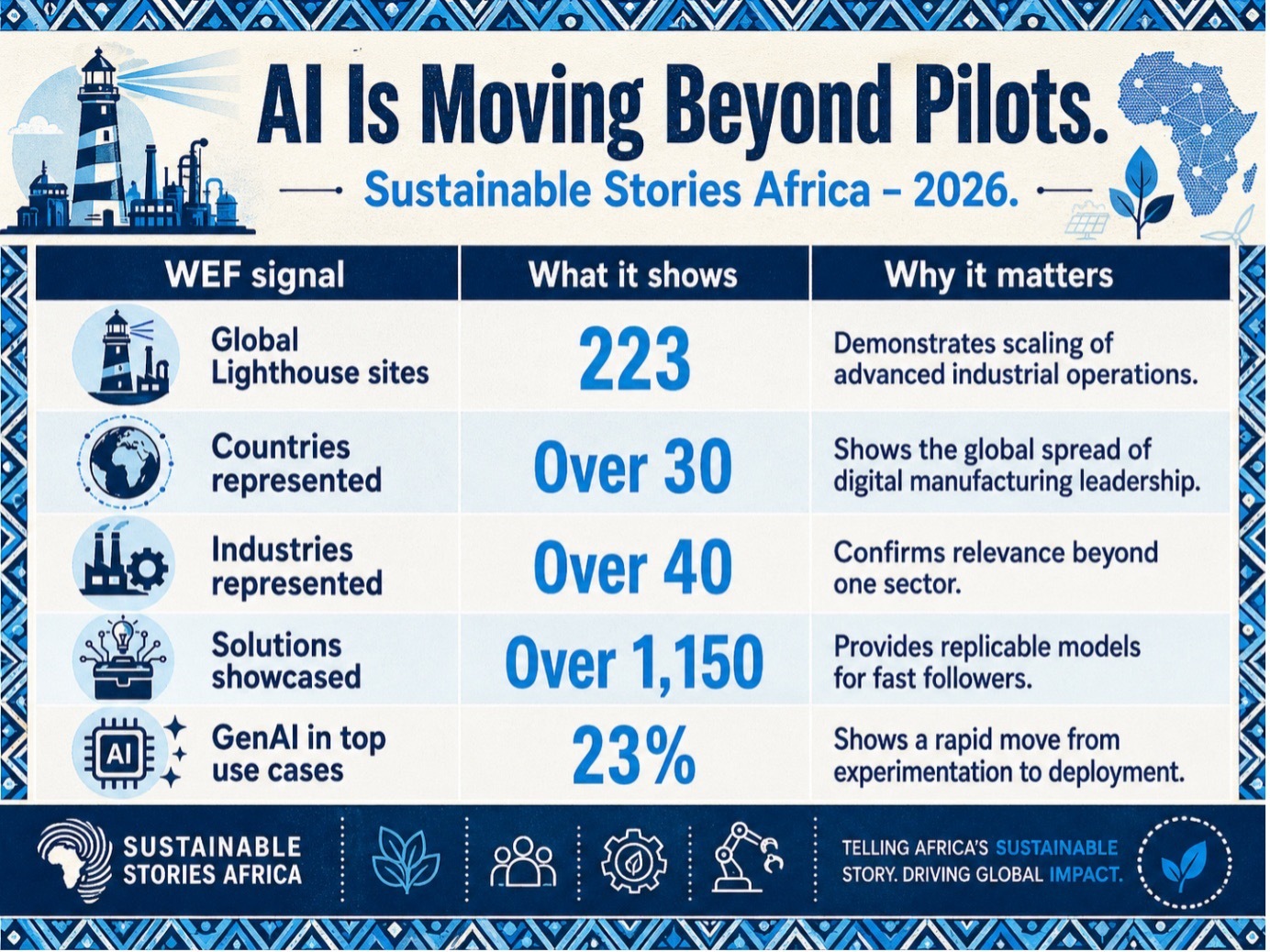
In its January 2026 white paper, Global Lighthouse Network: Rewiring Operations for Resilience and Impact at Scale, the Forum says the Global Lighthouse Network has grown from 16 factories in 2018 to 223 sites across more than 30 countries and 40 industries.
The network now showcases more than 1,150 solutions across production ecosystems.
The implications are significant for African and Global South manufacturers. As tariffs, inflation, logistics disruptions, labour shortages and energy constraints reshape industrial competitiveness, the factories that win will be those that can combine technology, workforce capabilities and sustainability into a single operating system.
Resilience Has Become Industrial Strategy
The WEF report opens with a simple industrial truth: transformation is not a destination but a capability.
Its 2025 Lighthouse cohort shows how leading companies are moving from risk mitigation to strategy-shaping resilience, with investments focused on network agility, digital workforce capability and collaboration across value chains.
The urgency is clear. The report notes that 82% of economists surveyed in the WEF’s Chief Economists’ Outlook: May 2025 reported “very high” levels of uncertainty, signalling continued pressure on trade and investment.
It also says supply-chain disruptions cost companies an average of 45% of one year’s cash profit.
For factories in Lagos, Nairobi, Accra, Johannesburg or Cairo, that volatility is not theoretical.
It can appear as delayed machinery, imported input inflation, port congestion, power instability, foreign-exchange shortages, skills gaps or customer demand swings.
The Lighthouse lesson is that resilience must be designed before disruption arrives.
AI Is Moving Beyond Pilots
The Global Lighthouse Network began by identifying factories that escaped “pilot purgatory” through the deployment of advanced technology. The WEF says its 223 Lighthouses represent a broader shift: operational excellence that scales with sustainability, workforce empowerment and innovation embedded into daily work.
In 2025, 34 new Lighthouses were added across 11 countries, including first-time entrants from Qatar and Azerbaijan.
A major shift is the pace of AI adoption. Analytical AI and machine learning are now embedded in nearly 62% of Lighthouse's top five use cases, while generative AI reached 23%, up from 9% in 2024.
The report argues that Lighthouses are overcoming the “GenAI paradox” by focusing on domain-specific applications that produce measurable operational results.
The report’s 2025 award categories now include productivity, supply chain resilience, sustainability, customer centricity and talent.
That expansion matters because it signals a broader understanding of industrial performance: factories are being judged by output, agility, emissions, workforce stability and responsiveness to customers.
Technology Works When People Lead
The most compelling part of the Lighthouse story is not the machines. It is the operating model around them.
WEF says Lighthouses are investing in three priorities:
- Building foundations for network agility and scale
- Empowering people to thrive in a digital world
- Amplifying impact through collaboration and purpose.
They master difficult trade-offs: speed versus standardisation, autonomy versus visibility, and connectivity versus cybersecurity.
Examples show how this becomes practical.
- Siemens Numerical Control in Nanjing, China, used digital twins to improve continuous cycle-time optimisation, increasing units per hour by 50%, reducing delivery lead time by 83% and cutting cycle time by 12%.
- Tüpraş in Türkiye deployed AI-driven crude supply-chain synchronisation to improve planning visibility and reduce inventory levels
- Qatar Shell used physics-based AI to extend critical equipment lifetime and lower annualised capital expenditure.
The talent dimension is equally important.
- Haier in Chongqing, China, used an AI-powered talent identification and career development platform to reduce key role vacancies by six percentage points and shorten promotion-cycle duration by 40%.
- AUO Corporation in Suzhou, China, deployed AI-enabled hiring tools trained on employee data to reduce first-90-day attrition by 81% and interview waiting time by 75%.
For African manufacturers, this is a crucial insight. Digital transformation is not just buying software, sensors or robots. It requires training workers, redesigning workflows, integrating data, building trust and linking technology to clear business problems.
African Industry Needs Scalable Playbooks
The WEF report says adoption alone does not guarantee impact. Even within the Global Lighthouse Network, only a select group has rewired operations enterprise-wide.
Those that succeed use a blueprint: strategic roadmaps, agile operating models, talent, technology and data, ecosystem collaboration and adoption programmes.
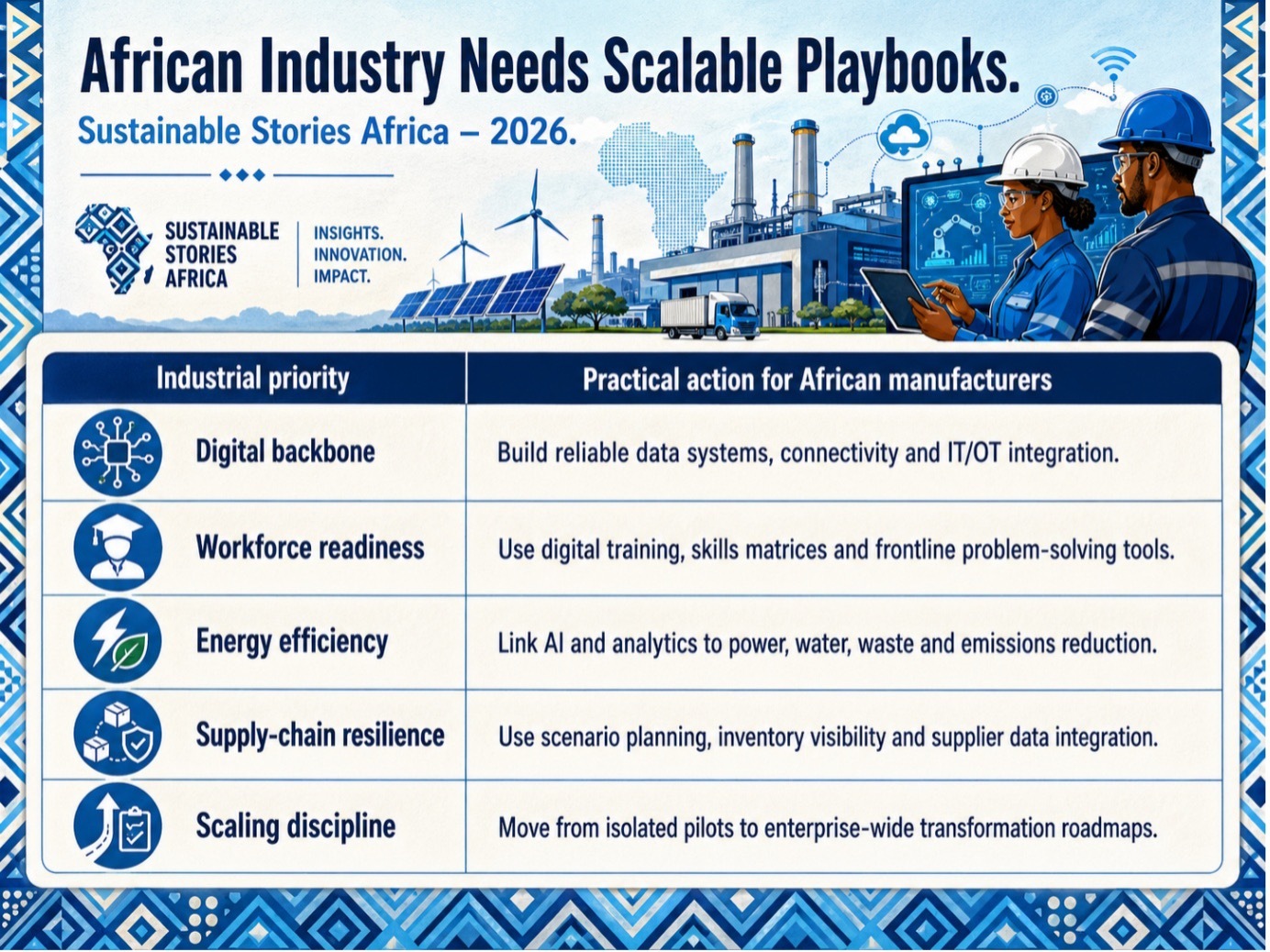
This matters because many African factories face a double constraint: underinvestment in industrial technology and rising pressure to meet global supply chain, climate and quality standards.
Export-oriented firms cannot ignore traceability, energy efficiency, delivery reliability or digital reporting. Domestic manufacturers also need resilience to compete against imports and manage local volatility.
The report identifies three scaling archetypes: centre of excellence, workforce capability building and technology integration.
Each combines structural, cultural and technological elements that help companies move from local success to network-wide transformation.
The policy lesson is direct.
- Governments should support industrial digitalisation through reliable power, broadband infrastructure, technical training, equipment finance, research partnerships and standards systems.
- Investors should back manufacturers with credible scaling roadmaps, not only isolated automation purchases.
- Companies should start with business value: quality, yield, downtime, energy use, lead time, safety or customer service.
Path Forward: Scale With People And Purpose
African industry should treat digital manufacturing as a resilience and sustainability agenda, not just a technology upgrade.
The priority is to scale practical solutions that improve productivity, skills, energy efficiency and supply -chain reliability.
The WEF Lighthouse model shows that durable transformation happens when people, systems and technology evolve together.
The next industrial advantage will belong to firms that act with discipline, build local capability and turn innovation into measurable operational impact.