By Eyikojoka Diboku
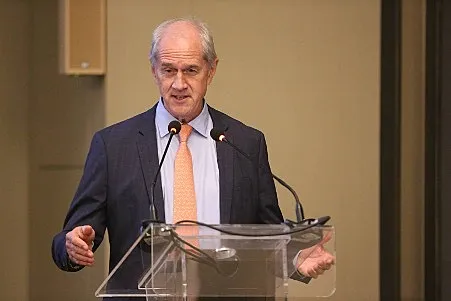
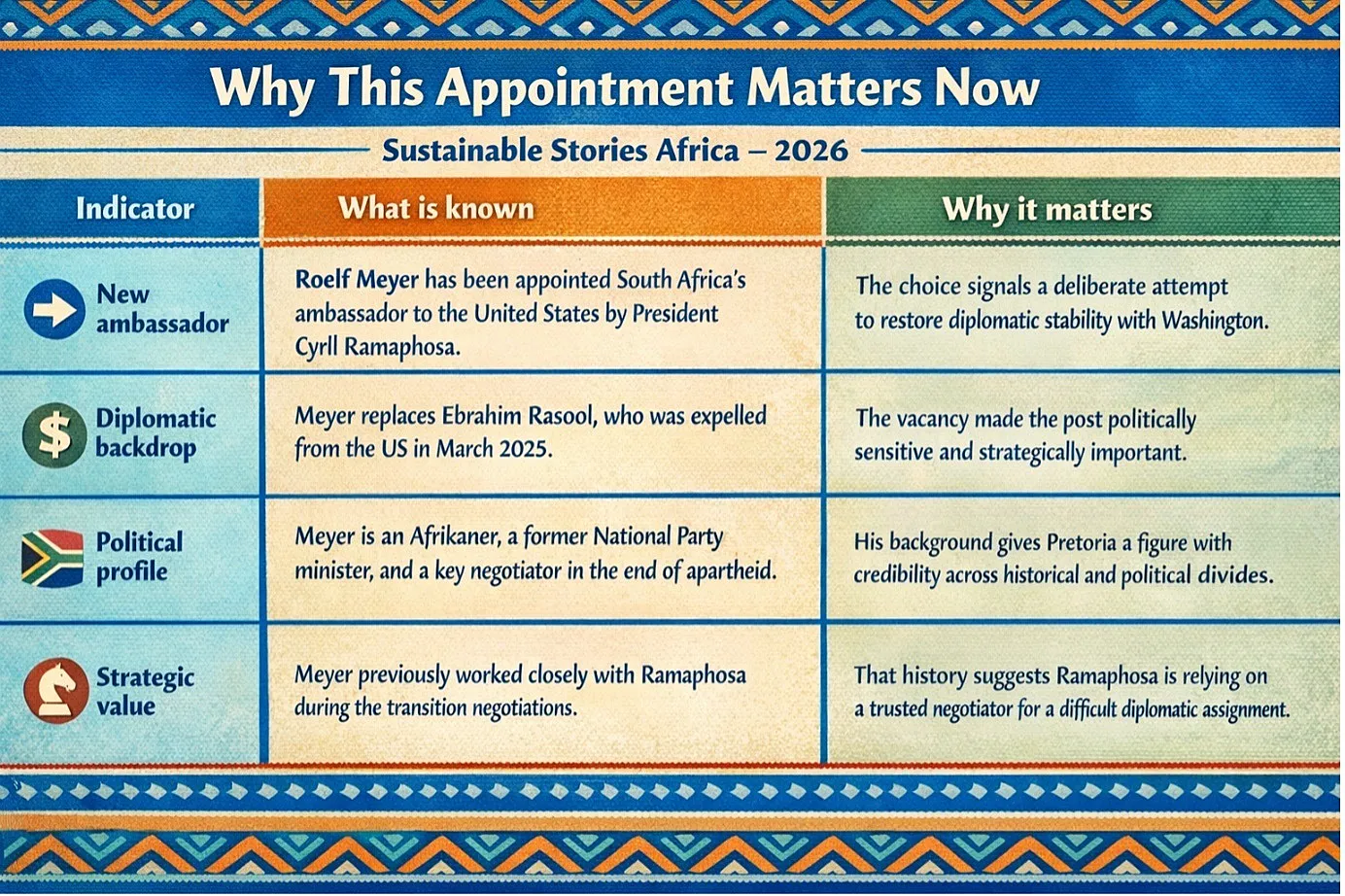
Roelf Meyer, the veteran apartheid-era negotiator who later became one of South Africa’s best-known bridge-builders, has been appointed the country’s ambassador to the United States, in a move that signals Pretoria’s attempt to steady strained ties with Washington.
President Cyril Ramaphosa confirmed the appointment this week, as bilateral relations remain under pressure following repeated claims by Donald Trump that South Africa is discriminating against white Afrikaners, claims the South African government has firmly rejected.
Meyer takes over from Ebrahim Rasool, who was expelled from the United States in March 2025 after criticising the Trump administration.
Early Life and Education
Meyer was born in 1947 in Port Elizabeth, in South Africa’s Eastern Cape, as the youngest son of farmer Hudson Meyer and school teacher Hannah Meyer, née van Heerden.
He attended school in Ficksburg before enrolling at the University of the Orange Free State, where he studied law and completed a BCom degree in 1968 and an LLB in 1971.
While at university, he served as president of the conservative Afrikaanse Studentebond, an early sign of his place within Afrikaner political structures during the apartheid era.
During his compulsory military service, Meyer was a member of the South African Defence Force choir, known as the “Kanaries”. After completing his studies, he practised as a lawyer in Pretoria and Johannesburg until 1980, before moving fully into formal politics through the National Party.
Political Career and Affiliations
Meyer entered parliament in 1979 during the apartheid era as a member of the National Party. Over the following years, he held several senior roles, including Deputy Minister of Law and Order, Minister of Defence under F. W. de Klerk, and later Minister of Constitutional Affairs, a portfolio that placed him at the centre of South Africa’s political transition.
In 1997, he broke with the National Party amid widening internal ideological divisions and co-founded the United Democratic Movement with Bantu Holomisa.
After retiring from frontline politics in 2000, he later joined the African National Congress in 2006, completing a striking political shift from apartheid-era governance to democratic realignment.
Role in Ending Apartheid
Meyer is best known for serving as chief negotiator for the apartheid government during the constitutional talks of the early 1990s.
Working alongside ANC negotiator Cyril Ramaphosa, he helped shape the agreements that opened the way to South Africa’s first democratic elections in 1994.
Their partnership was widely seen as central to securing a relatively peaceful transition from white minority rule to majority democracy.
Following that transition, Meyer served in Nelson Mandela’s cabinet as Minister of Constitutional Development and Provincial Affairs, extending his role from negotiator to institution-builder in the new democratic order.
Beyond Frontline Politics
After stepping back from active politics, Meyer moved into business and civil society while also building a reputation as an international mediator.
He has contributed to peace and negotiation efforts in places including Northern Ireland, Rwanda, Sri Lanka and Kosovo, and has also taken on governance and advisory roles focused on constitutionalism, dialogue and conflict resolution.
That broader post-political record helps explain why his return matters. Meyer is not only a figure from South Africa’s past; he is being deployed as a negotiator for a difficult present, one in which diplomatic repair now carries both symbolic and strategic weight.