Water scarcity is no longer just a drought story. The World Bank says the world is losing freshwater reserves fast enough to disrupt jobs, food systems, trade and ecosystems.
For Africa, the warning is especially sharp: drying is hitting rural labour, exposing weak water governance and raising the cost of delay.
A Silent Water Crisis Emerges
The World Bank’s new Global Water Monitoring Report makes a stark argument: the planet is not simply enduring more droughts and floods; it is also losing its underlying freshwater reserves.
That deeper shift, which the report calls “continental drying,” is turning water stress from a seasonal shock into a structural development risk.
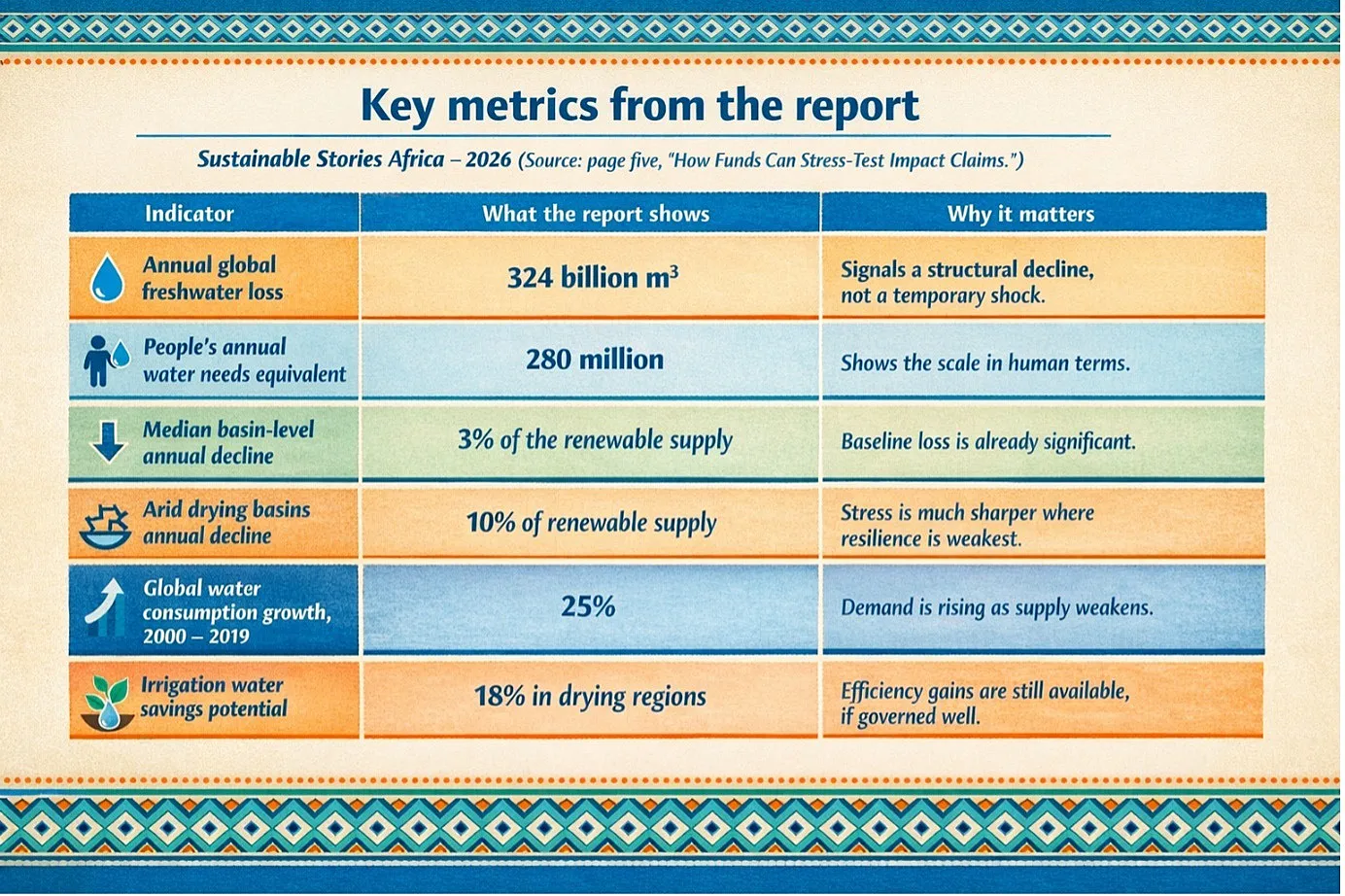
Using two decades of satellite data, the report estimates that global freshwater availability has been falling by about 324 billion cubic metres a year, enough to meet the annual needs of 280 million people. In basin terms, the median annual loss is about 3% of renewable freshwater supply, rising to 10% in arid basins already experiencing drying.
For African and other emerging markets, that matters because water sits beneath nearly every growth story: farming, power, manufacturing, trade, health, urbanisation and social stability.
The report’s central insight is simple but unsettling: when water storage falls, everything built on it becomes more fragile.
Drying’s New Math Is Hardening Fast
The report’s first message is scale. It finds a persistent global decline in freshwater reserves. It shows that dry areas are expanding more broadly and quickly than wetter ones, with “mega-drying” zones now spanning entire regions rather than isolated basins.
Even more striking is what is disappearing. In nonglaciated drying regions, groundwater accounts for 68% of water storage loss, followed by surface water at 18%, soil moisture at 9% and snow water at 5%, eroding the buffers economies depend on when rainfall fails.
The drivers are intertwined: global warming, worsening droughts and unsustainable land and water use.
Forests and wetlands help sustain freshwater, while urban expansion and intensive irrigation accelerate depletion. Countries with weak integrated water resources management deplete reserves two to three times faster than better-managed peers.
For Africa, where the DRC remains water-abundant, but Chad, Mauritania, Niger and Somalia face severe stress, governance will increasingly shape outcomes as much as climate exposure.
What The Satellites Saw From Above
The report is consequential partly because of how it measures risk. It uses terrestrial water storage, observed via GRACE satellites, to track freshwater reserves from space, with resolution improving from around 330 kilometres to about 25 kilometres, allowing sharper basin- and subnational analysis.
That clarity shows drying as an economic shock, not just a hydrological one. Approximately 78% of jobs worldwide are water-dependent, and 42% are highly water-dependent. 1.23 billion people are employed in agriculture, and exposure is concentrated in South Asia and Sub-Saharan Africa.
In Sub-Saharan Africa, a severe dry shock cuts employment by 2.5 percentage points on average and 7.5 percentage points in agriculture-dependent rural areas, leaving an estimated 600,000 to 900,000 people jobless each year between 2005 and 2018, disproportionately affecting women, older people, landless farmers and low-skilled workers.
Drying and warming also threaten food systems through nonlinear tipping points in some of the hottest, driest regions. A one-standard-deviation drop in soil moisture can cut crop productivity by 43%.
Because trade moves “virtual water”, local scarcity transmits globally. Virtual water trade rose 26% between 2000 and 2019, with about 25% of global water consumption by 2019 linked to exports; a modelled 100 mm rainfall drop in India could reduce global real income by $68 billion.
What Smarter Water Policy Could Unlock
The report is bleak about the trajectory, but not fatalistic about solutions. It argues that substantial water savings are still possible, particularly through more efficient agriculture and smarter water allocation.
If low-efficiency producers in drying regions raised their performance to at least median global efficiency, irrigation water use for 35 key crops, over 90% of global irrigation water use, could fall by 18%, saving 137 billion cubic metres a year, equivalent to the annual needs of 118 million people.
Trade already delivers 475 billion cubic metres of “virtual water” savings annually (9.4% of total water use for key crops), with drying countries capturing only about 8% savings compared to 11% in non-drying economies, suggesting distorted incentives.
Acting earlier also cuts ecological risk. Continental drying increases wildfire risk by 27% on average and 50% in biodiversity hot spots, and boosts burned area by 46%, in 17 of 36 global biodiversity hot spots already facing sustained freshwater decline.
For African markets, water reform is thus about fiscal stability, power reliability, food prices, export competitiveness and safeguarding ecosystems that underpin tourism, health and migration.
Who Must Move, And How
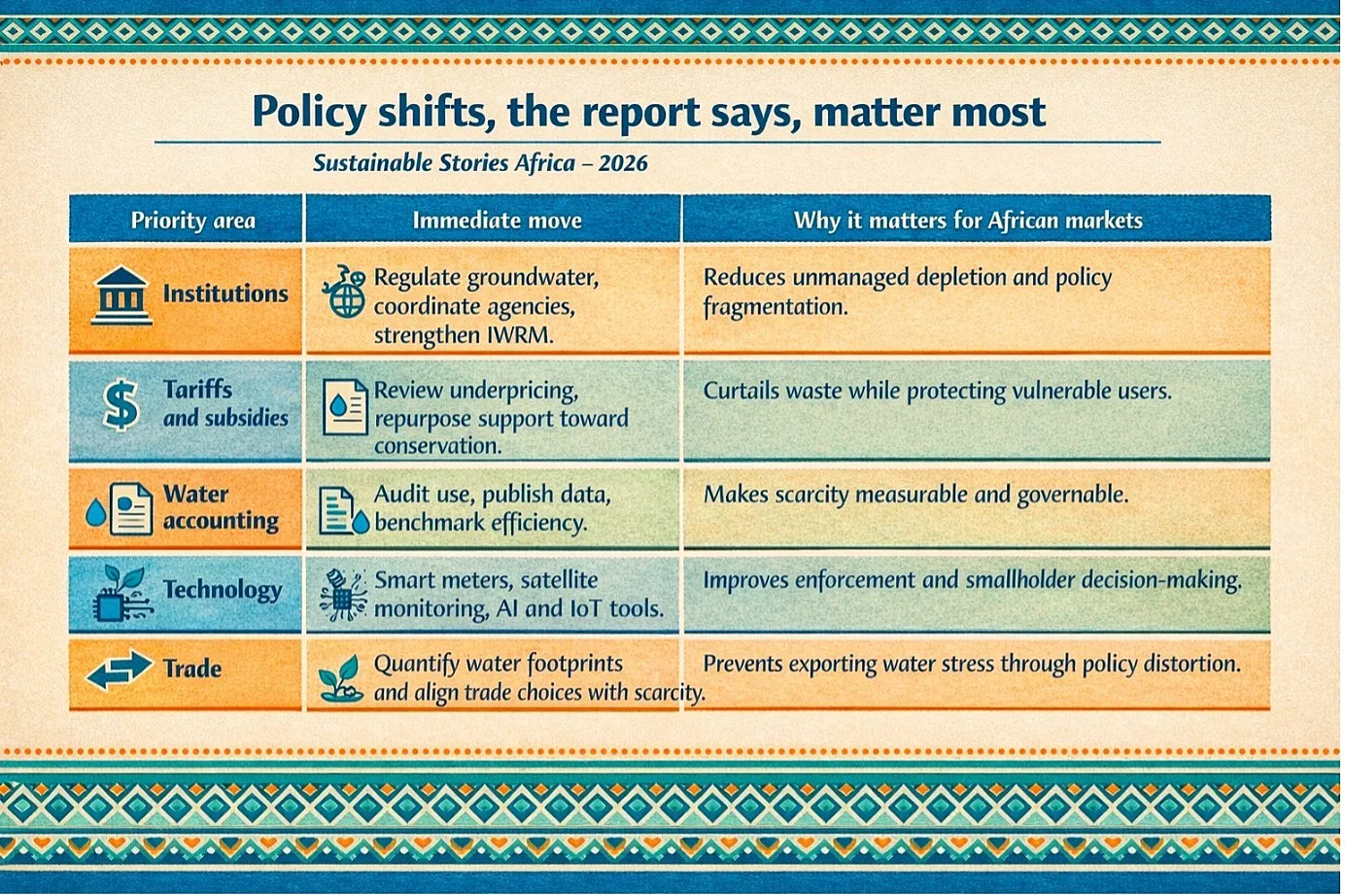
The World Bank sets out a three-part response: manage demand, augment supply, and improve allocation. Around that, it proposes five cross-cutting levers: stronger institutions, smarter tariffs and subsidy reform, water accounting, data and technology, and valuing water in trade.
- For governments, the first test is governance. That means groundwater rules, abstraction limits, interagency coordination, public water accounting and better enforcement.
- For regulators, it means shifting from politically easy underpricing to more cost-reflective systems, while protecting poor households and smallholders through targeted safety nets.
- For agriculture, the report points to practical measures with immediate relevance for African producers: drip irrigation, alternate wetting and drying, drought-tolerant crops such as sorghum and millet, better cropping calendars and deficit irrigation. Some of these methods can cut agricultural water use by 20% to 50% while maintaining yields. However, the report warns that efficiency alone is not enough; without quotas, pricing and monitoring, efficiency gains can fuel more water use.
- For investors and utilities, the supply agenda is clear: water reuse, desalination where viable, groundwater recharge, rainwater harvesting, and the restoration of forests and wetlands that act as natural storage.
Global reuse capacity reached 183 million cubic metres a day by the end of 2024, while more than 20,000 desalination plants across over 150 countries serve an estimated 300 million people.
However, desalination remains costly, often two to three times more expensive than conventional sources, so finance and technology choices will matter.
Path Forward – Turning Water Data Into Public Action
Continental drying is not just an environmental warning. It is a development signal that growth, jobs and resilience are now inseparable from water governance.
Africa’s exposure is high, but so is the potential payoff from acting earlier and more intelligently.
The report’s message is clear: measure water honestly, price it better, allocate it fairly, and stop treating hidden depletion as a free input to growth. In a drying world, that is no longer optional.