
For many companies, ESG still sits in strategy decks while executive pay remains tied to revenue, margin and quarterly growth.
That mismatch is now becoming harder for boards, investors and regulators to defend.
A March 2026 governance brief argues that linking variable compensation to climate and ESG targets is no longer symbolic.
It is becoming a practical test of whether sustainability commitments are truly embedded in corporate decision-making.
Pay, Purpose, and Corporate Credibility
Boards across African and emerging markets are facing a sharper governance question: can a company claim to be serious about climate risk, sustainable finance, and corporate integrity if its most senior executives are still rewarded almost entirely for short-term financial results?
That question sits at the centre of Pay for Purpose: Executive Compensation & ESG Targets, a March 2026 governance brief by Senior Sustainability Advisor Chika Onyekwere.
The paper argues that without direct pay linkage, sustainability strategies often remain “policy statements” rather than measured performance, leaving a gap between public ambition and internal accountability.
For African markets, the issue is especially important. As companies navigate tighter disclosure expectations, capital market scrutiny, and rising climate-related risks, executive compensation is emerging as a visible sign of whether ESG commitments are operational, board-owned, and investable.
Short-Term Pay Meets Long-Term Risk
The most immediate insight from the brief is simple: many incentive systems still reward behaviours that can work against long-term climate and governance goals.
On page two, the paper maps this “governance gap” across three influential groups.
- Loan officers are often rewarded for loan growth and deal origination, even where climate risk is not being measured.
- Investment managers are pushed by quarterly returns and short-term portfolio performance
- Transition risk is sidelined.
C-suite executives, meanwhile, are frequently assessed using only traditional financial KPIs such as revenue, margin, and earnings per share, leaving ESG commitments aspirational rather than binding.
That framing matters because it moves the ESG conversation away from branding and into incentive design. In practical terms, the brief suggests that a company cannot expect executives to deliver decarbonisation, climate resilience, financial inclusion, or sustainable finance targets if none of those outcomes affects how leadership is paid.
In African markets, where businesses are simultaneously managing growth pressure, foreign exchange volatility, energy insecurity, and evolving reporting expectations, that tension is even sharper.
Boards want near-term results, but regulators and investors increasingly want proof that companies are planning for resilience. The compensation structure is where those two demands collide.
How Boards Can Make It Work
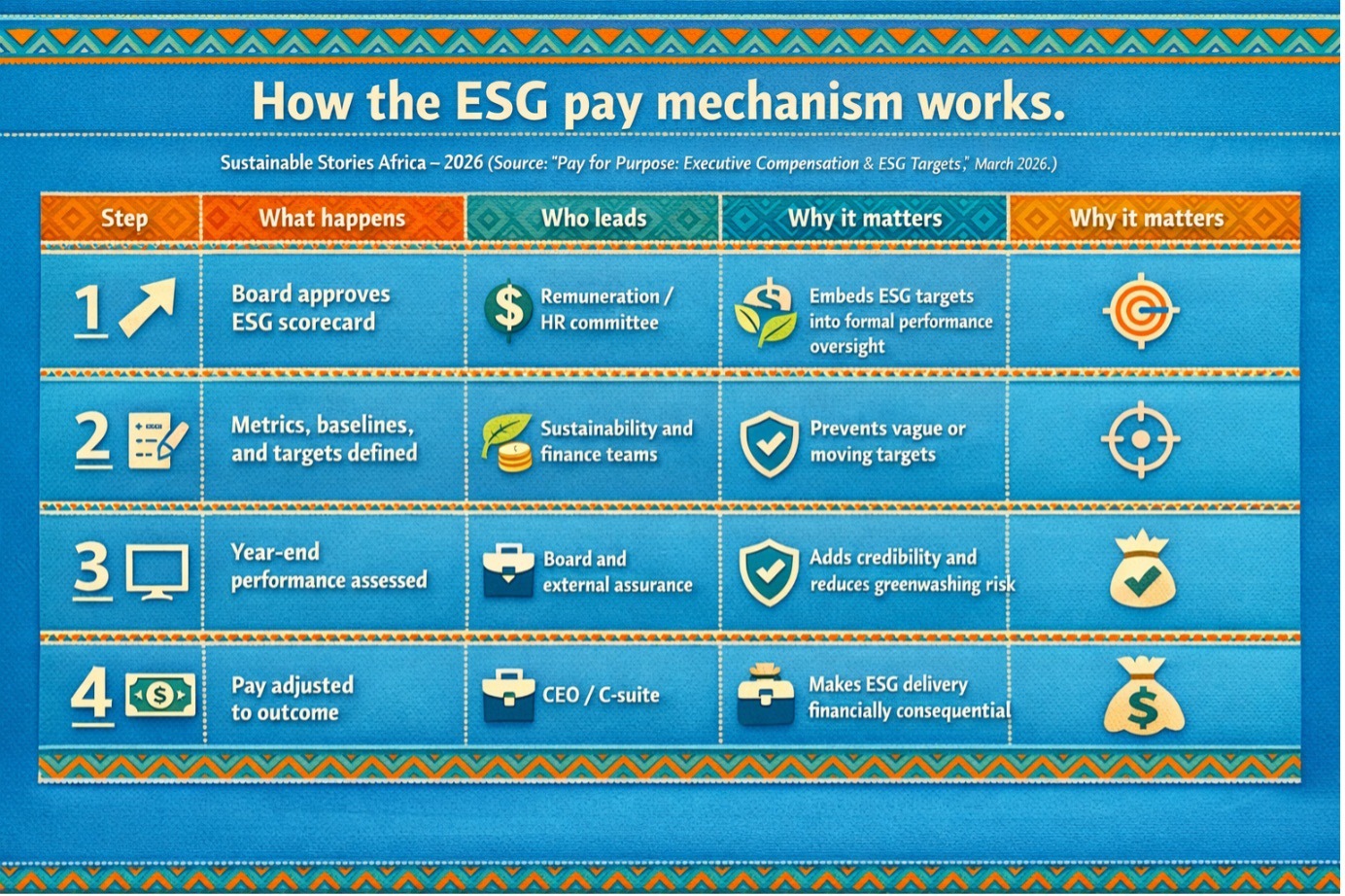
The document’s strongest contribution is that it does not stop at critique. It lays out a four-step mechanism for linking variable pay to specific, measurable ESG outcomes over a defined performance period.
- First, the board, usually through the remuneration or HR committee, approves an ESG scorecard alongside financial KPIs at the start of the performance year.
- Second, sustainability and finance teams define metrics, baselines, and targets. The examples given are concrete: reduce financed emissions intensity by 15% year on year, or disburse a defined amount in sustainable finance.
- Third, year-end performance is assessed by the board, with external assurance supporting credibility.
- Finally, pay is adjusted to outcomes: a shortfall reduces the bonus, on-target delivery unlocks full payout, and outperformance can be rewarded.
That sequence is important because it shows ESG-linked pay is not about vague promises. It is about governance architecture: approved metrics, pre-set baselines, measurable results, and transparent consequences.
What Credible ESG-Linked Pay Unlocks
The paper shows how ESG-linked pay can move from theory to practice. For CEOs, it proposes tying about 20% of variable compensation to indicators such as PCAF‑aligned financed emissions reduction, financial inclusion and sustainable lending performance, and employee engagement or ESG culture scores.
For the wider C‑suite, it suggests linking roughly 15% of variable pay to completed TCFD‑aligned climate risk disclosure, sustainable finance origination targets, and regular ESG performance discussions in annual staff reviews.
This creates personal accountability for leadership and signals that sustainability is part of core governance, not a side project.
The paper also stresses the culture cascade: once executives are assessed on ESG delivery, ESG KPIs spread into departments and performance reviews.
For African businesses, smarter incentive design can align capital allocation, climate disclosure, lending behaviour and workforce engagement, while strengthening the governance story for international investors, ensuring board‑level linkage to sustainability commitments.
What Boards, Regulators, and Firms Must Do
The paper’s final section lays out the ingredients of a credible ESG pay framework, and is where the governance test becomes harder.
Metrics must be specific and quantifiable. Baselines must be set before the performance year begins. Targets should align with science-based pathways. The entire linkage should be approved by the board and externally disclosed.
The governance guardrails are just as important. The brief calls for independent remuneration committee oversight, third-party assurance of ESG data, malus and clawback provisions, and annual public disclosure of the pay-ESG linkage.
Common metrics include financed emissions intensity, sustainable finance disbursements, TCFD disclosure completion rates, and employee ESG training completion.
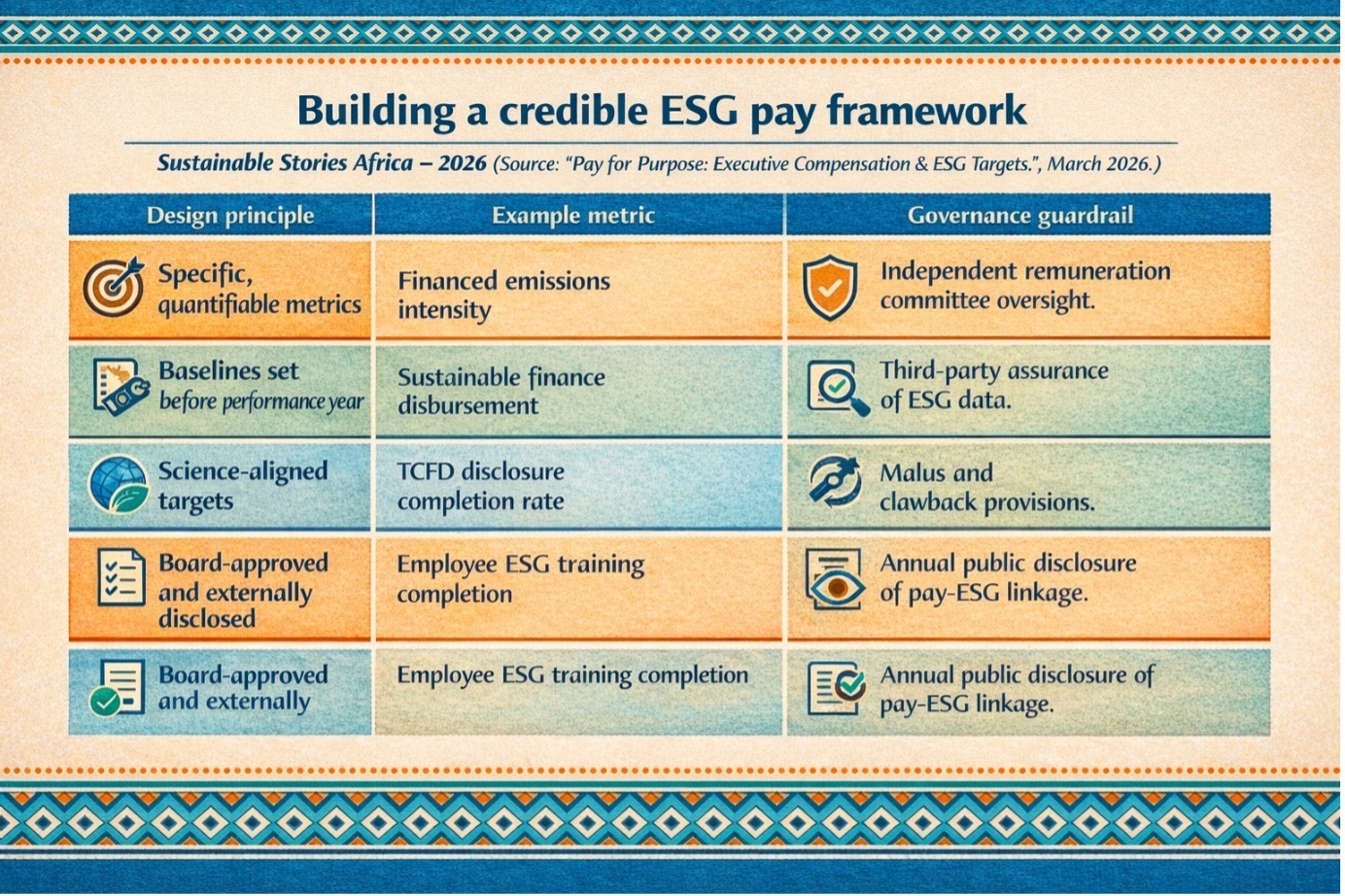
The message is clear: ESG-linked compensation only works when it is disciplined enough to survive scrutiny. Poorly designed scorecards can create box-ticking. Credible ones can reshape governance.
Path Forward – Through Incentive Discipline
African companies do not need perfect ESG systems before linking pay to sustainability outcomes.
However, they do need disciplined design: measurable metrics, credible baselines, board oversight, and transparent disclosure. That is how ESG moves from promise to performance.
The bigger shift being advocated is cultural as much as technical. When executive compensation reflects climate, governance, and inclusion outcomes, boards signal that long-term resilience matters as much as quarterly delivery.
In markets under pressure, that may become one of the clearest tests of corporate integrity.