Climate ambition is no longer judged only by targets, summits or speeches. It is increasingly judged by whether public money is tracked, policies are implemented, and results can be verified.
An Asian Development Bank guide argues that supreme audit institutions are becoming central to that test, especially as climate finance grows, public risk deepens, and governments face rising pressure to prove that climate spending is effective.
Auditors Enter Climate Governance
Climate policy has entered an accountability phase. The latest signal is the March 2026 Asian Development Bank guide on the role of supreme audit institutions, which frames public auditors not as back-office reviewers but as key actors in achieving climate objectives.
The logic is straightforward: as climate risks spread through budgets, infrastructure, energy systems and public services, governments need independent institutions that can test whether promises are funded, lawful, efficient and actually working.
That matters even more for developing and emerging markets. The guide focuses on Central and West Asia, but its argument travels well to African economies where climate vulnerability, fiscal strain and development pressure increasingly collide.
Audit institutions, the report suggests, can do something politics often struggles to do consistently: follow the money, check implementation and ask whether climate programmes are delivering measurable public value.
The timing is hard to ignore. The guide notes that the UN General Assembly, in December 2024, formally acknowledged the role supreme audit institutions can play in assessing national climate action, promoting transparency and improving governance.
It also cites the 2024 INTOSAI symposium, which urged SAIs to integrate climate issues into annual audit plans and across audit types.
Climate Money Needs Proof
The scale of the challenge is measurable. ADB estimates climate finance needs in Central and West Asia alone at $100 billion annually, while COP29 commitments have raised the target for international climate finance from $100 billion to $300 billion a year.
However, early ClimateScanner results show that 73% of 61 assessed Supreme Audit Institutions reported weak or insufficient systems for identifying and monitoring domestic climate expenditures.
That is the accountability gap in plain sight. Climate finance is growing, but many governments still cannot clearly identify what counts as climate spending, track how funds move across agencies or verify whether projects deliver real mitigation and adaptation outcomes.
In that environment, the audit function becomes strategic, not procedural, safeguarding credibility before public and investor confidence erodes.
The urgency is compounded by accelerating climate risk. The guide confirms that 2024 was the warmest year on record, approximately 1.55°C above pre-industrial levels, with current policy pathways still pointing to 2.6°C – 3.1°C of warming this century.
For African governments, that trajectory means heavier fiscal burdens, greater water stress, weakened agricultural productivity and increasingly constrained development choices.
Interest: From Targets to Testing
What exactly can audit institutions do? The guide makes a strong case that climate action should be tested through all three classic audit lenses: financial, compliance and performance audits. Financial audits can examine whether climate-related liabilities, costs and disclosures are properly reflected. Compliance audits can test whether spending and programmes follow laws, mandates and policy rules. Performance audits can ask the hardest question of all: did the intervention actually work?
That is especially relevant where climate policy cuts across ministries. The report stresses that climate change is cross-sectoral and cannot be handled by one department alone. Energy, agriculture, water, transport, public finance and social protection all intersect. That means audit teams also need to work across silos, share expertise and apply long-term thinking rather than narrow annual reviews.
One useful example in the guide is institutional design. It says climate audits are possible under any SAI model, but effectiveness improves when institutions build specialist capacity, create dedicated teams and embed climate in strategic and annual audit planning. It also points to Canada’s commissioner model as an illustration of how audit offices can deepen climate oversight through specialised mandates and recurring review cycles.
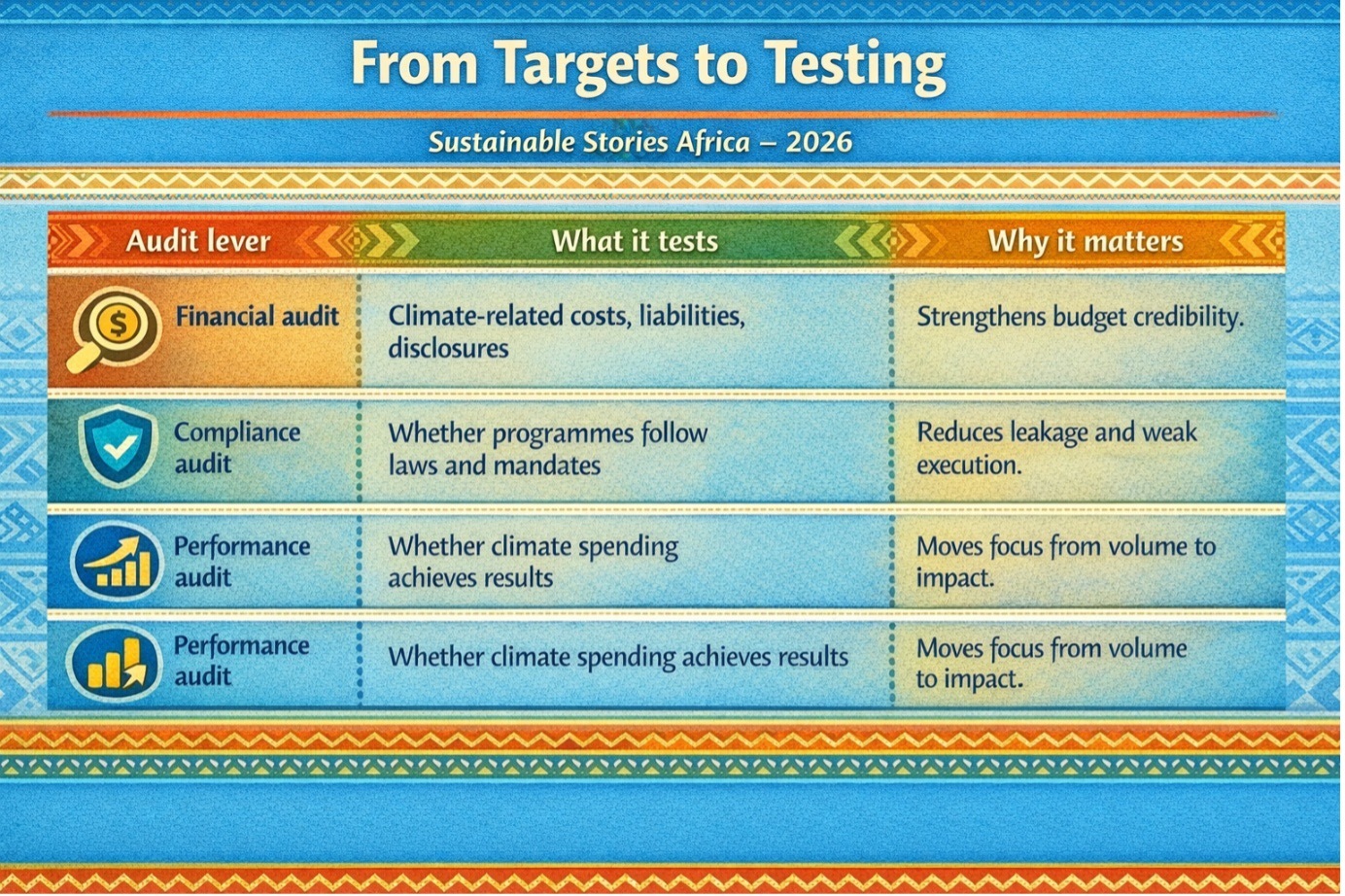
The guide’s central message is that climate governance now depends as much on verification as ambition.
What Better Auditing Unlocks
If governments strengthen climate auditing, the gains could be substantial.
- Better audit systems would make climate finance more traceable, improve investor and donor confidence, expose weak programme design earlier, and help governments shift scarce resources toward interventions that actually reduce emissions or build resilience.
For citizens, the benefits are even more concrete.
- It means adaptation funds are more likely to reach flood-prone communities, drought response is more likely to be measured against outcomes, and energy transition spending is less likely to disappear into opaque bureaucracy. In markets where trust in public spending can be fragile, credible audit findings can become a public good in themselves.
There is also a development upside. The guide notes that audits can assess whether climate efforts support broader national goals and whether public resources are being used efficiently.
In other words, auditing is not a brake on climate ambition. It is part of how ambition becomes investable, governable and durable when applied efficiently.
Build The Audit State
The report’s recommendations are pragmatic.
It calls on Supreme Audit Institutions to define:
- Climate risks across sectors
- Ensure mandates cover all audit types
- Establish dedicated climate units or teams, invest in training, integrate climate into strategic and annual planning, strengthen international knowledge-sharing, and develop follow-up mechanisms so recommendations are not ignored.
For African markets, the broader lesson is clear.
Climate policy cannot remain stuck in the era of declarations.
- Governments need auditable climate budgets.
- Regulators need clearer reporting systems.
- Audit institutions need capacity in climate science, finance and policy evaluation.
- Development partners need to treat audit readiness as part of climate readiness.
Without that shift, more money may flow, but confidence may not.
Path Forward – Climate Governance Now Needs Verification
Climate governance is moving from promise to proof. The next phase will depend on whether audit institutions are equipped to test spending, policy coherence and outcomes with the same seriousness governments apply to announcing targets.
What is being advocated is not more bureaucracy, but better accountability: stronger mandates, stronger skills, clearer climate tracking and tougher follow-through.
In emerging markets, that may prove to be one of the most practical ways to turn climate ambition into public results.