
Nigeria and Kenya are moving cautiously in the right direction on perceptions of women in leadership.
However, the latest Reykjavík Index shows that progress remains partial, uneven, and highly sector-specific.
That matters for African markets because leadership bias is not just cultural.
It shapes who is trusted with capital, who gets promoted, who gets heard in boardrooms, and whose authority is questioned in public life.
What The Latest Data Reveals
The clearest message from the Reykjavík Index for Leadership 2025/26 is that Nigeria and Kenya both posted year-on-year gains; however, from relatively low bases.
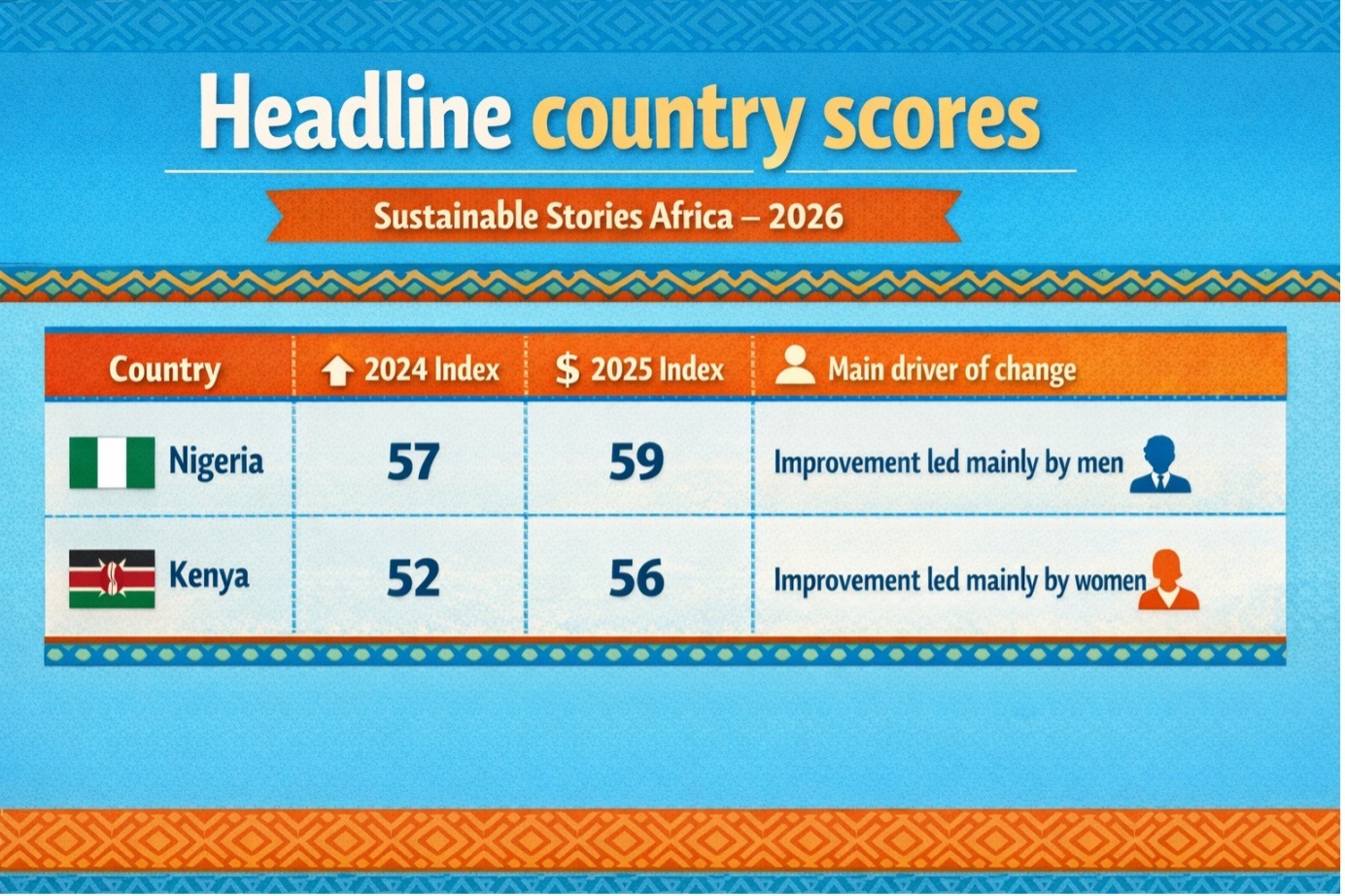
Nigeria’s 2025 Index score rose to 59 from 57 in 2024, while Kenya’s rose to 56 from 52. The Index defines 100 as a society in which men and women are viewed as equally suited to leadership.
That places both countries below the leading markets in the report. Iceland, for instance, scored 86, while the G7 average stood at 68 in 2025.
Even so, the African story in this year’s report is not one of stasis. It is one of the movements, with different drivers in each country.
- Nigeria’s improvement was driven by men becoming slightly more supportive.
- Kenya’s jump was led by women, whose Index score rose sharply to 62 from 54, compared with men at 50, almost unchanged from 49 in 2024.
Leadership Perceptions Meet Market Realities
The new data arrives at a moment when African economies are asking more of leadership: cleaner governance, better institutions, more credible regulators, stronger boards, and more inclusive growth.
However, the report suggests that perceptions about who looks “right” for leadership still lag these ambitions.
For Nigeria and Kenya, that gap is especially important. These are two of Africa’s most influential political and commercial markets, where public trust, executive authority, and institutional credibility matter far beyond elections or corporate titles. If women can be accepted in principle but still face resistance in practice across major sectors, then leadership pipelines remain narrower than they should be.
The report shows exactly that tension: relatively strong comfort with women in visible leadership roles, but stubborn bias when leadership is tested sector by sector.
The story, then, is not simply whether attitudes are improving. It is whether progress is deep enough to reshape how leadership is actually distributed.
Gains Matter, But Not Enough
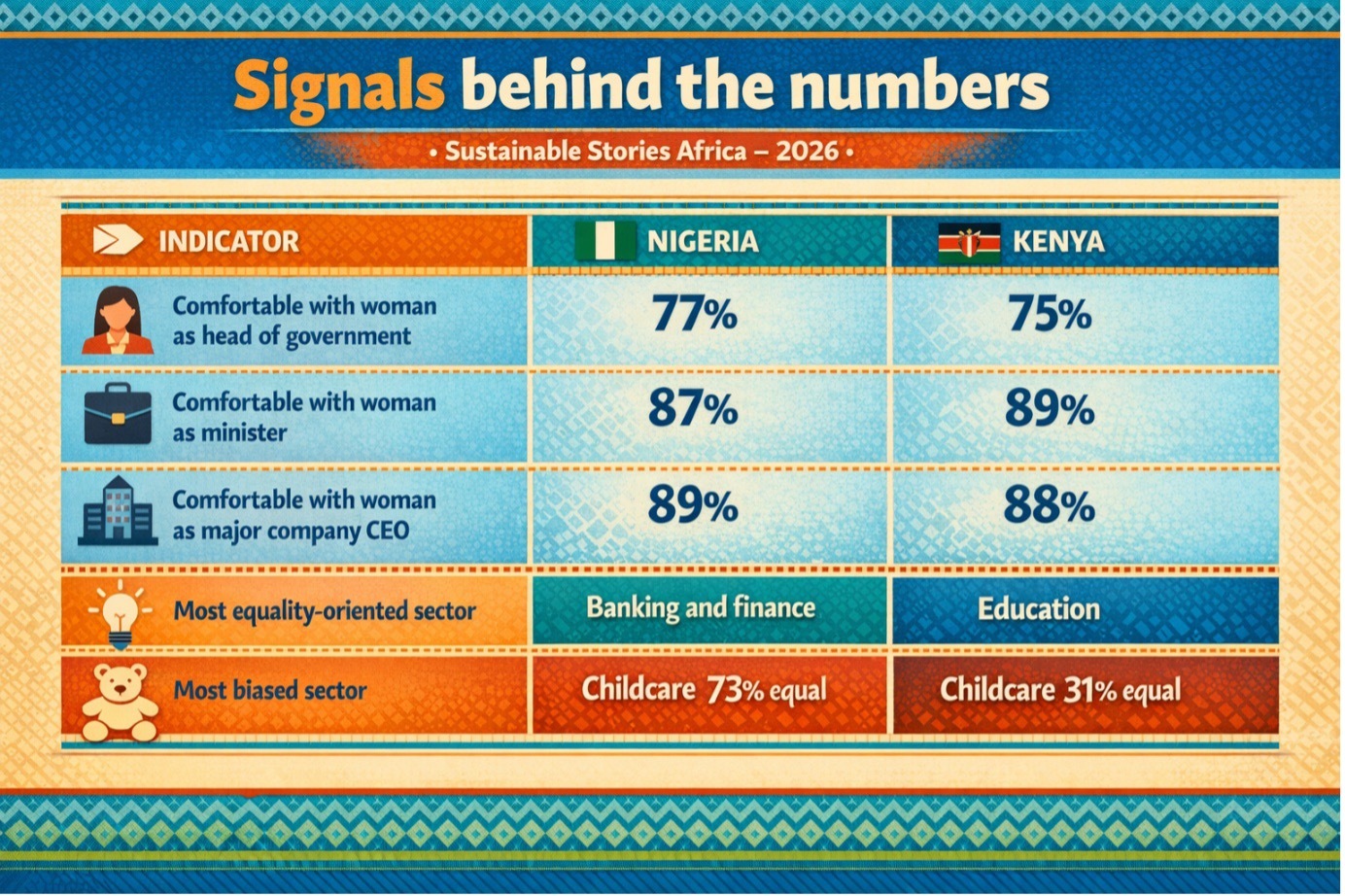
On the surface, the headline numbers are encouraging. In Nigeria, 77% said they were comfortable with a woman as head of government, while comfort was even higher for women as ministers (87%), CEOs of major companies (89%), and CEOs of SMEs (89%).
In Kenya, 75% said they were very or fairly comfortable with a woman as head of government, rising to 89% for a woman minister, 88% for a woman leading a major company, and 90% for a woman leading an SME.
Those are not marginal numbers. They suggest that outright rejection of women in leadership is not the dominant public mood in either market.
However, they also hide a more difficult truth: general comfort does not automatically translate into equal credibility across industries, professions, or decision-making spaces.
Where Bias Still Holds Firm
The report’s sector data is where the real tension appears.
In Nigeria, perceptions of equality are strongest in banking and finance, with 73%, education at 72%, and pharmaceutical and medical research at 70%, saying men and women are equally suited to leadership.
However, some sectors remain sharply gender-coded. In childcare, just 33% said men and women are equally suited, while 61% says a woman is better suited. In engineering, only 46% saw equal suitability, while 47% said men were better suited. Aerospace, architecture, and automotive manufacturing also remained weak on parity.
In Kenya, the pattern is similar, though with different strengths. Education leads at 71%, with men and women equally suited to leadership, followed by pharmaceutical and medical research at 70%, media and entertainment and banking and finance at 68%, and economics and political science at 67%.
However, the bias is steep in childcare, where only 31% see both as equally suitable and 66% say women are better suited. In automotive manufacturing, defence and police, 51% say men are better suited. Gaming and aerospace also remain skewed.
That split matters because it mirrors how labour markets often work in practice. Leadership is more acceptable where women’s participation is already socially legitimate, such as in education, healthcare-related sectors, or finance.
However, once the field is coded as technical, industrial, security-linked, or male-dominated, bias rises again.
What Stronger Equality Could Unlock
If these perception gaps narrow further, the gains would extend well beyond representation.
Nigeria and Kenya would widen their effective leadership pools, reduce friction in succession planning, and improve the credibility of public and private institutions that increasingly need to reflect the societies they serve.
That has consequences for governance quality, investor confidence, and organisational performance alike.
More equal perceptions would also matter for younger professionals. Leadership bias often does its damage long before the boardroom, shaping who studies what, who applies, who persists, and who gets sponsored.
A woman seen as acceptable in leadership only in “appropriate” sectors is still being limited. So is a man written off in care-oriented sectors.
The report is explicit that the Index tracks prejudice towards men as well as women.
Action: What Nigeria And Kenya Should Do Next
The next step is not a symbolic celebration. It is a targeted action.
- Governments should use this data to sharpen public-sector leadership pipelines, especially in ministries and agencies tied to infrastructure, science, industry, and security.
- Regulators and business associations should treat sector bias as an institutional risk, not a soft social issue. Companies should audit promotion pathways in technical and operational functions, where bias appears strongest.
- Schools and universities should intervene earlier, because these perceptions shape occupational sorting before careers fully begin.
For both markets, the practical challenge is the same: convert broad comfort with female leadership into consistent trust across all sectors.
Until that happens, headline acceptance will continue to mask deeper structural filters.
Path Forward
Nigeria and Kenya have shown that attitudes can improve, but the report makes clear that progress is fragile and uneven. The priority now is to move from visible acceptance of women leaders to deeper equality across technical, industrial, and public-authority roles.
What is being advocated is straightforward: use data, institutions, and leadership pipelines to break sector-specific bias. That is how these markets turn incremental gains into perception gains, stronger governance, wider opportunity, and more credible inclusion.