
The sustainability backlash has not erased a harder truth: investors still reward credible green strategies when tied to growth, costs or risk reduction. What markets reject is a vague purpose without business logic.
That distinction matters for Africa. As capital becomes more selective, companies and policymakers need to show not just why sustainability is necessary, but how it protects margins, extends cash flows and unlocks new markets.
When Sustainability Starts Looking Bankable
The case for sustainability is changing. It is no longer enough for companies to say a climate, water, circularity or supply-chain initiative is socially useful. Investors increasingly want to know whether it can raise revenues, lower costs, or reduce risks that threaten future cash flows.
A January 2025 BCG analysis makes that point directly: sustainability and value creation are not inevitably in opposition, and the market tends to reward sustainability announcements that include a thoughtful business case.
The findings matter well beyond developed markets. African businesses are operating through tighter financing conditions, rising climate exposure, growing disclosure demands and volatile input costs.
In that environment, sustainability has to earn its place inside capital allocation, not just corporate communications. The question is no longer whether sustainability sounds good. It is whether it can help businesses grow more durable cash flows in fragile operating environments.
BCG’s research, based on approximately 47,000 sustainability-related announcements from the world’s 1,000 largest public companies between 2015 and 2022, argues that the strongest value impact related to sustainability is clearly linked to business economics.
That is the deeper lesson African firms, investors, and regulators should be paying attention to now.
Markets Still Reward Credible Green Strategy
ESG has not peaked; investor expectations have sharpened. BCG research shows that high-quality sustainability announcements, those containing five or more strong business-case elements, outperformed low-quality ones by 1.1 percentage points in relative total shareholder return within three days of publication.
However, most companies are still failing the quality test. In 2022, only 18% of sustainability announcements qualified as high quality, even as total announcement volumes nearly doubled from 2019's pre-pandemic peak.
Separately, investor confidence in companies' ability to communicate sustainability rationale improved only marginally, from 37% in 2019 to 40% in 2024.
For African markets, where currency risk, infrastructure deficits, policy volatility, and climate exposure compound investor scrutiny, a weak business case beneath a sustainability label will not survive.
Credibility must be earned through substance, not volume.
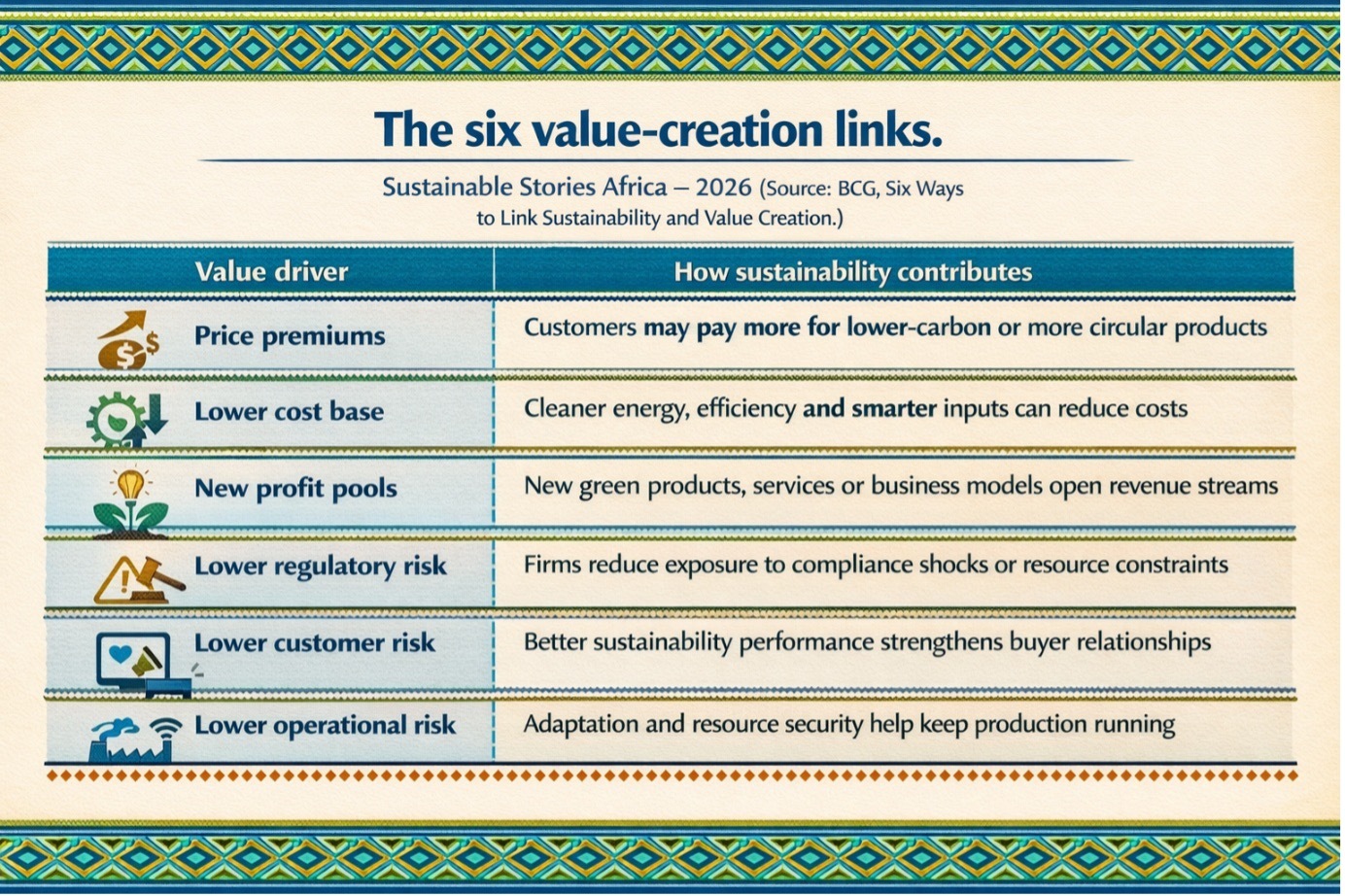
Six Routes From Sustainability to Value
BCG reduces the logic to a simple corporate-finance frame: value creation is a risk-adjusted function of two variables, the growth rate of free cash flow and the duration of that cash flow. Sustainability can support both.
On the growth side, the paper identifies three routes:
- Achieving price premiums
- Reducing the cost base
- Accessing new profit pools.
On the durability side, it identifies three additional routes:
- Mitigating regulatory risk
- Mitigating customer risk
- Mitigating operational risk.
That framework is useful because it strips away much of the ideological noise. A sustainability initiative does not have to be morally perfect to be financially relevant.
It needs to improve sustainable economics or reduce the risk of future cash flows deteriorating.
The most credible sustainability strategies are those that protect and grow core business value.
- Indorama Ventures invested $1.5 billion in recycled PET to secure growth and input-cost premiums.
- GM backed cheaper battery chemistry to reduce cost volatility at the EV scale.
- Schneider Electric earned twice its industry's average relative TSR uplift from sustainability announcements.
On the risk side:
- Antofagasta spent over $2 billion on desalination to reduce water-related regulatory exposure.
- Nestlé, Heineken, and others invested in traceability and water efficiency to defend the operating life of cash-generating assets, not as side projects, but as core business continuity decisions.
Why This Matters for African Markets
African companies do not need to replicate global multinationals, but they must absorb a core principle: across the continent, sustainability is already inseparable from business survival.
- Agribusinesses cannot create value without soil quality, water security, and export traceability.
- Manufacturers cannot absorb diesel-driven energy costs indefinitely.
- Banks cannot perpetually treat climate and nature risks as externalities.
- Consumer brands face real procurement and market-access consequences from deforestation, labour conditions, and packaging waste.
The value-creation lens reframes this reality.
- A Nigerian manufacturer improving energy efficiency reduces unit costs.
- A Kenyan horticulture exporter strengthening water stewardship preserves premium market access.
- A South African miner investing in circular water systems reduces operating interruptions and regulatory friction.
BCG argues that investors expect management to pursue green opportunities where firms have genuine capabilities and a right to win, and Africa's transition economy offers precisely that competitive space.
Three Steps From ESG Compliance to Business Strategy
The most important shift is internal.
- Boards must stop asking, "What ESG initiative should we announce?" and start asking, "Where can sustainability improve our revenue, margin, or resilience?" That reframe changes capital discipline entirely.
Evidence matters next.
- BCG identifies seven business-case elements that strengthen market response, with the strongest impacts coming from company materiality, explicit linkage to value creation, and funding clarity. Lessons African firms raising debt or courting investors must absorb immediately.
Prioritisation follows.
- Not every sustainability investment delivers immediate returns, and the most credible firms acknowledge that openly. The task is identifying where capabilities, competitive position, and operating context make sustainability commercially actionable.
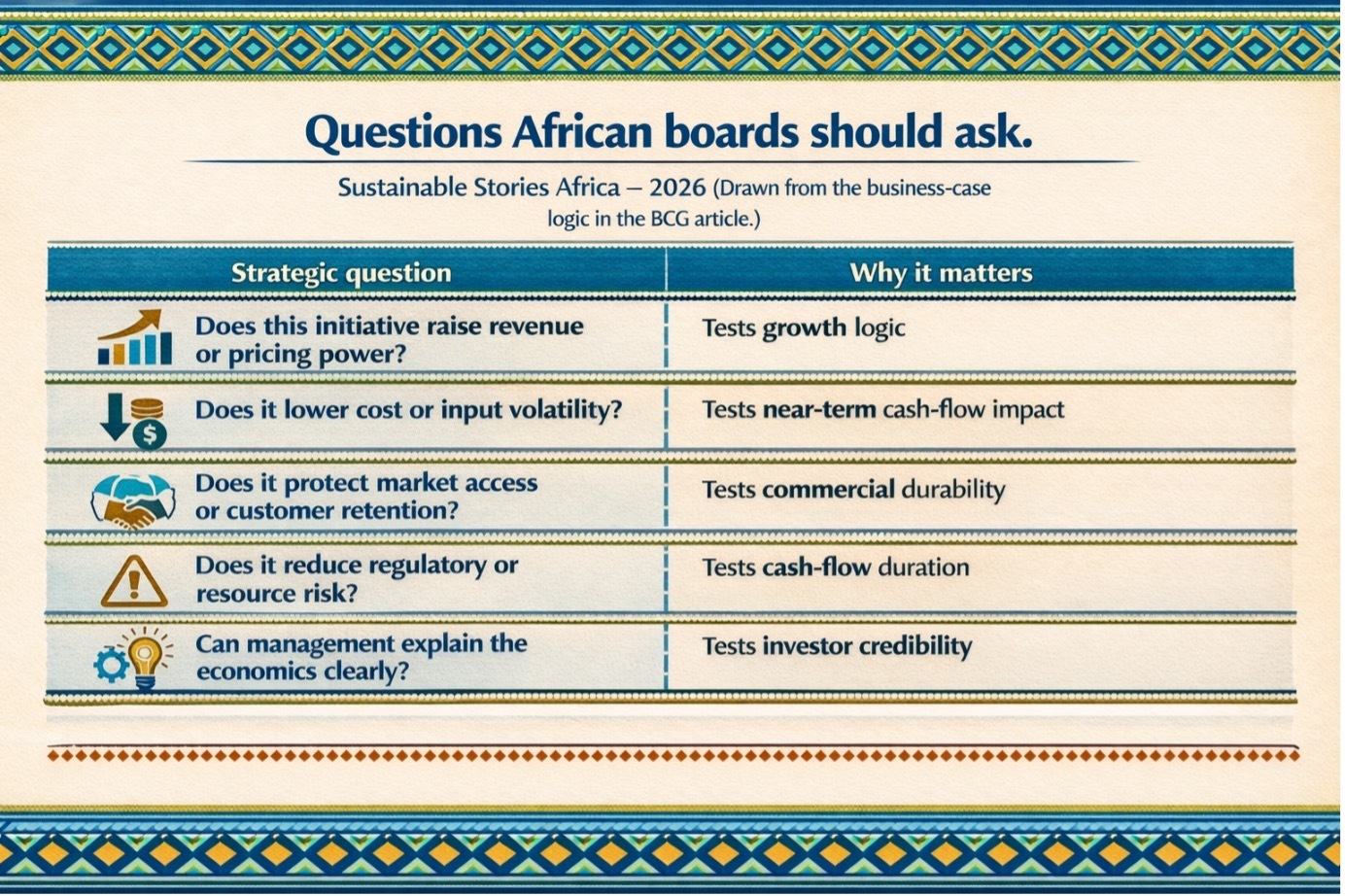
For investors and lenders, the standard is identical: evaluate sustainability claims with the same rigour applied to any capital project:
- Expected returns
- Strategic fit
- Execution credibility
- Downside protection.
Path Forward – Strategy Must Carry the Story
Sustainability will disappoint markets when it is treated as language rather than economics.
The winning companies will be those that show how climate, resource and social decisions strengthen free cash flow and reduce future fragility.
For African markets, the priority is not more slogans. It is sharper capital allocation, clearer investor communication and sustainability strategies built around sectors where resilience, competitiveness and value creation already overlap.