
ESG scores are getting harder to improve just as disclosure rules spread and capital gets pickier.
For African issuers, lenders and suppliers, the easiest gains no longer come from glossy reports.
The real lift now comes from five operational moves: sharper materiality, stronger governance, cleaner data, fuller value-chain accounting, and credible targets backed by assurance.
Why one ESG score can mislead
What many executives still call the ESG score is, in practice, a bundle of judgments made by raters, investors, lenders and regulators.
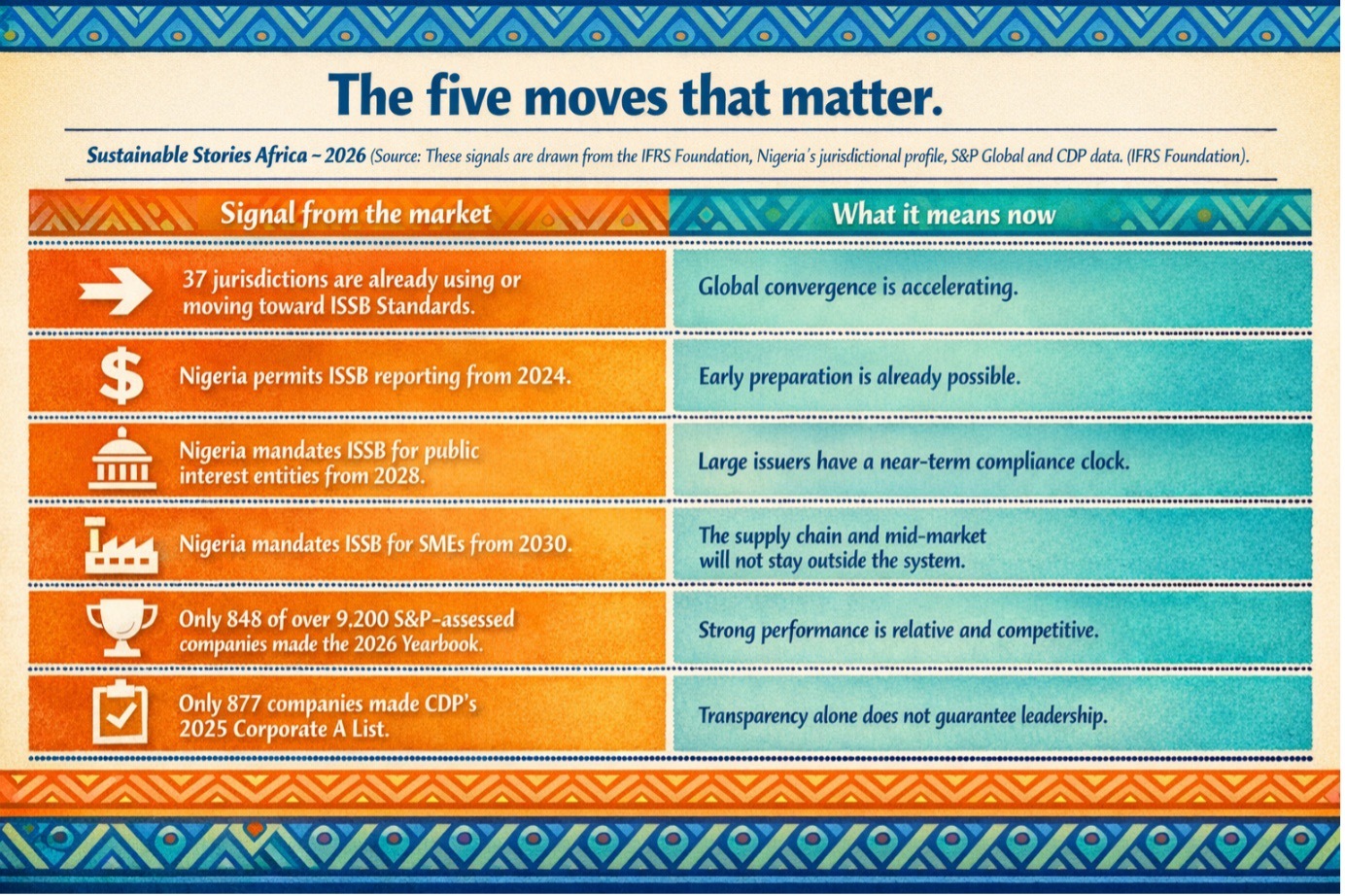
That bundle is becoming more consequential as ISSB-based disclosure rules spread, with 37 jurisdictions already using or moving to introduce ISSB Standards as of September 2025.
This represents approximately 60% of global GDP, more than 40% of global market capitalisation and about 60% of global greenhouse gas emissions.
Nigeria’s direction of travel is especially clear. All entities are permitted to apply ISSB Standards from reporting periods beginning on or after 1 January 2024; public interest entities, including listed companies, are required to apply them from 1 January 2028, while SMEs are to commence 1 January 2030.
The bigger mistake is to chase presentation before substance. Research from MIT Sloan’s Aggregate Confusion Project found that divergence in ESG ratings is driven mainly by measurement differences, followed by scope, with weighting a much smaller factor.
That is why companies that improve fastest usually fix the operating system underneath the report, not just the wording on the cover.
The market rewards proof
The competitive bar is already high. S&P Global says more than 9,200 companies were assessed for its 2026 Sustainability Yearbook, but only 848 achieved membership. CDP says 22,100+ organisations disclosed in 2025, yet only 877 companies made its Corporate A List and just 23 achieved Triple A. Disclosure, in other words, is no longer distinctive; verified excellence is. (S&P Global)
That matters in African markets because ESG now shapes more than reputation. IFRS S1 is explicitly framed around sustainability-related risks and opportunities that can affect cash flows, access to finance and cost of capital. So, when boards ask how to “fix the score”, the serious answer is not branding. It is evidence.
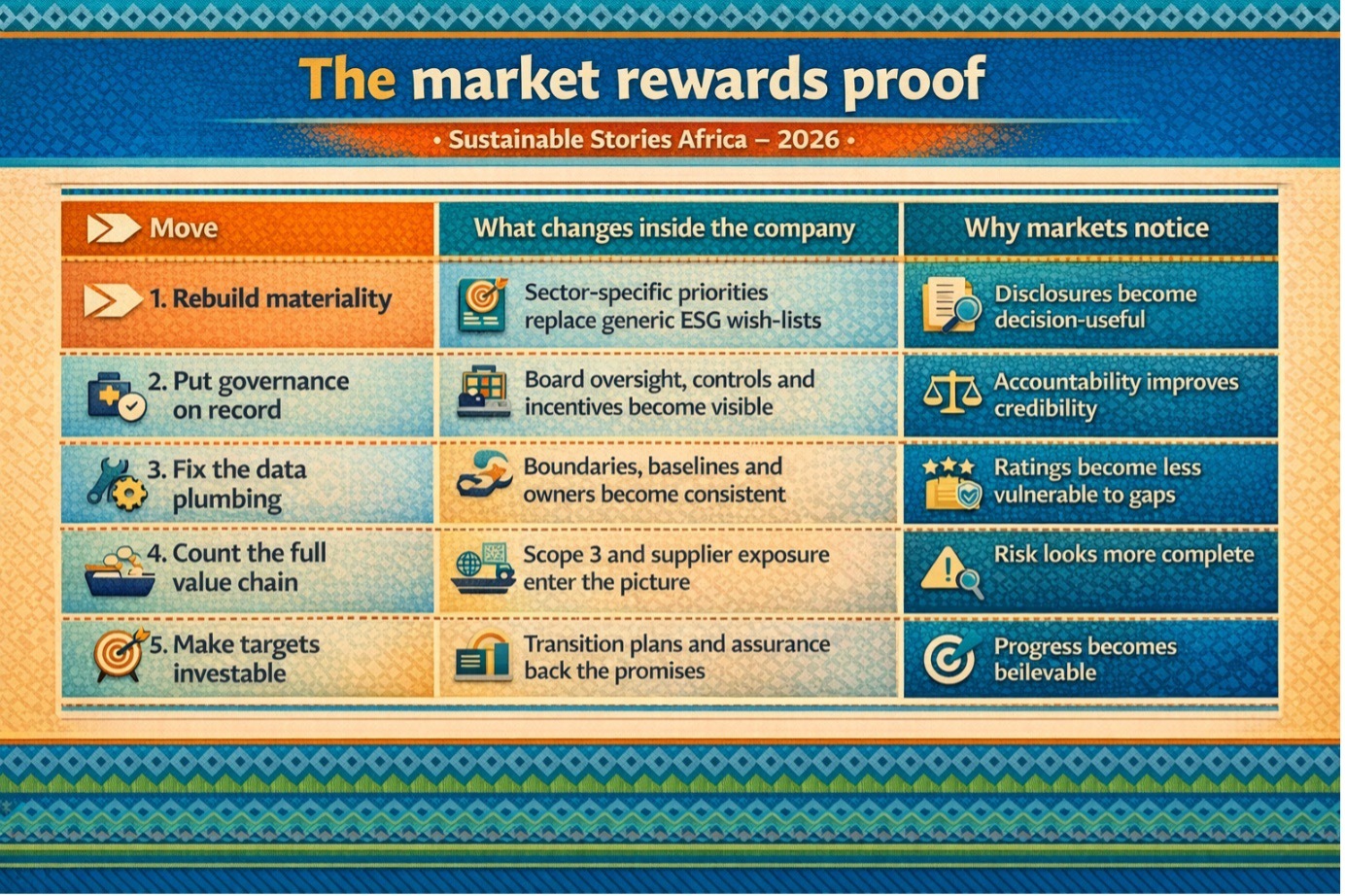
This synthesis reflects how leading standards and assessment systems are built around
- Governance
- Strategy
- Risk management
- Metrics, targets, value-chain emissions
- Assurance.
Five Moves That Separate ESG Leaders From ESG Laggards
Move 1: Start with materiality, not marketing – Strong ESG performance begins with a single disciplined decision: identifying what is truly material. GRI Standards and EFRAG's double materiality assessment both centre on this principle.
African banks, cement producers, and telecoms operators each face distinct material priorities, from financed emissions and responsible lending to process emissions, energy intensity, and data governance.
Companies that try to report everything at once rarely move markets; those that focus on issues genuinely driving enterprise value, external impact, and stakeholder risk consistently outperform.
Move 2: Put governance in writing – Governance must follow, in writing, not in culture alone. IFRS S1 requires explicit disclosure of governance processes, controls, and procedures that oversee sustainability risks and opportunities.
ESG scores rarely improve sustainably until board-level accountability, aligned management incentives, and the embedding of sustainability risks in capital-allocation decisions replace once-a-year narrative reporting.
Move 3: Fix the data plumbing – Data infrastructure is the least glamorous move and often the most consequential. S&P Global's scoring system averages approximately 130 questions per company, drawn from up to 1,000 underlying data points.
Weak consolidation boundaries, shifting methodologies, and missing baselines are not administrative inconveniences; they are rating liabilities. One reporting perimeter, named data owners, and a defensible audit trail are the foundation.
Move 4: Count the whole value chain – Value-chain accounting closes the next gap. IFRS S2 requires Scope 1, 2, and 3 disclosure of emissions using the GHG Protocol.
Companies mapping supplier hotspots, procurement exposure, and downstream use-phase emissions are better disclosed and better managed.
Move 5: Make targets investable – Finally, targets must become investable. IFRS S2 expects the disclosure of what climate targets cover.
IAASB's ISSA 5000, which becomes effective for periods beginning 15 December 2026, sets the global assurance baseline.
A net-zero commitment without capital expenditure linkage, procurement requirements, timelines, and external assurance is no longer a strategy. It is an aspiration.
What stronger scores really buy
When done properly, these five moves do more than lift a rating outcome. They improve financing conversations, procurement eligibility, insurer confidence and regulatory readiness.
They also sharpen internal decisions: which plants to retrofit first, which suppliers expose the firm to the highest transition risk, which community or labour issues could become costly governance failures, and which climate claims are robust enough to survive scrutiny.
For African corporates, the upside is especially concrete. Early movers will arrive at Nigeria’s reporting milestones with stronger systems, lower compliance friction and better lender-facing data.
They will also be better positioned for export markets and multinational supply chains that increasingly expect disclosure in a language global capital can read.
Stop treating ESG as theatre
The most practical next step is a 12-month repair agenda. Boards should sponsor a refreshed materiality exercise, assign accountable executives, unify group-wide datasets, identify Scope 3 hotspots, and run pre-assurance over the metrics most likely to shape investor, lender and customer judgment.
Stock exchanges and regulators, for their part, should keep pushing clearer sector guidance and comparability so that better disclosure rewards better management rather than better storytelling.
African markets do not need imported templates without context. They need interoperable, decision-useful reporting that translates local operational realities into a format investors and counterparties can trust.
The companies most likely to improve their ESG scores, and keep improving them, will be the ones that understand that the score is an output. The work happens upstream.
Path Forward – Build evidence before the deadline arrives
The priority is no longer more ESG language. It is material topics, board ownership, reliable data, value chain visibility and assured progress. Those are the foundations of stronger scores and better capital conversations.
Nigeria’s 2028 and 2030 milestones make early preparation the smart move, not the optional one. Companies that build now should reach compliance with less friction and far more credibility.
Culled From: 5 Moves That Fix Your ESG Score