Tourism is no longer being treated only as a leisure industry. It is increasingly viewed as a development platform that can create jobs, attract investment, support conservation and strengthen local economies, if destinations are designed to manage both growth and its side effects.
A World Bank review of a decade of tourism work argues that the sector’s promise is real, but not automatic.
For African markets, the lesson is direct: tourism works best when it is integrated, data-led, community-linked and measured by what it leaves behind for people and places.
When tourism becomes a development policy
Tourism’s development story is often told through arrivals, hotel openings and foreign exchange earnings. The World Bank’s new report, Tourism for Development: Lessons Learned from a Decade of World Bank Experience, asks a harder question: under what conditions does tourism actually improve livelihoods, strengthen local economies and protect the assets that make destinations valuable in the first place?
Its answer is both encouraging and cautionary. The report finds that tourism can be a powerful engine of economic growth, job creation and environmental protection of cultural assets, but only when governments treat it as a cross-sector development system rather than a narrow marketing exercise.
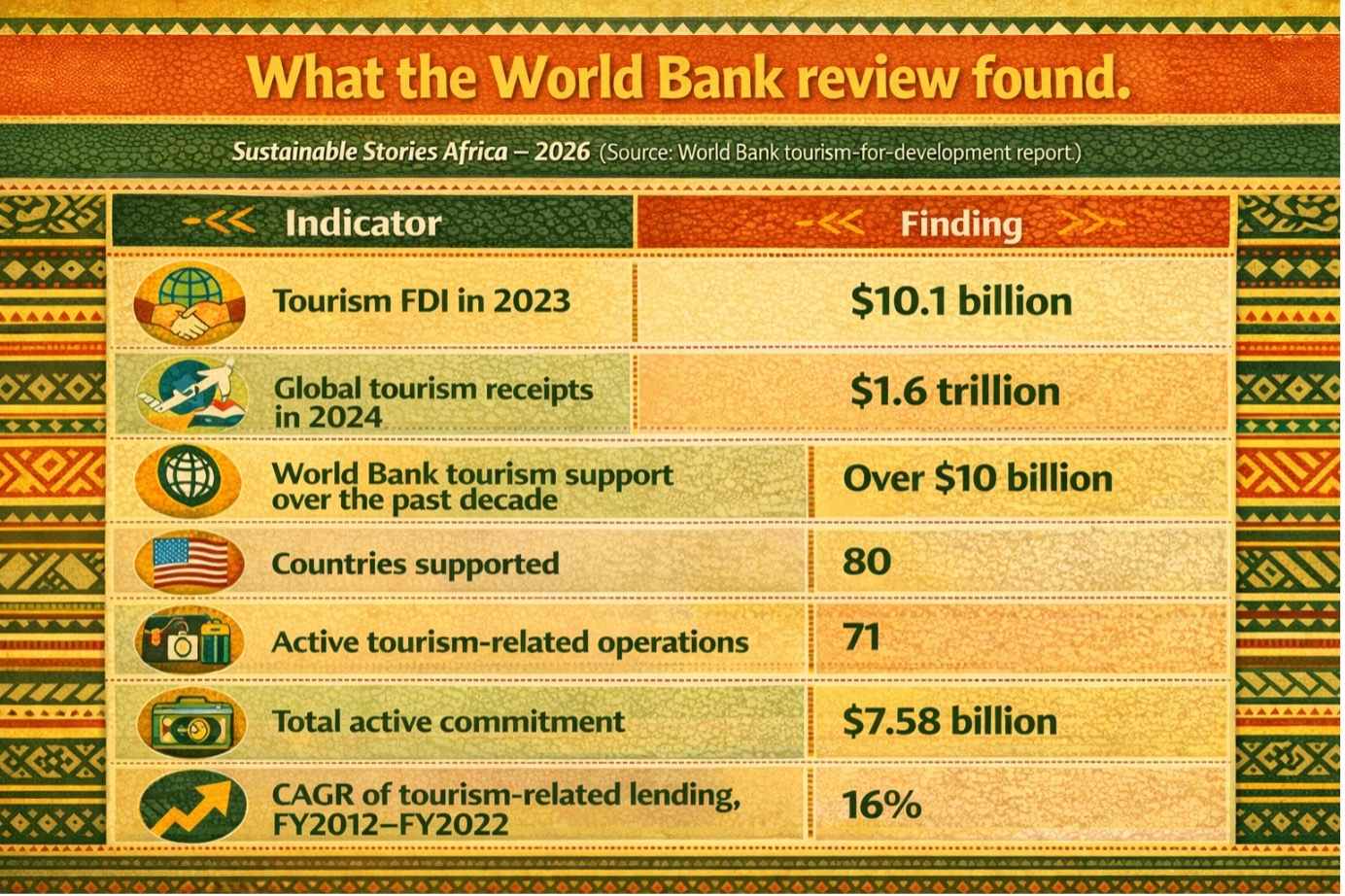
Over the past decade, the World Bank mobilised more than $10 billion for tourism development across 80 countries, reviewed more than 100 tourism publications, and assessed 85 lending operations active between 2012 and 2022 to identify what works.
For African countries, where tourism is often expected to generate jobs, diversify exports and support local enterprise, the message is especially relevant.
The World Bank’s own operations review shows Africa already accounts for the largest share of tourism-related projects in its portfolio. However, the report also shows that the quality of tourism growth matters more than the sector’s headline size.
Tourism’s growth promise meets reality
Global tourism’s story remains strong. In 2024, tourism receipts reached $1.6 trillion, while the sector attracted $10.1 billion in FDI in 2023, reinforcing its appeal to low- and middle-income economies seeking fast job creation. The World Bank sees this confidence reflected in its portfolio.
At the time of writing, the Bank was supporting 71 tourism-related operations across 47 countries, with commitments totalling $7.58 billion. Between FY2012 and FY2022, tourism lending expanded at a 16% compound annual growth rate, more than double the 7% growth rate for World Bank lending, signalling rising demand for sector support.
That demand reflects tourism’s development value. Beyond visitor spending, the sector can strengthen balance-of-payments inflows, boost foreign-exchange earnings, attract investment into lagging regions, and create jobs across hospitality, transport, food systems, crafts, events and cultural industries.
In Mexico, a 10% increase in local hotel revenues was associated with a 4% increase in nominal municipal GDP.
Jobs matter, but quality matters too
Tourism remains attractive to development planners largely because of its employment potential, especially for women and young people.
The report notes that women make up 53% of tourism employment, compared with 39% in the broader economy, while young people hold 18% of tourism jobs compared to 15% across all industries.
These figures help explain why the sector is often framed as an inclusive growth engine, with relatively low barriers to entry and visible pathways into services and entrepreneurship.
However, the report is careful not to romanticise that promise. Tourism work is seasonal, part-time and lower-paid, leaving workers exposed to instability. In the same vein, women still earn less than men even within the sector, albeit with a narrower gap than in the wider economy.
Inclusion, in this context, does not automatically translate into decent work.
The same tension defines tourism’s wider development impact. Revenues can strengthen local economies and public services. In Nepal’s Annapurna Conservation Area, communities earn more than $5,000 annually from campsites and over $15,000 from hotels and lodges, much of it reinvested in reforestation and water management.
In Uganda, Bwindi’s gorilla trekking and park fees generate 60% of Uganda Wildlife Authority revenue. However, unmanaged tourism can also deepen environmental stress.
The report estimates tourism accounts for 8% to 10% of global carbon emissions, while tourists consume far more water and generate significantly more waste than residents.
What makes tourism projects work
The report’s strongest contribution is its operational clarity: tourism projects deliver better results when they are multisectoral, grounded in robust diagnostics, and designed with real sector expertise.
They perform best when tourism ministries lead implementation, governments coordinate through steering committees, and project design links infrastructure to private-sector development, destination management, and market access.
In effect, tourism is not a standalone industry but a coordination challenge shaped by roads, air access, planning systems, skills, digital tools, environmental stewardship, safety, and local enterprise support.
The case studies show what that looks like in practice.
- Indonesia leveraged $955 million, improved infrastructure and services for 5.4 million people, trained more than 84,000 tourism workers, and attracted over US$870 million in private investment.
- Jordan increased visitor stays from 1.5 days to 2.8 days.
- Mozambique combined concessions and investment mobilisation.
Together, the examples show that tourism works best when institutions, infrastructure, and development move in step.
A better tourism model is possible
The report is strongest when it shifts the conversation from more tourism to better tourism. It argues that not all tourism models deliver equal development value: volume-led, foreign-owned formats such as some all-inclusive resorts and cruise operations often generate higher leakage and deeper environmental pressure, while smaller-scale, community-linked models tend to retain more value locally and support more inclusive employment.
For African destinations still defining their tourism identities, that creates room to choose differently.
Rather than chase visitor volume alone, countries can build around heritage, conservation, domestic and regional travel, creative industries, food systems, blue tourism and MSME supply chains.
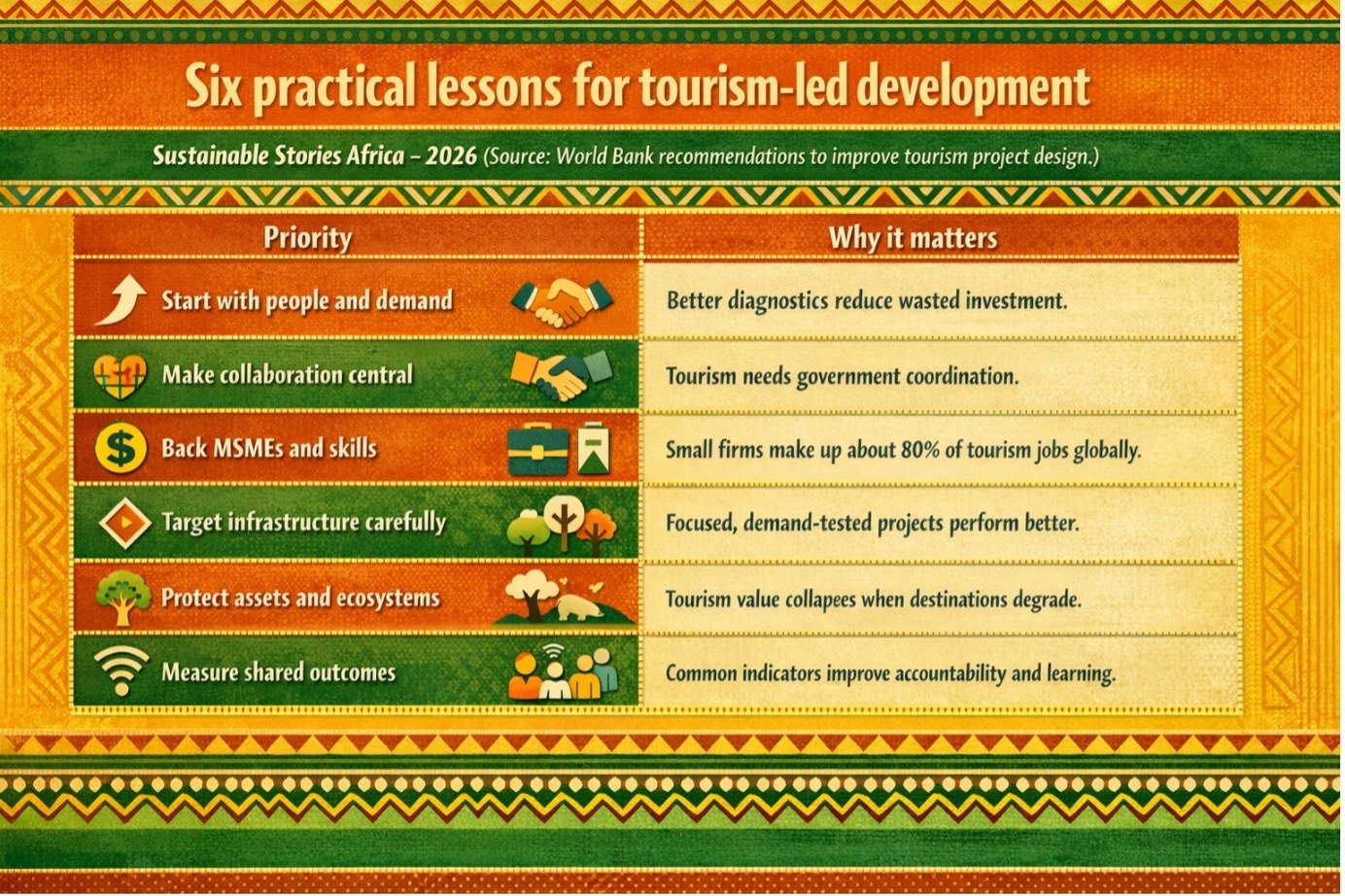
The report’s recommendations, better data, stronger collaboration, MSME finance and skills, community-serving infrastructure, regenerative tourism and people-centred measurement, are ultimately about system design.
What African policymakers should prioritise
For African governments, the report sets out a practical tourism agenda. Planning must start with market evidence:
- Who visits
- Why do they come
- How much they spend
- How tourism can connect credibly to local value chains.
It also argues that tourism ministries need stronger authority to coordinate:
- Transport
- Environment
- Culture
- Planning
- Investment agencies
- Support for MSMEs
Women-led firms and youth employment must move beyond rhetoric into finance, training, certification and market access.
Infrastructure choices should be focused, scaled and grounded in demand and sustainability. Destinations also need systems that reinvest revenues into conservation, services and asset upkeep.
Without that loop, tourism can erode the assets it depends on. The report’s message is clear: integrated planning delivers stronger outcomes.
Path Forward – Build destinations that endure
The World Bank’s review argues that tourism should be designed as a development system, not just a visitor economy.
That means better data, stronger coordination, targeted infrastructure, support for local firms, and mechanisms that protect communities and natural or cultural assets as tourism grows.
For African markets, the opportunity is not only to grow arrivals. It is to build tourism models that retain local value, widen inclusion and keep destinations livable long after the visitor leaves. That is the development test the sector now has to meet.