For decades, Nigeria's states waited for FAAC allocations, federal transfers, and central government capital projects that rarely arrived on time or at scale. That waiting is now visibly ending.
At Proshare HardFacts Episode 9, Bolaji Balogun of Chapel Hill Denham identified subnational infrastructure and regional capital allocation as a critical frontier in Nigeria's development finance story.
Fifteen states have already committed N10.7 trillion in capital budgets for 2026. The question is no longer whether the states can lead; it is whether the capital market is ready to follow.
States Rewrite Nigeria's Development Finance Script
Nigeria's federalist fiscal architecture has long placed states in a structurally subordinate position relative to the federal government, dependent on centrally shared revenues, and largely excluded from the deeper pools of institutional and market capital that drive transformation in more mature economies. That is changing.
At the ninth edition of Proshare HardFacts, held on March 30, 2026, Bolaji Balogun, Chief Executive Officer of Chapel Hill Denham and one of Africa's most experienced infrastructure finance practitioners, spotlighted subnational infrastructure and regional capital allocation as one of the four pillars shaping Nigeria's infrastructure finance future.
Speaking with Proshare's Olufemi Awoyemi, Balogun argued that state governments must now function as active market participants, not passive recipients of federal transfers.
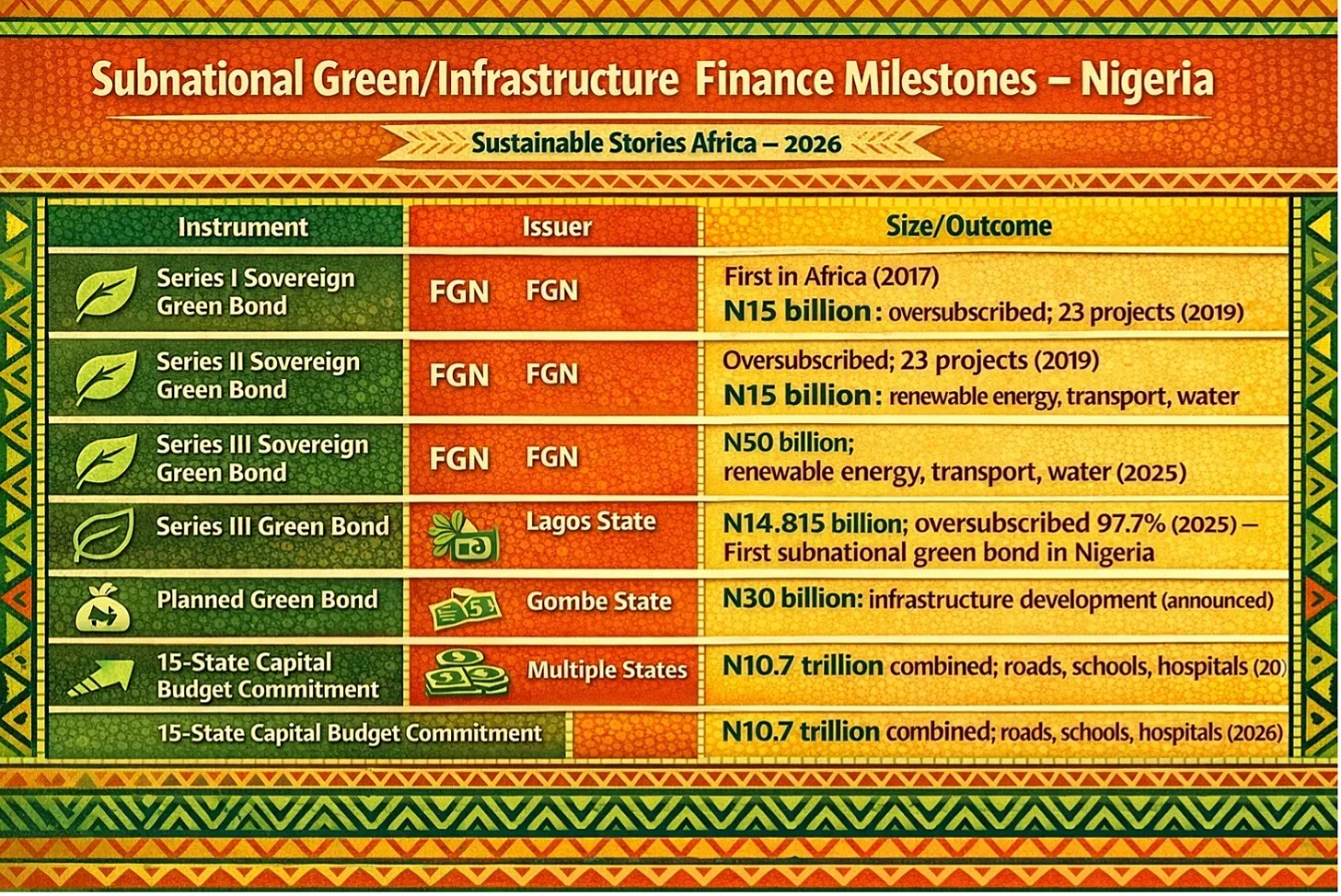
The evidence of that shift is already measurable. Fifteen Nigerian states collectively earmarked N10.7 trillion for capital expenditure in their 2026 fiscal estimates, a figure that represents not just ambition, but a structural rethinking of how subnational governments source and deploy development capital.
The model being pioneered is no longer budget-dependent. It is bond-enabled, PPP-anchored, and, increasingly, green.
Lagos Opens a Door States Cannot Afford to Miss
Subnational access to capital markets in Nigeria is no longer aspirational; it is already financing development.
Lagos State’s Series III N14.815 billion Green Bond, issued in November 2025 under its wider N214.8 billion programme, marked the country’s first subnational green bond and was oversubscribed by 97.7%, attracting N29.29 billion in subscriptions.
It showed that states with credible governance, strong preparation, and clear pipelines can raise institutional capital at scale and on competitive terms.
The shift is spreading beyond Lagos. Gombe State’s proposed N30 billion green bond suggests the model is becoming replicable.
With the DMO affirming that bonds, Sukuk, and Green Bonds have broadened market participation, the message is unmistakable: states that avoid capital markets risk losing ground over time.
The Architecture of a New Subnational Market
Nigeria’s shift toward subnational capital market financing is the product of deliberate market design, regulatory enablement, and institutional learning.
The federal sovereign green bond programme built the template: the 2017 debut made Nigeria Africa’s first sovereign green bond issuer; the 2019 N15 billion issuance financed 23 climate-aligned projects; and the 2025 N50 billion offer backed renewable energy, clean transport, water management, and climate adaptation.
Together, these issuances deepened investor confidence and created the credibility that later enabled Lagos State’s landmark green bond.
For the 15 states planning N10.7 trillion in 2026 capital spending, the financing toolkit is now broader.
States can draw on domestic bonds, Sukuk, PPPs, green instruments, and DFI capital, reinforcing the IFC’s February 2026 agreement to develop bankable projects in transport, energy, ICT, and sanitation.
However, Balogun’s central point remains decisive: access to capital markets depends on the quality of governance. Without transparent procurement, predictable revenues, and credible execution, states will find investors less forgiving than federal allocations.
What a Functional Subnational Market Unlocks
Getting subnational infrastructure finance right matters far beyond state balance sheets. At the state level, infrastructure is where development becomes tangible, such as roads that move farm produce, schools that build human capital, hospitals that save lives, and water systems that shape everyday wellbeing.
If states can consistently access capital markets, the gains become structural. Pension funds hold N29.43 trillion in assets as of February 2026, creating a substantial pool of long-term domestic capital that could support local-currency infrastructure financing.
Investors gain a broader pipeline of bankable projects, while communities benefit from infrastructure delivered with stronger market discipline and accountability.
NIDF has already shown that naira-denominated infrastructure debt can generate resilient returns while funding essential services; extending that model to states is the next frontier for Nigeria’s development finance architecture.
What States, Regulators, and Markets Must Do Now
The pathway from aspiration to execution at the subnational level requires coordinated action across four domains:
- Governance and creditworthiness: State governments must invest in credit rating processes, clean audited financials, and transparent debt management frameworks that make them legible to institutional investors and rating agencies
- Project preparation and bankability: The federal government's partnership with IFC to develop PPP pipelines must be extended to state-level project preparation facilities, so that infrastructure assets arrive at market investment-ready rather than as speculative proposals.
- Regulatory enablement: The SEC, PenCom, and the CBN must maintain and deepen the regulatory corridors that permit pension funds, insurance companies, and other institutional investors to allocate to subnational bonds and infrastructure funds within appropriate risk frameworks.
- Green and sustainability integration: States with qualified projects, such as renewable energy, climate-resilient transport, water, waste management, should prioritise issuance under green bond or sustainability-linked frameworks, accessing the growing pool of ESG-mandated capital globally and domestically.
Proshare's Capital Market Outlook 2026 specifically called for expansion of the subnational bond market, citing continued oversubscription of infrastructure bonds and Lagos's model as the template for replication.
That call is no longer theoretical; it is a market signal that structurally prepared states will find capital waiting.
Path Forward – Building From Lagos to the Nation
Nigeria's subnational infrastructure finance story is at a pivotal early stage — compelling enough to validate the model, and early enough that most of the market opportunity remains uncaptured. Lagos has proven the concept; the task now is to replicate this systematically, supported by project preparation funding, regulatory alignment, and institutional investor education.
For this to scale, states must be treated as market participants, not petitioners. Governments, regulators, and development finance institutions must co-invest in the preparatory infrastructure, governance, legal frameworks, credit ratings, and capacity for deal structuring that allows Nigeria's 36 states to progressively access the N29.43 trillion pension pool and the growing pipeline of impact and green capital seeking African markets.