Climate adaptation is no longer a side issue to emissions policy. It is becoming a test of whether governments, markets and communities can protect lives, infrastructure and growth as climate risks intensify.
A European Commission-backed study argues that adaptation still lacks the scale, leadership and financing needed.
For African markets, the message is clear: waiting for climate shocks before reforming systems will cost more than building resilience early.
Adaptation cannot stay secondary
Climate change adaptation is too often treated as an afterthought, even as climate risks grow more frequent, more interconnected and more expensive. That is the central warning from Better Climate Change Adaptation through Transformative Innovation – Enabling Conditions and Future Perspectives, a 2026 study prepared for the European Commission’s Joint Research Centre.
Drawing on five case studies across Slovenia, Iceland, the Northern Netherlands, Finland and France, the report argues that adaptation remains underdeveloped, reactive and too weakly linked to innovation systems, financing frameworks and wider development strategy.
The report’s importance goes beyond Europe. Its core finding is that adaptation fails when it is treated as a technical add-on, a disaster response issue, or a loose collection of pilot projects.
It works better when it is approached as a long-term societal transformation, supported by political leadership, cross-sector coordination, finance, experimentation and public buy-in.
That matters for African and other emerging markets, too. While the study is European, its logic travels well: if better-resourced systems still struggle to mainstream adaptation, regions facing tighter fiscal space, faster urbanisation and higher climate exposure will need even more deliberate resilience planning.
That is an inference from the report’s framework and findings.
When adaptation stays invisible
Climate adaptation, the report warns, is not being implemented at the scale, speed or depth required to avoid dangerous risk.
National strategies exist on paper, but leadership, governance, financing and public engagement still lag, even under the EU Adaptation Strategy and Mission on Climate Change Adaptation.
The misunderstanding runs deeper. Adaptation is frequently conflated with mitigation or reduced to disaster response, narrowing public support for sustained, preventive measures.
In many regions, recent floods or fires have locked debate into emergency mode rather than long-term resilience planning.
The result is a policy trap: governments react after crises, fund short projects, then move on, while core vulnerabilities in land use, infrastructure, water, agriculture, health and local planning remain largely intact.
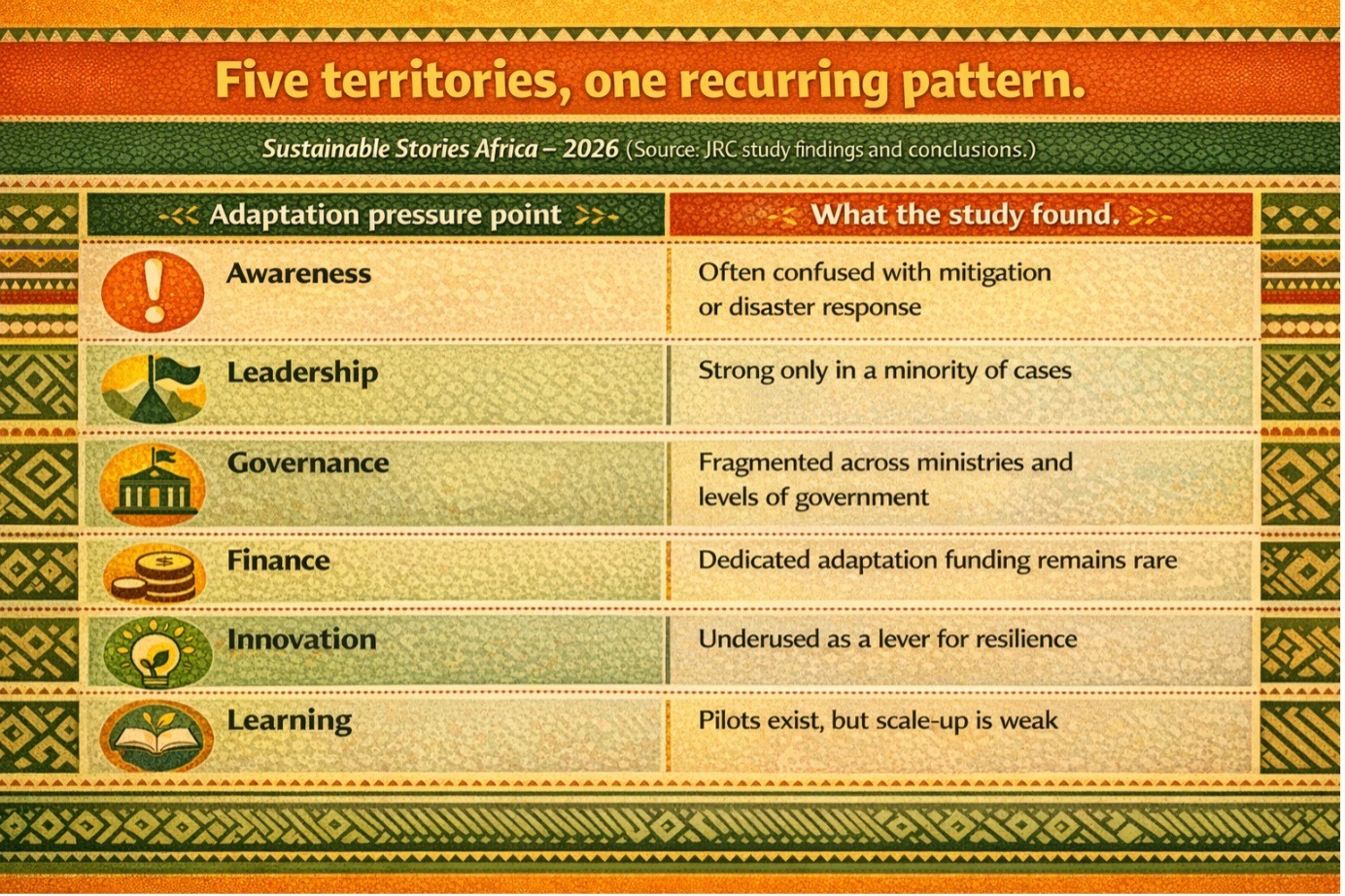
Five territories, one recurring pattern
The study’s five case territories, from flood-prone Gorenjska in Slovenia to glacier- and fisheries-exposed Iceland, the drought- and flood-sensitive Northern Netherlands, Turku in Finland, and water-stressed Provence-Alpes-Côte d’Azur in France, underline that climate risk is never just environmental. It is territorial, economic and institutional.
A central contribution is an eight-part framework for transformative adaptation: awareness, leadership, stakeholder involvement, cross-domain coordination, multi-level governance, coherent funding, space for experimentation, and strong policy intelligence. Weakness in any one pillar can compromise the whole strategy.
Across cases, the problem is not a lack of plans but a lack of joined-up execution. Awareness is patchy, leadership uneven, engagement shallow, funding rarely targeted, pilots remain small, and monitoring focuses on outputs rather than resilience outcomes.
Why the Dutch case stands out
The Northern Netherlands offers a glimpse of what stronger adaptation governance can look like.
Stable national leadership, predictable funding, scenario-based planning and mission-oriented innovation have helped turn high-level strategy into local action, supported by clear communication tools, climate stress tests and public awareness of water risk.
Its deeper lesson is structural. Adaptation became more effective once policy shifted from “fighting nature” to “working with nature,” from single-use spaces to multi-functional land, and from hard, one-dimensional infrastructure to blue–green solutions.
For African policymakers, the point is not to copy Dutch tools, but to embed resilience into planning, investment, innovation and public accountability, rather than treating it as a peripheral environmental add-on.
What stronger adaptation could unlock
The report is cautionary, but also practical. It argues that adaptation works best when treated not as a narrow climate response, but as a long-term societal transformation tied to competitiveness, public services, health, food systems, urban development and local economic renewal.
For emerging and African economies, this widens the policy opportunity: stronger adaptation can reduce future losses, improve food and water security, protect livelihoods, strengthen investor confidence and avoid costly maladaptive lock-ins in housing, tourism and infrastructure.
It is equally direct on business and innovation. Smart Specialisation Strategies and research programmes still rarely prioritise adaptation, even though they could help align researchers, firms and public institutions around place-based resilience.
For regions trying to build green industry and durable local economies, that omission is no longer marginal; it is a strategic gap.
What governments and markets should do
- The report’s practical message is that adaptation must become more intentional. Governments need stronger mandates, clearer objectives, better indicators and dedicated institutional capacity.
- They need to mainstream adaptation across policy domains, not leave it stranded inside environment departments.
- They need funding portfolios that combine domestic instruments, innovation finance and broader development planning.
Just as important, the study argues for more space for experimentation and more discipline in learning from it.
- Too many pilots remain isolated.
- Too few become repeatable systems.
That means resilience policy needs not only projects, but pathways to scale.
For African policymakers, investors and development institutions, the implied lesson is immediate:
- Adaptation strategy should be tied to industrial policy, urban planning, agriculture, health systems and infrastructure finance from the outset.
Waiting until hazards intensify will raise both fiscal and social costs. That is an inference, but a grounded one.
Resilience must become a core development
Europe’s adaptation gap is not just a European story. It is an early warning about what happens when climate resilience is acknowledged rhetorically but not built institutionally.
The report shows that strategies alone are not enough. Systems, incentives and leadership decide whether adaptation stays on paper or changes outcomes.
For African markets, the most useful takeaway is also the simplest:
- Adaptation should no longer be treated as a future environmental issue.
- It is already a present development, governance and competitiveness issue.
That inference is exactly what makes this European report worth reading far beyond Europe.
Path Forward – Turn plans into systems
The report advocates stronger political mandates, clearer resilience goals, better monitoring, deeper stakeholder engagement, and tighter links between adaptation, innovation and finance.
It calls for adaptation to move from fragmented projects to system-wide governance.
For African markets, the practical next step is to embed adaptation into infrastructure, local planning, business strategy and public investment now, before climate stress locks in costlier and weaker development paths.