A global analysis shows climate change is no longer an abstract future threat. Between December 2025 and February 2026, it helped drive dangerous heat exposure across much of the world, often in places least able to absorb the shock.
Africa stands out sharply. Of the nearly 228 million people who experienced 30 or more climate-added risky heat days during the period, 81% lived on the continent.
When Heat Stops Feeling Seasonal
Climate change is now showing up not only in models and policy documents, but in the number of days ordinary people spend living through unusual heat.
A Climate Central analysis covering December 2025 to February 2026 finds that every day during the three months, more than one in six people on Earth experienced temperatures that were at least twice as likely due to human-caused climate change.
On several February days, that share rose to about 42% of the global population, more than 3 billion people.
The findings are global, but the human geography of harm is uneven. The report shows that nearly 228 million people experienced 30 or more risky heat days added by climate change over the three months, and 81% of them, approximately 185 million people, lived in Africa.
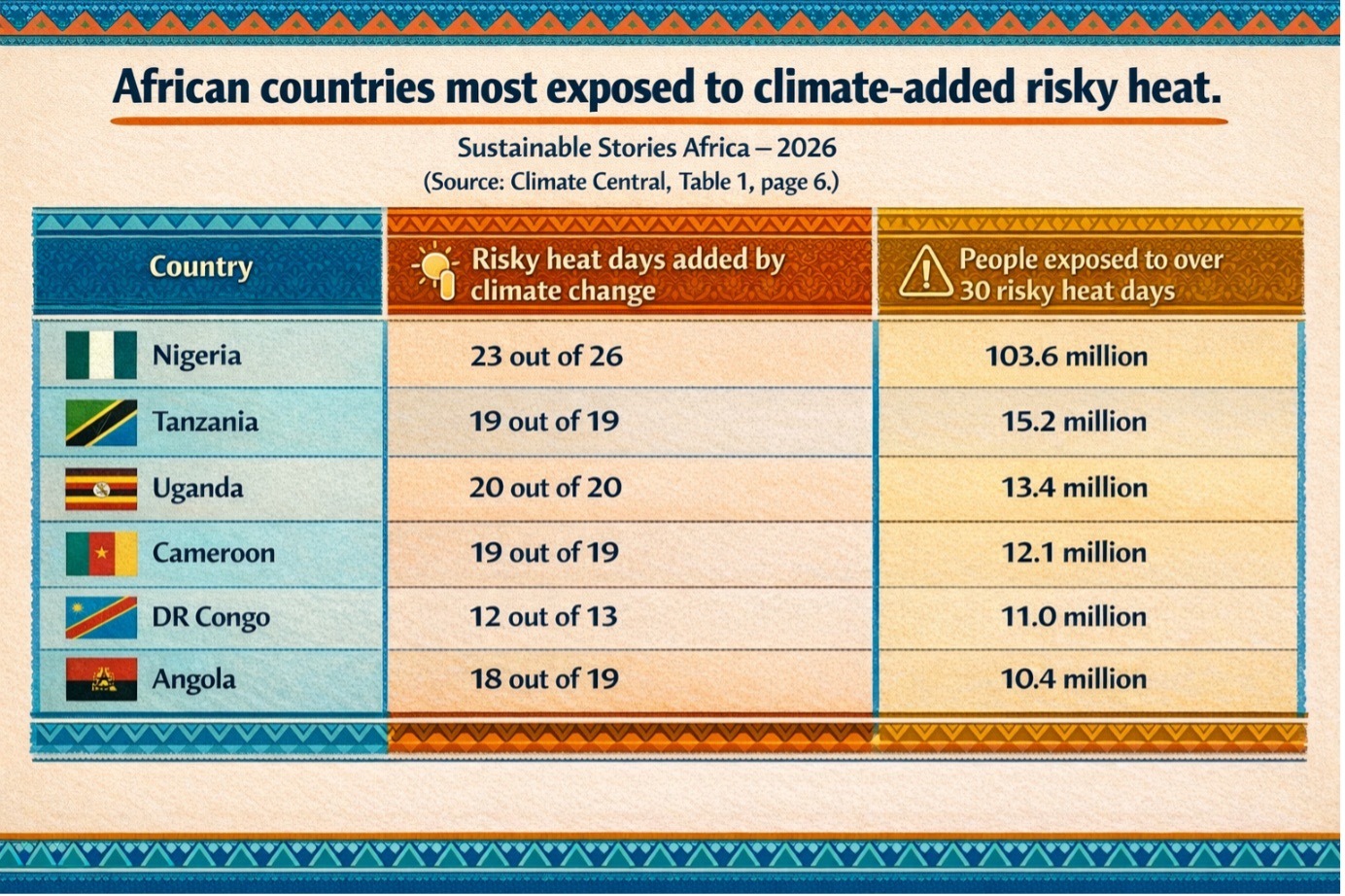
Nigeria alone accounted for 103.6 million people exposed, or 99% of its population in the analysis.
That matters beyond climate science. It speaks directly to public health, labour productivity, food systems, electricity demand, urban planning and financial resilience.
For African countries already grappling with adaptation gaps, rising temperatures are not merely environmental signals. They are development stress tests.
1.4 Billion People Per Day: Climate Heat Is No Longer Exceptional
The scale is no longer exceptional; it is daily. From 1 December 2025 to 28 February 2026, approximately 1.4 billion people per day, 17% of the global population, experienced temperatures with a strong climate change influence, measured at Climate Shift Index level 2 or higher.
For 47 of those 90 days, at least one in four people on Earth experienced that level of climate-linked heat exposure.
This is not a story about isolated heatwaves. It is about a persistent, population-level climate reality.
Large stretches of Africa, Latin America, Oceania, and parts of Asia recorded high concentrations of days with temperatures made at least twice as likely by climate change.
The report measures risk locally against temperatures historically observed in each area between 1991 and 2020.
On that basis, the average person experienced approximately seven risky heat days during the period, with five directly attributable to climate change.
Africa Leads the World's Most Dangerous Heat Exposure Rankings
Africa dominates the global ranking of countries with the most people exposed to 30 or more climate-added risky heat days.
- Nigeria led with 103.6 million people exposed
- Tanzania at 15.2 million
- Uganda at 13.4 million
- Cameroon at 12.1 million
- Democratic Republic of Congo at 11 million
- Angola at 10.4 million.
The intensity is equally striking.
- Nigeria recorded 23 climate-added risky heat days out of 26 total.
- Cameroon and Uganda each recorded perfect climate fingerprints, 19 out of 19 and 20 out of 20, respectively.
In several African countries, nearly all dangerous seasonal heat carried a direct climate attribution, not weather variability.
Africa and Oceania dominate Table 2 (page 7) for climate-added risky heat days. Comoros recorded 34 out of 35, Mayotte 34 out of 34, and Equatorial Guinea 32 out of 32, near-total climate fingerprints across entire seasons.
Urban Africa faces compounding exposure. Table 6 (page 10) shows that Lagos recorded 79 climate-influenced days over the 90 days, the highest among all listed global megacities.
Kinshasa followed with 55 days. In both cities, density, informal housing, limited green space, and urban heat island effects transform every additional degree into a multiplied public health and economic risk.
From Data to Decision: People-Centred Climate Evidence Must Drive African Policy
The report's most practical contribution is its people-centred methodology. By using the Climate Shift Index, risky heat days, and local temperature anomalies, rather than generic warming averages, it tracks what populations actually experienced, giving governments and businesses a sharper lens for resource allocation.
For Africa, the practical applications are immediate.
- Heat-health warning systems can be refined.
- Labour protections for outdoor workers can be calibrated around peak exposure periods. Schools, hospitals, urban planners, insurers, lenders, and infrastructure developers can identify where repeated heat stress is becoming a structural risk rather than an occasional weather event.
The "Heat and Beyond" section (pages 11–12) confirms that heat is not acting alone.
- Kenya endured its driest season since 1981, threatening over two million people with hunger.
- Somalia and southeastern Ethiopia faced crop failures and yield losses.
- Southern Africa experienced climate-driven storms that triggered deadly floods and devastated livelihoods.
The signal is unambiguous: heat is amplifying broader system stress across the continent, and resilience investment is no longer optional.
Action: Adaptation Must Become A Core Economic Strategy
- The first requirement is to treat heat as a macroeconomic issue, not just a weather story. Health ministries, agriculture agencies, energy planners, city governments and finance ministries need shared exposure data and joint response systems.
Where extreme heat is increasingly frequent, adaptation cannot remain a side programme. It has to move into core budgeting, infrastructure design and social protection.
- Second, African cities need more heat-smart planning. Lagos and Kinshasa’s high CSI exposure is a warning that megacities need more shade, better building design, reflective materials, greater electricity reliability, water access and emergency response systems.
Heat resilience belongs alongside transport and housing policy, not after them.
- Third, climate finance must track lived exposure more closely. A continent carrying 81% of the people exposed to 30 or more climate-added risky heat days in this analysis has a strong case for more adaptation finance, more concessional support for heat resilience, and stronger protection for food, labour and health systems.
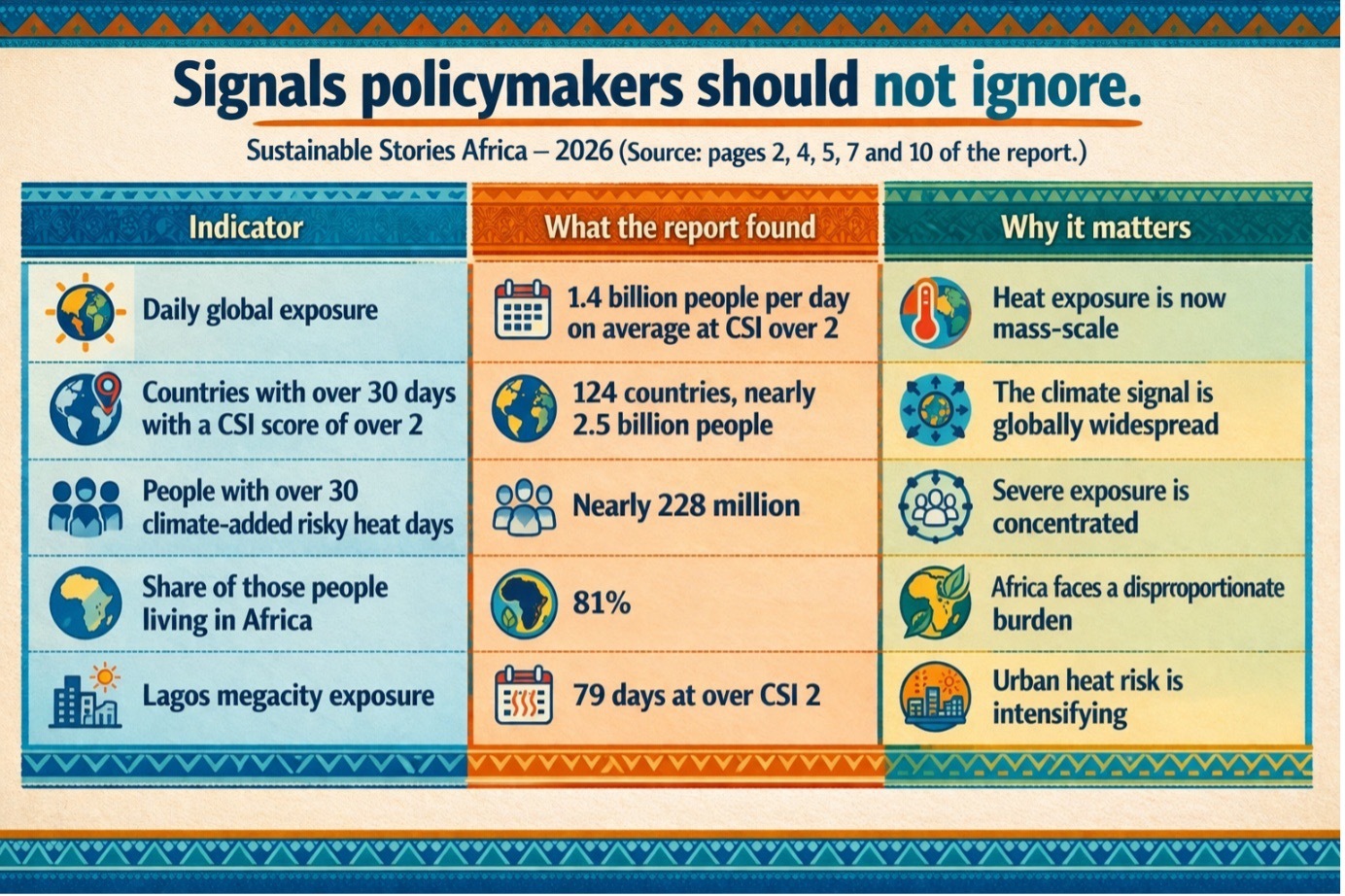
Path Forward – Count People, Not Just Degrees
The most important lesson in this report is as much political as it is methodological: climate risk becomes harder to ignore when it is measured in people, days and places.
That is the level at which governments, investors and citizens make decisions.
For Africa, the next step is clear. Heat exposure must be integrated into adaptation planning, urban policy, food security strategy and climate finance claims, because data now show that the continent is holding a disproportionate share of the human burden.