Africa’s climate transition, a growing school of African thought argues, cannot be judged only by carbon targets. It must also be judged by who gets power, who controls resources and who captures value.
That reframes the debate around energy access, food sovereignty, industrial policy and fair finance at a moment when Africa contributes by far less than 4% of global carbon dioxide emissions but faces some of the harshest impacts of climate change.
Why This Debate Matters for Africa
The debate over Africa’s just transition is becoming sharper, more strategic and harder to ignore.
At the centre of it is Just Transition: A Climate, Energy and Development Vision for Africa, a report co-authored by independent experts under the leadership of Youba Sokona and supported through the Africa Climate, Energy and Development initiative hosted by Power Shift Africa.
The report argues that Africa’s climate future cannot be separated from its development future.
Its core intervention is simple but disruptive: Africa should not be asked to choose between development and decarbonisation. However, it should also not be pushed into repeating an extractive model under green branding.
Instead, the authors call for a people-centred transition built around food sovereignty, energy sovereignty and industrial upgrading, rather than raw-material dependency and externally driven energy exports.
That matters now because African governments, investors and development institutions are being pulled in opposite directions. Climate pressure is rising, capital is chasing “transition” minerals and fuels, and millions of Africans still lack the basic energy systems that make modern life possible.
The result is a high-stakes question: can Africa build a low-carbon future that is also fair, sovereign and developmental?
A Transition Defined by Real Scarcity
Africa's renewable energy potential is estimated at 50 times the anticipated global electricity demand in 2040. The continent also holds more than 40% of global reserves of key minerals for batteries and hydrogen technologies, the world's largest tracts of arable land, and a population where 70% are under 30.
That combination, the report argues, should anchor prosperity, rather than invite a new scramble for extraction.
However, the urgent reality cuts the other way.
- Approximately 278 million Africans face food insecurity
- Life expectancy stands at 61 years against a global average of 72
- Climate stress is deepening existing fragility. Despite contributing less than 4% of global carbon dioxide emissions
- Africa could see 105 million internal climate migrants by 2050, according to World Bank projections.
The energy deficit further sharpens the stakes.
- Around 600 million Africans lack electricity
- 970 million lack clean cooking access.
- Without major policy shifts, 565 million people could remain without electricity by 2030 and approximately one billion without clean cooking.
The report is unambiguous: Africa's first test of a just transition is not the volume of climate pledges announced abroad, but whether households, farmers and firms gain affordable, reliable and sustainable energy.
The Numbers Behind Africa’s Climate Warning
The report’s most important insight is that Africa’s climate debate is inseparable from its trade and debt structure. It identifies three persistent weaknesses:
- Lack of food sovereignty
- Lack of energy sovereignty
- Low-value-added exports relative to imports.
These, it argues, lock countries into trade deficits, currency weakness and repeated dependence on debt.
The report anchors that diagnosis in a stark trade picture:
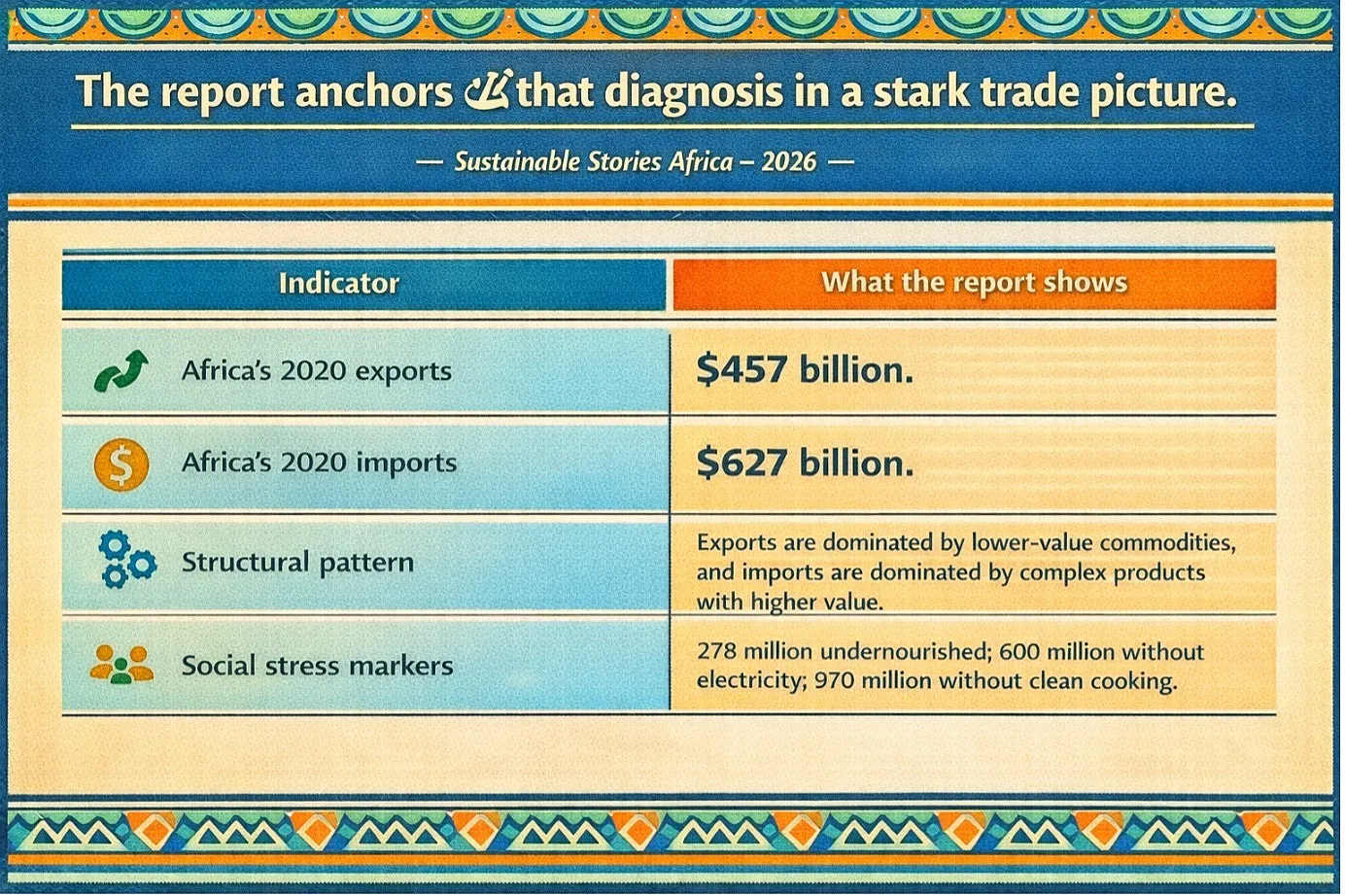
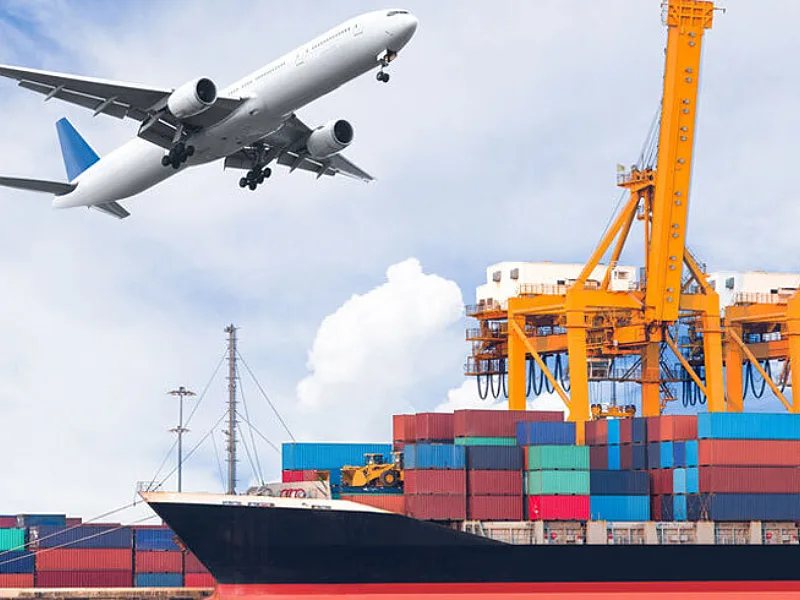
Africa's commodity dependence weakens currencies, deepens debt and leaves the continent importing back value it could have created domestically.
The report's authors are sceptical of familiar remedies, arguing that export-led strategies, tourism dependence and certain privatisation models can increase import bills, profit repatriation and financial fragility.
They also caution against "false solutions" dressed as climate action, including some carbon markets, carbon capture and geoengineering.
On green hydrogen, the warning is specific. Export-first models risk worsening water stress, redirecting renewable power away from domestic needs and destroying between 40% and 50% of usable energy during transmission and conversion, with each kilogram of green hydrogen requiring between 18 and 24 kilograms of water once demineralisation is factored in.
What a Fair Transition Could Unlock
If the report is right, the upside is large. A genuine just transition would not only cut emissions exposure and stranded-asset risk.
- It could also expand electricity access, reduce clean-cooking poverty, support agro-ecological food systems, and create more value from African minerals, labour and industrial capability within African economies.
That is why the document ties climate action to development outcomes rather than treating them as separate files.
It calls for decentralised, people-centred renewable energy systems, stronger African ownership of energy planning, and an industrial policy that expands internal markets and captures a greater share of value for Africans.
It also places equity, social justice and stakeholder participation at the centre of transition planning.
Even its political language reflects that broader ambition. The report says the just transition began with labour-rights concerns but now requires deeper economic and social transformation.
In practice, that means a transition that is not only about lower carbon, but also less extractive, less externally dependent and more accountable to communities.
What Governments and Markets Must Do
For policymakers, the article’s practical message is clear.
- First, stop treating energy access as a side issue. In the African context, universal electricity and clean cooking are central development priorities.
- Second, design renewable systems around domestic resilience and productive use, not only export demand.
- Third, align climate policy with industrial strategy so critical minerals and clean-energy investments support local jobs, skills and manufacturing capacity.
The financing agenda is equally explicit. The report argues that Africa should pursue both domestic and international tools:
- Build productive capacity
- Fix market abuses
- Scale climate finance
- Explore financial transaction taxes and SDR redirection
- Press for debt cancellation, tighten regulation of transnational corporations, reform unfair trade and technology rules, and revive broader debates on international financial architecture and reparations.
These are ambitious proposals, but the report’s point is that incrementalism will not finance a transition at the scale required.
- For investors and development partners, the implication is uncomfortable but important. A project is not automatically “just” because it is renewable.
The report repeatedly warns that land grabs, abusive mining, export-oriented hydrogen schemes or donor-shaped transition plans can reproduce the very inequities they claim to solve.
The transition, in this view, must be judged by outcomes for African citizens, not by labels alone.
The Path Forward Starts at Home
Africa’s just transition argument is, at heart, a governance argument: power people first, add value locally, and do not swap fossil dependency for green dependency.
The continent’s climate future, the report suggests, should be built around sovereignty as much as sustainability.
What is being advocated is a deeper reset: cleaner energy, yes, but also stronger food systems, fairer finance, smarter industrial policy and African ownership of transition choices. That is what would make the transition not only green but genuinely just.