African and emerging markets are entering a new carbon-market era with Article 6 largely settled; however, it is not yet safely governed.
The rules are clearer; the politics, trade-offs and institutional demands are only becoming sharper.
The real question is no longer whether Article 6 will matter. It is whether African countries will shape it as a tool for credible climate finance and development or let it become another market where value leaves faster than capacity grows.
Carbon Markets Need Development Discipline
Article 6 of the Paris Agreement was developed to allow countries to cooperate by transferring mitigation outcomes, align carbon trading with national climate targets, and avoid double counting through corresponding adjustments.
After years of negotiations, COP29 largely completed the rulebook, while COP30 left the architecture broadly intact and pushed the conversation to implementation.
That matters for Africa because the debate has moved beyond theory. Countries across the continent are already appearing in the implementation landscape, from Ghana, Kenya, Rwanda, Tanzania and Zambia to wider African Union work on market principles and integrity.
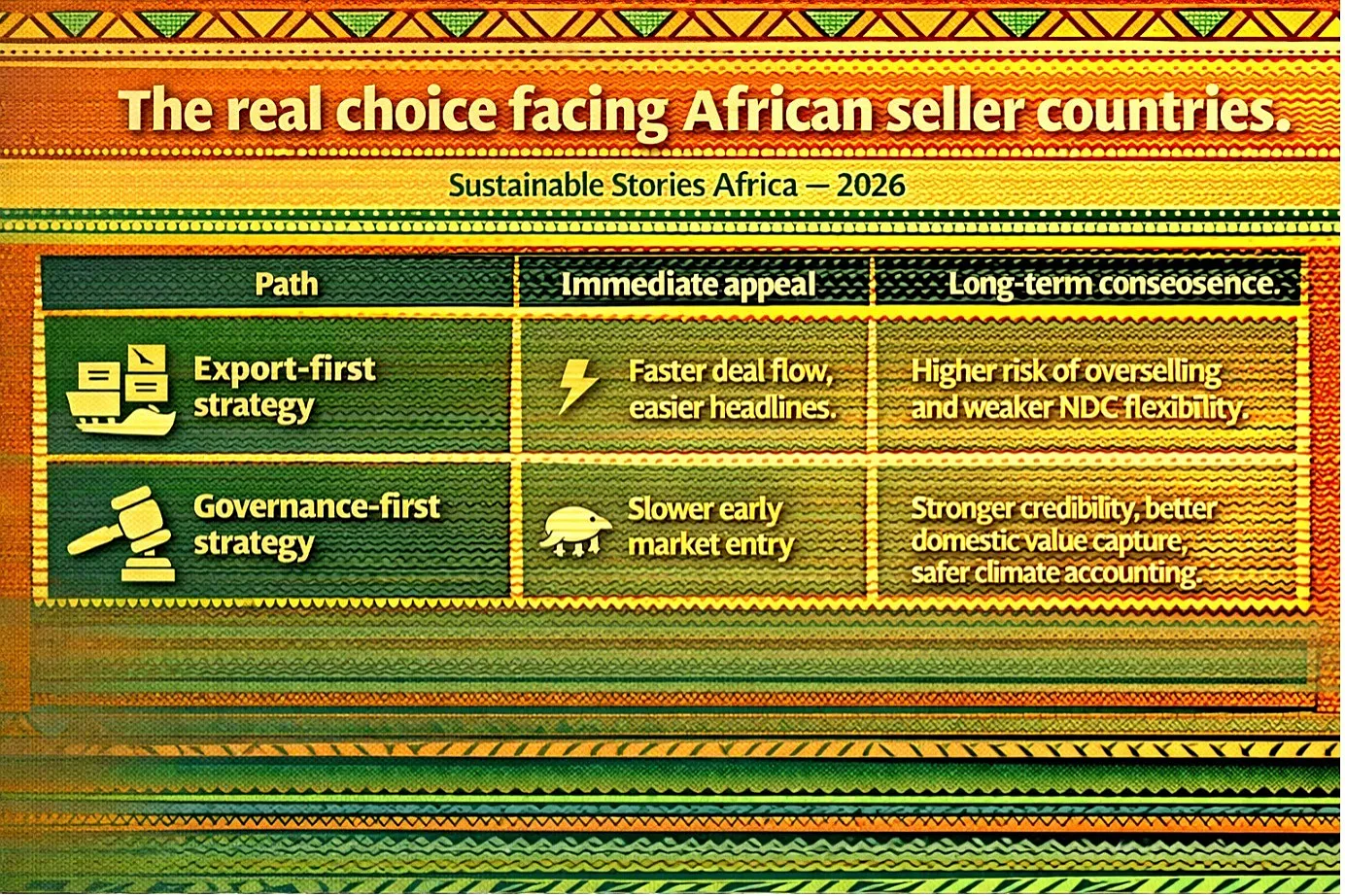
The central argument is straightforward: Article 6 should not be treated as an export window for cheap credits. It should be treated as a governance test.
If African governments get the rules, sequencing and benefit-sharing right, Article 6 can support domestic climate ambition, attract finance and build institutional credibility.
If they do not, it could reproduce the familiar pattern of external demand driving local depletion.
The Carbon Market Story Has Changed
The most important fact about Article 6 is that it is no longer a distant negotiating concept.
The Paris Agreement established it; COP26 made Article 6.2 operational; COP29 finalised most remaining building blocks; and COP30 chose not to reopen the rulebook before the scheduled 2028 review.
In other words, the broad market signal is now one of policy certainty, even if key technical issues remain unsettled.
That certainty will draw investors, standards bodies, airlines, compliance buyers and project developers more aggressively toward jurisdictions that can offer credible pipelines.
However, market certainty is not the same thing as safety for seller countries. Every authorised ITMO transferred abroad reduces the mitigation outcomes a seller country can count toward its own NDC.
That single accounting fact should dominate African strategy discussions.
The old voluntary-market mindset, including generating credits first, asking governance questions later, is no longer good enough.
Under Article 6, climate integrity, national accounting, domestic policy and market access are now inseparable.
Why Africa Should Care, and Why It Should Be Careful
The case for Article 6 engagement is clear: it offers countries access to finance, technology and market partnerships through bilateral trade, the Paris Agreement Crediting Mechanism and non-market cooperation.
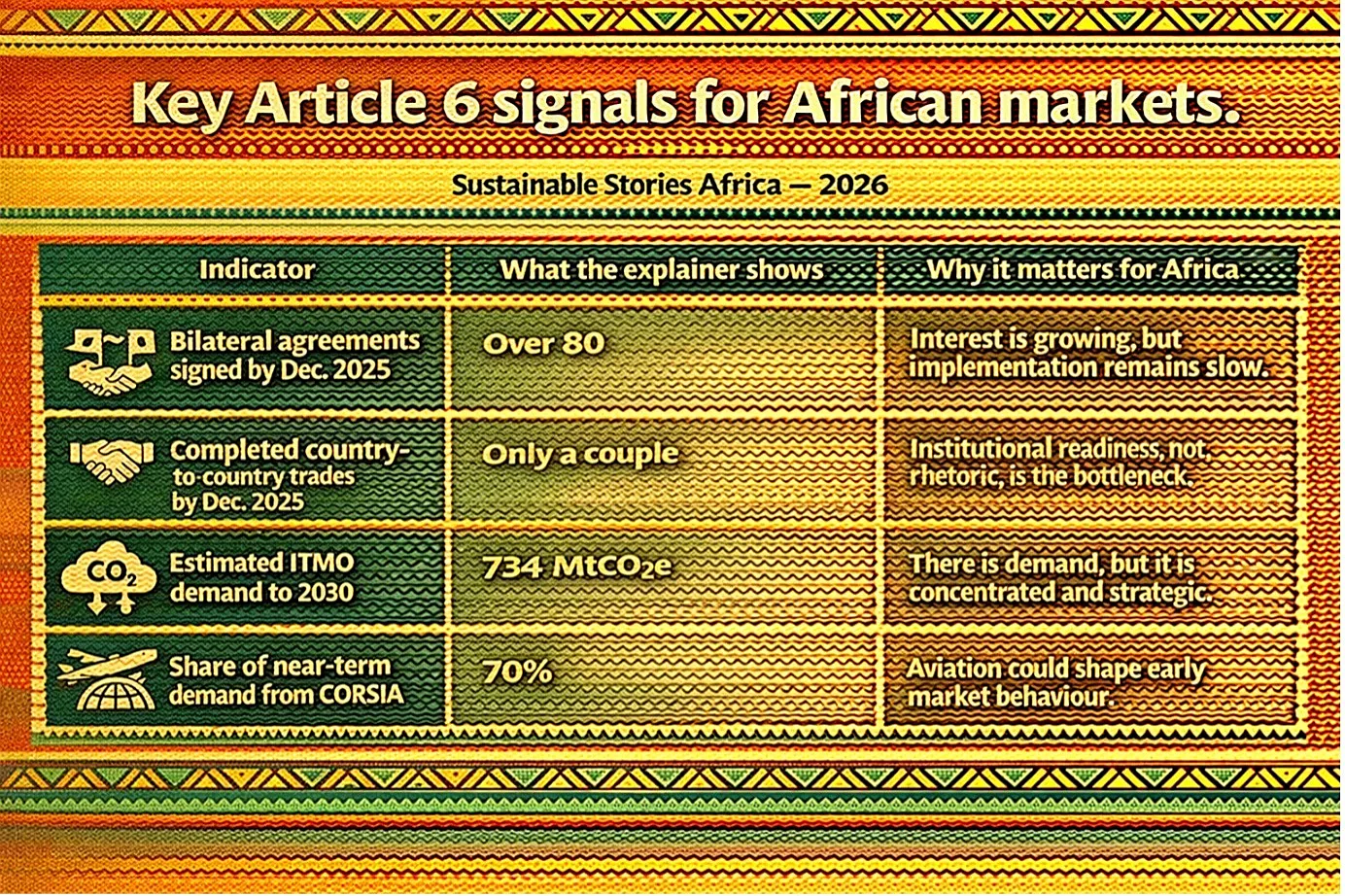
However, the rollout has been far slower than the hype suggests. Although Article 6.2 has been operational since 2021 and more than 80 bilateral agreements had been signed by December 2025, only two country-to-country trades had been completed, reflecting weak domestic frameworks, uncertainty around NDC progress and fragmented buyer demand.
For African governments, the message is straightforward. The market is real, but it is not automatic: countries still need registries, authorisation systems, reporting capacity, oversight institutions and clear rules on value, ownership and developmental trade-offs.
With airlines under CORSIA expected to drive most near-term demand, speed may attract buyers, but selling early is not the same as selling well.
Country examples show governance is already tightening.
Kenya, Ghana, Tanzania and Zambia are building rules to protect local value, signalling that credible seller countries understand the early risks of overselling.
Desire — What Good Article 6 Strategy Could Unlock
Handled well, Article 6 could help African countries move beyond carbon-credit models by linking carbon markets to national strategy, revenue systems, safeguards, benefit-sharing and investor confidence.
The real opportunity is not to sell quickly, but to use international trading to finance higher-cost or conditional mitigation while reserving lower-cost options for domestic targets.
That high-hanging-fruit approach allows countries to attract external capital without weakening their own transition pathways.
There is also a dividend for standards and governance. As Article 6 shapes expectations across voluntary markets, compliance systems and CORSIA, African institutions are well placed to influence the rules.
If governments insist on transparent accounting, strong authorisation, community benefits and domestic retention of mitigation outcomes, Article 6 could reinforce sovereignty rather than dilute it.
What Must Happen Next
- First, African governments need domestic Article 6 laws and procedures before they chase scale. Authorisation, benefit-sharing, tax treatment, registry design, safeguards, grievance systems and export limits should not be improvised after deals are signed.
- Second, countries should separate market enthusiasm from climate arithmetic. Corresponding adjustments prevent double-counting, but they also make every international transfer a strategic decision. That means finance ministries, environment ministries and planning agencies must work from the same carbon ledger.
- Third, African negotiators should push for transparency in the next phase of Article 6.4 implementation. COP30 left key technical work with the Supervisory Body, including unresolved issues around permanence, reversals, jurisdictional REDD+ and large-scale crediting programmes. Those decisions will shape which activities qualify, how nature is treated and whether markets are workable in practice.
- Fourth, integrity must include communities, not just accounting. Kenya’s 25% local-benefit rule points in the right direction. The continent should treat benefit-sharing not as a moral add-on but as a condition of market legitimacy.
- Finally, African countries should resist the lazy claim that a corresponding adjustment automatically means a high-quality credit. The explainer is clear: accounting rules are not the same as project integrity. Markets still need credible baselines, verification, safeguards and transparency.
Path Forward Requires Domestic Carbon Governance
Article 6 gives Africa an opening, not a guarantee. The smartest countries will treat carbon-market access as something earned through institutions, transparency and disciplined development choices.
The next phase should focus on domestic frameworks, community benefit-sharing, cautious authorisation, and stronger African influence over integrity standards.
That is how Article 6 becomes climate finance with sovereignty, not just carbon trade with paperwork.