Africa stands at a decisive geopolitical and economic turning point. Declining foreign aid, rising global competition, and shifting power dynamics are forcing the continent to redefine its development model, moving from dependency toward self-determined growth.
However, this shift is more strategic rather than defensive. With vast natural resources, demographic strength, and growing global relevance, Africa now has a rare opportunity to reshape global partnerships, unlock domestic financing, and assert its position as a decisive force in the future global economic order.
Africa’s strategic autonomy defines its development future
According to the FORESIGHT AFRICA TOP PRIORITIES FOR THE CONTINENT IN 2026, Africa’s development trajectory is entering a historic reset.
For decades, external aid, concessional financing, and global partnerships anchored the continent’s economic progress.
Today, those foundations are shifting rapidly, forcing Africa to redefine its development model from one of dependence to one of strategic autonomy.
The urgency is clear. Sub-Saharan Africa faces an annual development financing gap of approximately $245 billion, while official development assistance continues to decline amid tightening fiscal conditions in donor countries.
However, beneath these pressures lies an extraordinary opportunity. Africa’s $6 trillion natural resource base, demographic expansion, and strategic geopolitical position provide the foundations for a new era of self-determined growth.
The continent’s challenge is no longer to participate in the global order, but to help shape it.
Africa faces defining geopolitical economic crossroads
Africa is confronting a profound transformation in the global development landscape. Traditional aid flows, once the backbone of development financing, are shrinking rapidly.
Official development assistance declined by 9% in 2024 and is projected to fall by a further 9% 17% in 2025, reflecting a structural shift in global priorities.
At the same time, Africa’s financing needs are accelerating. The continent requires an additional $245 billion annually to close its investment gap, highlighting the magnitude of structural transformation required.
These pressures coincide with deeper global realignments. Rising geopolitical competition, evolving trade alliances, and the weakening of traditional multilateral frameworks are reshaping Africa’s strategic environment.
Africa is no longer simply navigating global change; it is being forced to respond strategically to preserve its development trajectory.
Domestic resource mobilisation becomes a strategic imperative
Africa’s development future increasingly depends on mobilising its own financial and economic resources rather than relying primarily on external financing.
The continent’s resource base provides a powerful foundation for transformation.
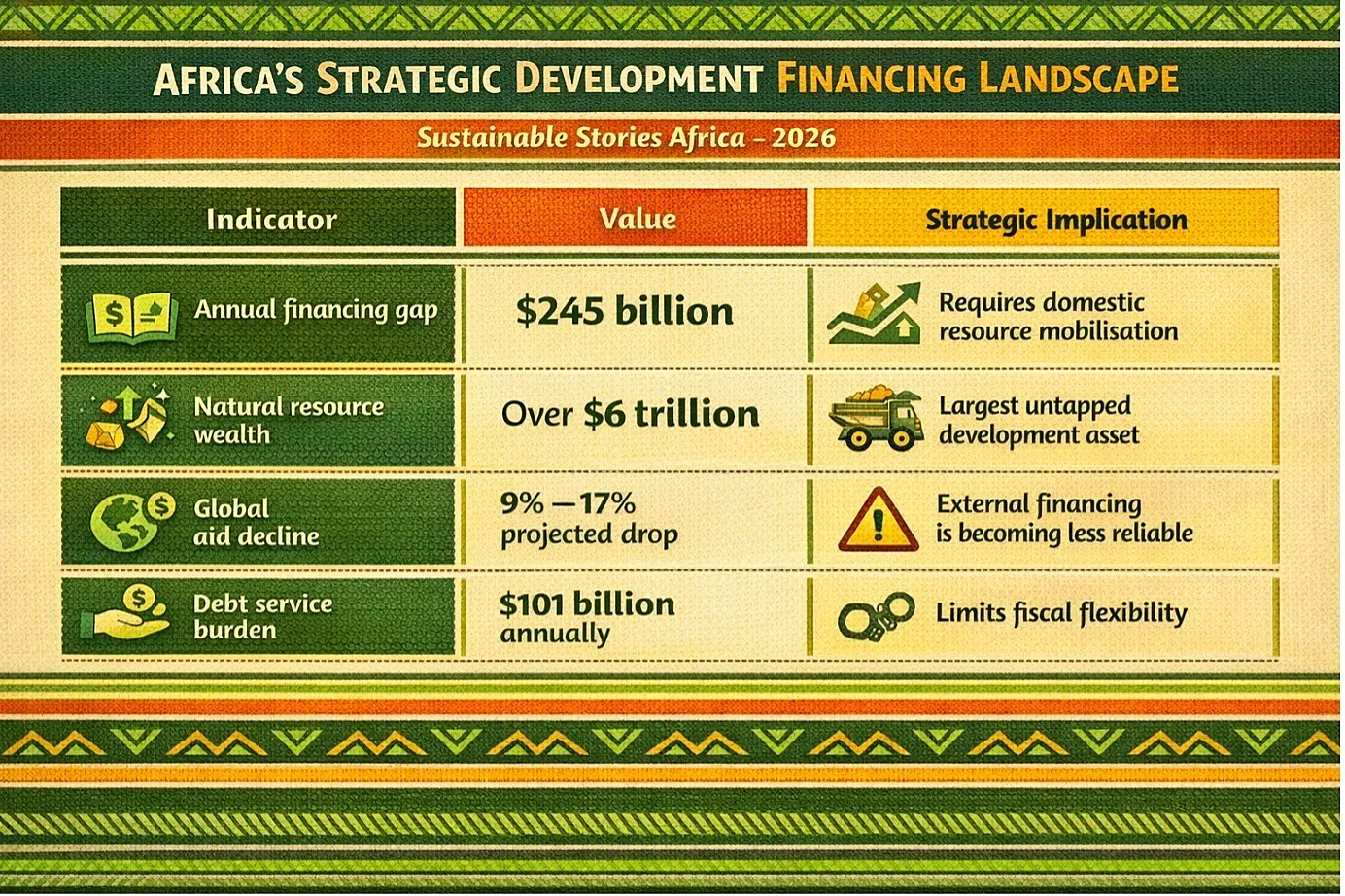
Africa’s Strategic Development Financing Landscape
Indicator | Value | Strategic Implication |
|---|---|---|
Annual financing gap | $245 billion | Requires domestic resource mobilisation |
Natural resource wealth | Over $6 trillion | Largest untapped development asset |
Global aid decline | 9% – 17% projected drop | External financing is becoming less reliable |
Debt service burden | $101 billion annually | Limits fiscal flexibility |
Africa holds at least 30% of the global critical mineral reserves and is poised to capture nearly $2 trillion in revenues from critical minerals over the next 25 years.
However, much of this wealth remains underutilised. Many African countries export raw materials without capturing the full economic value, limiting job creation, fiscal revenues, and economic transformation.
The report emphasises that strengthening domestic resource mobilisation, including taxation reforms, development of a sovereign wealth fund, and improved governance, represents the most reliable pathway to sustainable development financing.
This represents a fundamental shift in Africa’s development model—from externally financed growth toward internally anchored transformation.
Strategic global positioning unlocks transformative opportunities
Africa’s repositioning within the global economic order creates unprecedented opportunities for long-term economic transformation.
The continent’s strategic assets, including its demographic strength, natural resources, and expanding regional markets, provide the foundations for sustained global relevance.
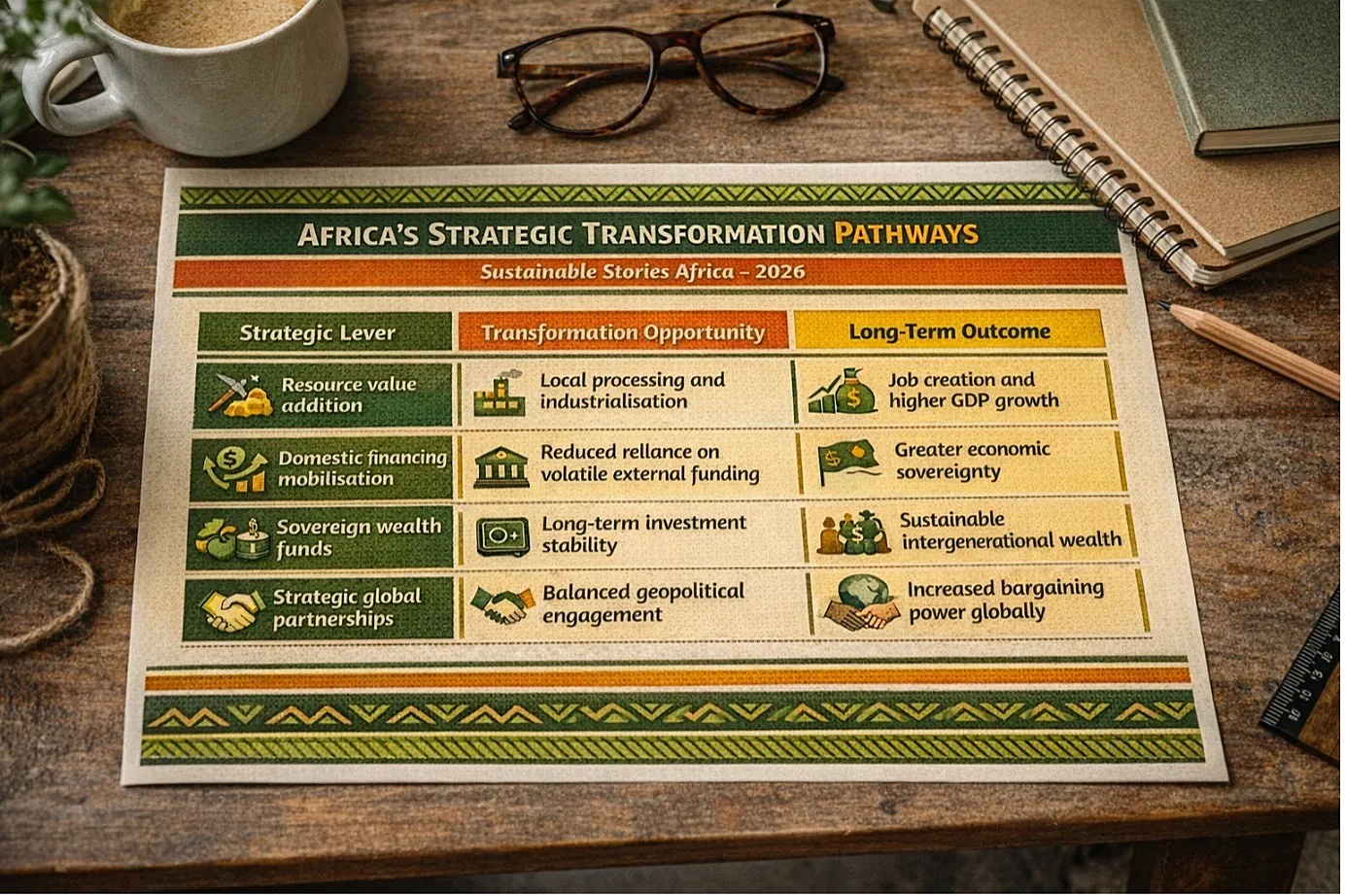
Africa’s Strategic Transformation Pathways
Strategic Lever | Transformation Opportunity | Long-Term Outcome |
|---|---|---|
Resource value addition | Local processing and industrialisation | Job creation and higher GDP growth |
Domestic financing mobilisation | Reduced reliance on volatile external funding | Greater economic sovereignty |
Sovereign wealth funds | Long-term investment stability | Sustainable intergenerational wealth |
Strategic global partnerships | Balanced geopolitical engagement | Increased bargaining power globally |
Africa’s critical mineral reserves, renewable energy potential, and expanding labour force position the continent as a central player in the global energy transition and economic transformation.
Renewable energy alone could supply more than 80% of Africa’s new power generation capacity, providing opportunities for sustainable industrialisation and energy security.
The continent’s demographic expansion, projected to make one in four people globally African by 2050, represents both an opportunity and a responsibility to create large-scale economic opportunities.
With strategic policy alignment, Africa can transition from structural vulnerability into strategic advantage.
Governance reforms must anchor Africa’s economic transformation
Realising Africa’s strategic potential requires coordinated institutional, governance, and policy reforms.
Critical priorities include:
- Strengthening domestic resource mobilisation – Improving tax administration, combating illicit financial flows, and expanding fiscal capacity could mobilise billions in additional development financing.
Africa loses approximately $90 billion annually through illicit financial flows, underscoring the importance of governance reforms.
- Capturing value from natural resources – Scaling local processing and industrialisation can transform resource extraction into sustainable economic growth.
- Establishing sovereign wealth funds and long-term investment vehicles – Sovereign wealth funds can stabilise revenues, support domestic investment, and strengthen economic resilience.
- Reshaping global partnerships strategically – Africa must engage global partners from a position of strategic alignment, ensuring partnerships advance domestic development priorities rather than reinforcing structural dependency.
This requires proactive leadership, institutional strengthening, and the coordination of policy execution.
PATH FORWARD – Africa must lead global economic transformation
Africa’s development future depends on mobilising domestic resources, strengthening governance, and strategically positioning itself within the evolving global economic order. The continent must prioritise institutional reform, value-added industrialisation, and sustainable investment frameworks.
By reshaping global partnerships and asserting strategic autonomy, Africa can unlock sustainable growth, strengthen economic sovereignty, and define its role as a decisive force shaping the future global economy.
Strategic Editorial Analysis (SSA Perspective) - Africa’s development model enters historic reset
Africa is entering a defining era of economic transformation. Declining external aid, rising global competition, and shifting geopolitical dynamics are transforming the continent, fundamentally redefining its development model.
However, this shift presents an opportunity, not a crisis.
With its vast natural resources, expanding population, and strategic geopolitical relevance, Africa possesses the foundations for self-determined growth.
The next decade will determine whether Africa remains a participant in the global economic order or emerges as one of its architects. The choice and opportunity is now Africa’s to shape.